If $x$ longitudinal strain is produced in a wire of Young's modulus $y,$ then energy stored in the material of the wire per unit volume is
AIIMS 2001, Medium
Download our app for free and get started
(d) Energy stored per unit volume
$ = \frac{1}{2} \times {\rm{Stress}} \times {\rm{Strain}}$
$ = \frac{1}{2} \times {\rm{Young's\, modulus }} \times {{\rm{(Strain)}}^{\rm{2}}} = \frac{1}{2} \times Y \times {x^2}$

Download our appand get started for free
Experience the future of education. Simply download our apps or reach out to us for more information. Let's shape the future of learning together!No signup needed.*
Similar Questions
- 1The force required to punch a square hole $2\,cm$ side in steel sheet $2\,mm$ thick is (shearing stress of steel sheet $= 3.5\times 10^8\,\,N/m^2$ )View Solution
- 2If the potential energy of a spring is $V$ on stretching it by $2\, cm$, then its potential energy when it is stretched by $10 \,cm$ will beView Solution
- 3Overall changes in volume and radii of a uniform cylindrical steel wire are $0.2 \%$ and $0.002 \%$ respectively when subjected to some suitable force. Longitudinal tensile stress acting on the wire is ($Y = 2.0 × 10^{11} Nm^{-2}$)View Solution
- 4A solid cube of copper of edge $10 \,cm$ subjected to a hydraulic pressure of $7 \times 10^6\, pascal$. If Bulk modulus of copper is $140 \,GPa$, then contraction in its volume will be ................ $m ^3$View Solution
- 5A block of mass $M$ is suspended from a wire of length $L$, area of cross-section $A$ and Young's modulus $Y$. The elastic potential energy stored in the wire isView Solution
- 6View SolutionThe Poisson's ratio cannot have the value
- 7A steel wire of length $3.2 m \left( Y _{ S }=2.0 \times 10^{11}\,Nm ^{-2}\right)$ and a copper wire of length $4.4\,M$ $\left( Y _{ C }=1.1 \times 10^{11}\,Nm ^{-2}\right)$, both of radius $1.4\,mm$ are connected end to end. When stretched by a load, the net elongation is found to be $1.4\,mm$. The load applied, in Newton, will be. (Given $\pi=\frac{22}{7}$)View Solution
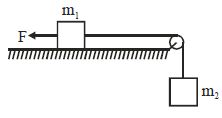
- 8Consider the situation shown in figure. The force $F$ is equal to the $m_2g/2.$ If the area of cross-section of the string is $A$ and its Young's modulus $Y$, find the strain developed in it. The string is light and there is no friction anywhereView Solution
- 9If the temperature of a wire of length $2 \,m$ and area of cross-section $1 \,cm ^2$ is increased from $0^{\circ} C$ to $80^{\circ} C$ and is not allowed to increase in length, then force required for it is ............$N$ $\left\{Y=10^{10} \,N / m ^2, \alpha=10^{\left.-6 /{ }^{\circ} C \right\}}\right.$View Solution
- 10A wire of length $2\, m$ is made from $10\;c{m^3}$ of copper. A force $F$ is applied so that its length increases by $2\, mm.$ Another wire of length 8 m is made from the same volume of copper. If the force $F$ is applied to it, its length will increase by......... $cm$View Solution