Question
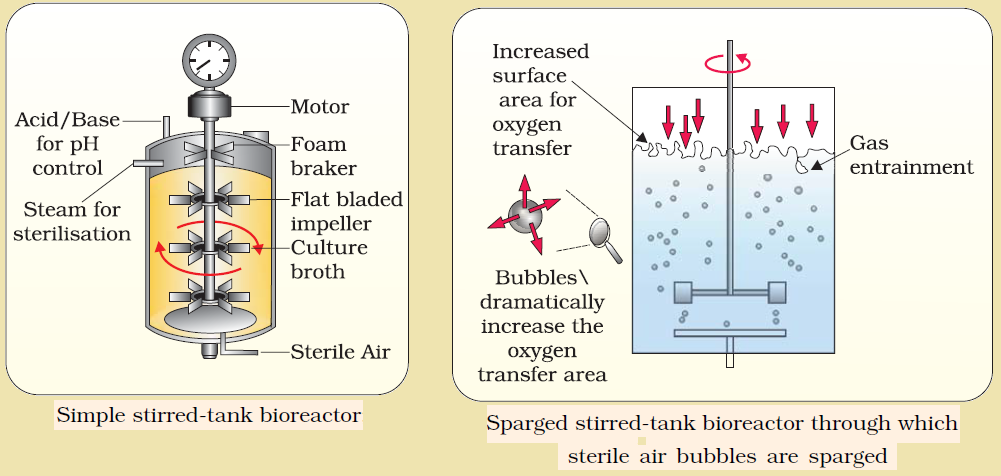
Illustrate the design of a bioreactor. Highlight the difference between a flask in your laboratory and a bioreactor which allows cells to grow in a continuous culture system.
Answer

Small volume cultures cannot yield appreciable quantities of products. To produce in large quantities, the development of bioreactors, where large volumes (100-1000 litres) of culture can be processed, was required. Thus, bioreactors can be thought of as vessels in which raw materials are biologically converted into specific products, individual enzymes, etc., using microbial plant, animal or human cells. A bioreactor provides the optimal conditions for achieving the desired product by providing optimum growth conditions (temperature, pH, substrate, salts, vitamins, oxygen).

Structure of Bioreactor:

  • It is a cylindrical structure with a curved base.
  • A stirrer is present for even mixing and oxygen availability throughout the reactor.
  • There is an agitator system, an oxygen delivery system, a foam control system, a temperature control system, etc.
  • There is a sampling port through which small volumes of culture can be taken out periodically.

A flask in a laboratory cannot be used for producing recombinant DNA on large scale. Unlike a bioreactor; a flask cannot be used to grow culture continuously.

Difference:

 
Flask
 
Bioreactor
i.
Flask is used to small laboratory scale testing of a culture.
i.
Bioreactor is used for commercial scale production.
ii.
The cells harbouring cloned genes of interest may be grown on a small scale in the laboratory.
ii.
The cells can also be multiplied in a continuous culture system wherein the used medium is drained out from one side while fresh medium is added from the other to maintain the cells in their physiologically most active log/ exponential phase. This type of culturing method produces a larger biomass leading to higher yields of desired protein.
iii.
Small volume cultures cannot yield appreciable quantities of products.
iii.
To produce in large quantities, the development of bioreactors, where large volumes (100–1000 litres) of culture can be processed, was required.


Need a full question paper?

Generate a complete, print-ready paper with questions like this in minutes — across 16+ boards, with answer keys.
Start Generating Free

Similar questions

  1. Name the two growth models that represent population growth and draw the respective growth curves they represent.
  2. State the basis for the difference in the shape of these curves.
  3. Which one of the curves represents the human population growth at present? Do you think such a curve is sustainable ? Give reason in support of your answer.
Why is thalassemia categorised as a Mendelian disorder? State the condition when an individual will suffer from the disease.
  1. Explain with the help of Griffith’s experiment how the search for genetic material was conducted and what was the conclusion drawn?
  2. How did MacLeod, McCarty and Avery establish the biochemical nature of the so called ‘genetic material’ identified by Griffith in his experiment.
(i) Explain the amino acylation process of tRNA and describe its role in the translation process.
(ii) How does the translation process start in prokaryotes (infinite nuclei)? Describe.
(iii) Where are the untranslated regions located in m-RNA and why?
When and how does placenta develop in human female?
  1. Draw a simplified model of phosphorus cycling in a terrestrial ecosystem.
  2. Write the importance of such cycles in ecosystems.
Define ecological pyramids and describe with examples, pyramids of number and biomass.
How is the phenotypic ratio of F2 generation different in a dihybrid cross?
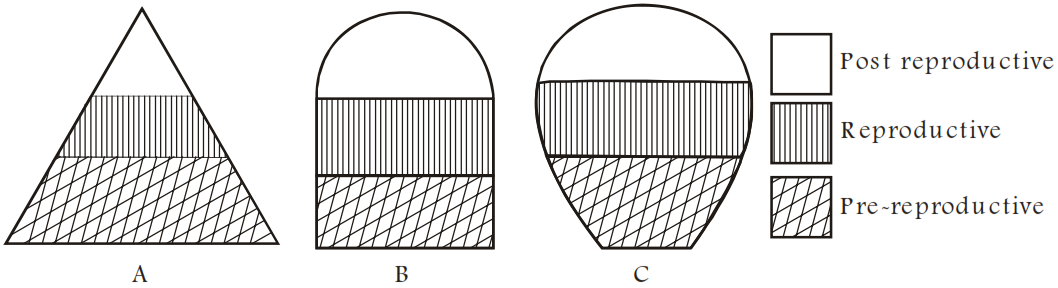
The following diagrams are the age pyramids of different populations. Comment on the status of these populations.

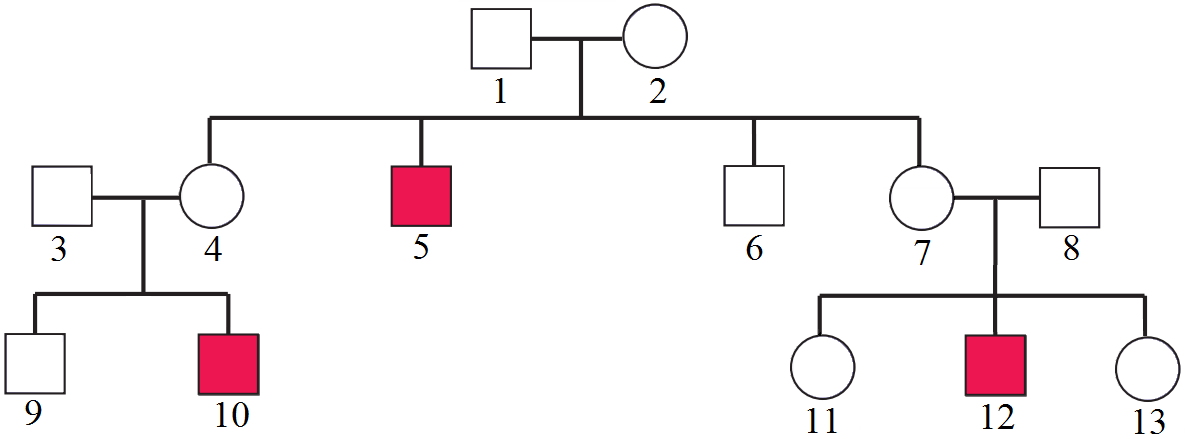
Haemophilia is a sex–linked recessive disease. Study the pedigree analysis given below showing the inheritance of the disease in a family and answer the questions that follow.

  1. Give the evidence from the above analysis which suggests that the disease is:
    1. Sex–linked and,
    2. Caused by a recessive allele.
  2. Write the possible genotypes of the individuals ‘2’ and ‘5’.