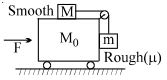
Imagine $a$ situation in which the horizontal surface of block $M_0$ is smooth and its vertical surface is rough with $a$ coefficient of friction $\mu$ In above problem, the value $(s)$ of $F$ for which $M$ and $m$ are stationary with respect to $M_0 mg$
Advanced


Download our appand get started for free
Experience the future of education. Simply download our apps or reach out to us for more information. Let's shape the future of learning together!No signup needed.*
Similar Questions
- 1Determine the maximum acceleration in $m/s^2$ of the train in which a box lying on its floor will remain stationary, given that the co-efficient of static friction between the box and the train’s floor is $0.15.$View Solution
- 2View SolutionIf the overbridge is concave instead of being convex, the thrust on the road at the lowest position will be
- 3A cylinder of mass $10\,kg$ is sliding on a plane with an initial velocity of $10\,m/s$. If coefficient of friction between surface and cylinder is $ 0.5$, then before stopping it will describe ............. $\mathrm{m}$View Solution
- 4The upper half of an inclined plane of inclination $\theta$ is perfectly smooth while the lower half is rough. A body starting from the rest at top comes back to rest at the bottom if the coefficient of friction for the lower half is given byView Solution
- 5A block of mass $M$ rests on a rough horizontal table. A steadily increasing horizontal force is applied such that the block starts to slide on the table without toppling. The force is continued even after sliding has started. Assume the coefficients of static and kinetic friction between the table and the block to be equal. The correct representation of the variation of the frictional force $f$, exerted by the table on the block with time $t$ is given byView Solution
- 6The retarding acceleration of $7.35\, ms^{-2}$ due to frictional force stops the car of mass $400\, kg$ travelling on a road. The coefficient of friction between the tyre of the car and the road isView Solution
- 7A particle of mass $m$ is at rest at the origin at time $t = 0$. It is subjected to a force $F(t) = F_0e^{-bt}$ in the $x$ -direction. Its speed $v(t)$ is depicted by which of the following curves ?View Solution
- 8An isolated rail car originally moving with speed $v_0$ on a straight, frictionles, level track contains a large amount of sand. $A$ release valve on the bottom of the car malfunctions, and sand begins to pour out straight down relative to the rail car. What happens to the speed of the rail car as the sand pours out?View Solution
- 9A block of mass $5\,kg$ is placed at rest on a table of rough surface. Now, if a force of $30\,N$ is applied in the direction parallel to surface of the table, the block slides through a distance of $50\,m$ in an interval of time $10\,s$. Coefficient of kinetic friction is (given, $g =10\,ms ^{-2}$)View Solution
- 10A cyclist moves in a circular track of radius $100$ m. If the coefficient of friction is $0.2$, then the maximum velocity with which the cyclist can take the turn with leaning inwards is ...... $m/s$View Solution