MCQ
Imagine a Young's double slit interference experiment performed with waves associated with fast moving electrons produced from an electron gun. The distance between successive maxima will decrease maximum if
  • A
    the accelerating voltage in the electron gun is decreased
  • the accelerating voltage is increased and the distance of the screen from the slits is decreased
  • C
    the distance of the screen from the slits is increased.
  • D
    the distance between the slits is decreased.
Answer

Correct option: B.
the accelerating voltage is increased and the distance of the screen from the slits is decreased
b

Need a full question paper?

Generate a complete, print-ready paper with questions like this in minutes — across 16+ boards, with answer keys.

Start Generating Free

Similar questions

If $10^{9}$ electrons move out of a body to another body every second. how much time is required to get a total charge of $1 \,C$ on the other body?
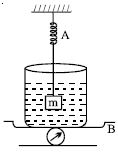
The spring balance $A$ reads $2$ $kg$ with a block $m $ suspended from it. $A$ balance $B$ reads $5$ $kg$ when a beaker with liquid is put on the pan of the balance. The two balances are now so arranged that the hanging mass is inside the liquid in the beaker as shown in the figure in this situation:
A transformer operating at primary voltage $8\,kV$ and secondary voltage $160\,V$ serves a load of $80\,kW$. Assuming the transformer to be ideal with purely resistive load and working on unity power factor, the loads in the primary and secondary circuit would be.
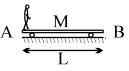
The figure shows a man of mass $m$ standing at the end $A$ of a trolley of mass $M$ placed at rest on a smooth horizontal surface. The man starts moving towards the end $B$ with a velocity $u_{rel}$ with respect to the trolley. The length of the trolley is $L$. The velocity of the man with respect to ground $v_1$ will be
A simple pendulum is attached to the roof of a lift. If time period of oscillation, when the lift is stationary is $T$. Then frequency of oscillation, when the lift falls freely, will be
A $20 \,cm$ length of a certain solution causes right-handed rotation of $38^o $. A $30\,cm $ length of another solution causes left-handed rotation of $24^o $. The optical rotation caused by $30\,cm$ length of a mixture of the above solutions in the volume ratio $1 : 2$ is
A particle, of mass $10^{-3} kg$ and charge $1.0 C$, is initially at rest. At time $t =0$, the particle comes under the influence of an electric field $\dot{E}( t )= E _0 \sin \omega t \hat{ i }$, where $E _0=1.0 N C ^{-1}$ and $\omega=10^3 rad s ^{-1}$. Consider the effect of only the electrical force on the particle. Then the maximum speed, in $m s ^{-1}$, attained by the particle at subsequent times is. . . . . .
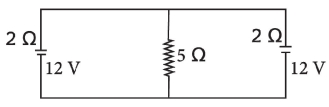
In the arrangement shown in figure, the current through $5\,\Omega$ resistor is ............. $A$
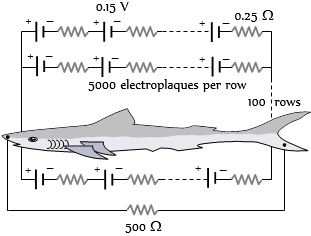
Eels are able to generate current with biological cells called electroplaques. The electroplaques in an eel are arranged in $100$ rows, each row stretching horizontally along the body of the fish containing $5000$ electroplaques. The arrangement is suggestively shown below. Each electroplaques has an emf of $0.15\, V$ and internal resistance of $0.25 \,\Omega$ The water surrounding the eel completes a circuit between the head and its tail. If the water surrounding it has a resistance of $500 \,\Omega$, the current an eel can produce in water is about  .............. $A$
In a transformer the primary has $500$ turns and secondary has $50$ turns. $100 $ volts are applied to the primary coil, the voltage developed in the secondary will be.....$V$