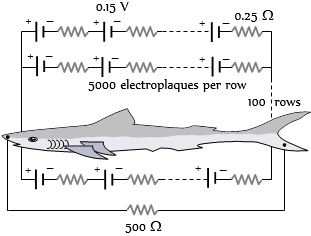
Eels are able to generate current with biological cells called electroplaques. The electroplaques in an eel are arranged in $100$ rows, each row stretching horizontally along the body of the fish containing $5000$ electroplaques. The arrangement is suggestively shown below. Each electroplaques has an emf of $0.15\, V$ and internal resistance of $0.25 \,\Omega$ The water surrounding the eel completes a circuit between the head and its tail. If the water surrounding it has a resistance of $500 \,\Omega$, the current an eel can produce in water is about .............. $A$
AIIMS 2004, Diffcult


Download our appand get started for free
Experience the future of education. Simply download our apps or reach out to us for more information. Let's shape the future of learning together!No signup needed.*
Similar Questions
- 1A wire of resistance $4 \,\Omega$ is stretched to twice its original length. The resistance of stretched wire would be ........... $\Omega$View Solution
- 2Three copper rods are subjected to different potential difference. Compare the drift speed of electrons through them. Assume that all $3$ are at the same temperature.View Solution
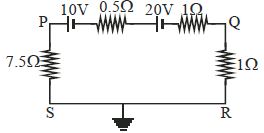
Length Diameter Potential difference $(A)$ $L$ $3d$ $V$ $(B)$ $2L$ $d$ $2V$ $(C)$ $3L$ $2d$ $2V$ - 3View SolutionIn the circuit shown in figure, which of the statement is incorrect ?
- 4A button battery is rated $3 \,V$ and $225 \,mAh . A$ cricket ball (mass $=0.163 \,kg$ ) having energy equal to that stored in the battety will have speed closest to ............ $\,m / s$View Solution
- 5A galvanometer of resistance, $G,$ is connected in a circuit. Now a resistance $R$ is connected in series of galvanometer. To keep the main current in the circuit unchanged, the resistance to be put in parallel with the series combination of $G$ and $R$ isView Solution
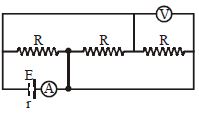
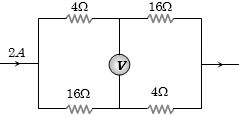
- 6In the circuit shown below, The reading of the voltmeter $V$ is ...........View Solution
- 7View SolutionAs the temperature of a conductor increases, its resistivity and conductivity change. The ratio of resistivity to conductivity
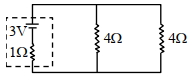
- 8View SolutionIn the given circuit, the terminal potential difference of the cell is:
- 9In a potentiometer, the null point is received at $7^{th}$ wire. If now we have to change the null point at $9^{th}$ wire, what should we do ?View Solution
- 10In the following circuit diagram, $E = 4\,V, r = 1\,\Omega$ and $R = 45\, \Omega$, then reading of the ammeter $A$ will beView Solution