Question
In a class test of class XI, a teacher asked to students to consider $\mathbf{A}+\mathbf{B}=\frac{\pi}{4}$, where $\mathbf{A}$ and $\mathbf{B}$ are acute angles.
Based on the above information, answer the following questions.
(i) Find the value of $(1+\tan A)(1+\tan B)$ ?
(ii) Find the value of $(\cot \mathbf{A}-1)(\cot \mathbf{B}-1)$ ?
(iii) Find the value of
$
\sin (A+B)-\cos (A+B)+\tan (A+B) .
$


Answer

(i) We have,
$
\begin{aligned}
& \mathrm{A}+\mathrm{B}=\frac{\pi}{4} \\
& \Rightarrow \tan (A+B)=\tan \frac{\pi}{4} \\
& \Rightarrow \frac{\tan A+\tan B}{1-\tan A \tan B}=1 \\
& \Rightarrow \tan A+\tan B=1-\tan A \tan B \\
& \Rightarrow \tan A+\tan B+\tan A \tan B=1 \\
&
\end{aligned}
$

On adding 1 both sides of Eq. (i), we get
$
\begin{aligned}
& & 1+\tan A+\tan B+\tan A \tan B & =2 \\
\Rightarrow & & (1+\tan A)+\tan B(1+\tan A) & =2 \\
\Rightarrow & & (1+\tan A)(1+\tan B) & =2
\end{aligned}
$

(ii) On dividing both sides of Eq. (i) by $\tan$ Atan B, we get
$
\begin{array}{ll} 
& \frac{\tan A+\tan B+\tan A \tan B}{\tan A \tan B}=\frac{1}{\tan A \tan B} \\
\Rightarrow & \cot B+\cot A+1=\cot A \cot B \\
\Rightarrow & \cot A \cot B-\cot A-\cot B=1 \\
\Rightarrow & \cot A \cot B-\cot A-\cot B+1=2 \\
\Rightarrow & \cot A(\cot B-1)-(\cot B-1)=2 \\
\Rightarrow & (\cot B-1)(\cot A-1)=2
\end{array}
$

(iii) Given, $A+B=\frac{\pi}{4}$
$\begin{aligned} & \therefore \sin (A+B)=\sin \frac{\pi}{4}=\frac{1}{\sqrt{2}}, \\ & \cos (A+B)=\cos \frac{\pi}{4}=\frac{1}{\sqrt{2}} \\ & \text { and } \tan (A+B)=\tan \frac{\pi}{4}=1 \\ & \therefore \sin (A+B)-\cos (A+B)+\tan (A+B) \\ & =\frac{1}{\sqrt{2}}-\frac{1}{\sqrt{2}}+1=1\end{aligned}$

Need a full question paper?

Generate a complete, print-ready paper with questions like this in minutes — across 16+ boards, with answer keys.

Start Generating Free

Similar questions

A function $f$ is said to be a rational function, if $f(x)=\frac{g(x)}{h(x)}$, where $g(x)$ and $h(x)$ are polynomial functions such that $h(x) \neq 0$.
Then, $\lim _{x \rightarrow a} f(x)=\lim _{x \rightarrow a} \frac{g(x)}{h(x)}$
$
=\frac{\lim _{x \rightarrow a} g(x)}{\lim _{x \rightarrow a} h(x)}=\frac{g(a)}{h(a)}
$
However, if $h(a)=0$, then there are two cases arise,
(i) $g(a) \neq 0$
(ii) $g(a)=0$. In the first case, we say that the limit does not exist.
In the second case, we can find limit.

Based on above information, answer the following questions.

(i) $\lim _{x \rightarrow-1}\left(\frac{x^{10}+x^5+1}{x-1}\right)$ is equal to
    (a) $\frac{1}{2}$     (b) $\frac{-1}{2}$     (c) 2     (d) $\frac{3}{2}$

(ii) $\lim _{x \rightarrow-1} \frac{(x-1)^2+3 x^2}{\left(x^4+1\right)^2}$ is equal to
    (a) $\frac{7}{4}$     (b) $\frac{6}{5}$     (c) $\frac{4}{7}$     (d) $\frac{3}{4}$

(iii) The value of $\lim _{x \rightarrow 2}\left[\frac{x^2-4}{x^3-4 x^2+4 x}\right]$ is
    (a) 0     (b) 1     (c) 2     (d) Does not exist

(iv) $\lim _{x \rightarrow 1} \frac{x^7-2 x^5+1}{x^3-3 x^2+2}$ is equal to
    (a) 0     (b) 1     (c) 2     (d) 3

(v) $\lim _{x \rightarrow 0} \frac{\sqrt{1+x^3}-\sqrt{1-x^3}}{x^2}$ is equal to
    (a) 1     (b) 0     (c) -1     (d) 2
Two complex numbers $Z _1= a + ib$ and $Z _2= c + id$ are said to be equal, if $a = c$ and $b = d$.
$i.$ If $(x+i y)(2-3 i)=4+i$ then find the value of $(x, y)$.
$ii.$ If $\frac{(1+i)^2}{2-i}=x+i y$, then find the value of $x+y. (1)$
$iii.$ If $\left(\frac{1-i}{1+i}\right)^{100}=a+i b$, then find the values of $a$ and $b. (2)$
$OR$
If $(a-2,2 b+1)=(b-1, a+2)$, then find the real values of $a$ and $b. (2)$
A manufacturing company produces certain goods. The company manager used to make a data record on daily basis about the cost and revenue of these goods separately. The cost and revenue function of a product are given by $C(x)=20 x+4000$ and $R(x)=60 x+2000$, respectively, where $x$ is the number of goods produced and sold.

Based on above information, answer the following questions.

(i) How many goods must be sold to realise some profit?
(a) $\mathrm{x}<\mathbf{5 0}$
(b) $x>50$
(c) $x \geq 50$
(d) $\mathbf{x} \leq \mathbf{5 0}$

(ii) If the cost and revenue functions of a product are given by $C(x)=3 x+400$ and $R(x)=$ $5 x+20$ respectively, where $x$ is the number of items produced by the manufacturer, then how many items must be sold to realise some profit?
(a) $x \leq 190$
(b) $x \geq 190$
(c) $x<190$
(d) $x>190$

(iii) Let $\mathbf{x}$ and $\mathbf{b}$ are real numbers. If $\mathbf{b} > \mathbf{0}$ and $\mathbf{x}< \mathbf{b}$, then
(a) $x$ is always positive
(b) $\mathbf{X}$ is always negative
(c) $\mathrm{x}$ is real number
(d) None of these

(iv) The solution set of $\mathbf{3}-\mathbf{5}<\mathrm{x}+\mathbf{7}$, when $\mathrm{x}$ is a whole number is given by
(a) $\{0,1,2,3,4,5\}$
(b) $(-\infty, 6)$
(c) $[0,5]$
(d) None of these

(v) Graph of inequality $x>2$ on the number line is represented by
(a) Image
(b)Image 
(c) Image
(d) None of the above
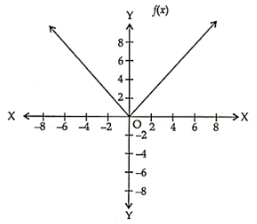
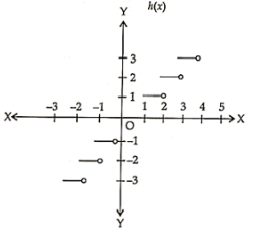
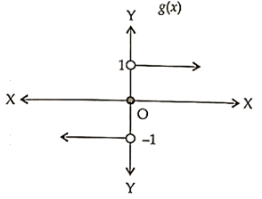
Consider the graphs of the functions f(x), h(x) and g(x). 
Image
Image
Image

i. Find the range of h(x). (1)
ii. Find the domain of f(x). (1)
iii. Find the value of f(10). (2)
OR
Find the range of g(x). (2)
Consider the data.
Class Frequency
$0-10$ $6$
$10-20$ $7$
$20-30$ $ 15$
$30-40$ $ 16$
$40-50$ $4$
$50-60$ $2$
$i$. Find the mean deviation about median. $(1)$
$ii$. Find the Median. $(1)$
$iii$. Write the formula to calculate the Mean deviation about median? $(2)$
OR
Write the formula to calculate median? $(2)$
Shweta was teaching "method to solve a linear inequality in one variable" to her daughter.
Step I Collect all terms involving the variable (x) on one side and constant terms on other side with the help of above rules and then reduce it in the form $\mathbf{a x}<\mathbf{b}$ or $\mathbf{a x} \leq \mathbf{b}$ or $\mathbf{a x}>\mathbf{b}$ or $\mathbf{a x} \geq \mathbf{b}$.
Step II Divide this inequality by the coefficient of variable (x). This gives the solution set of given inequality.
Step III Write the solution set.

Based on above information, answer the following questions.

(i) The solution set of $\mathbf{2 4 x}<\mathbf{1 0 0}$, when $\mathrm{x}$ is a natural number is
    (a) $\{1,2,3,4\}$     (b) $(1,4)$     (c) $[1,4]$     (d) None of these

(ii) The solution set of $24100 \mathrm{x}<$, when $\mathrm{x}$ is an integer is
    (a) $\{\ldots \ldots-4,-3,-2,-1,0,1,2,3,4\}$     (b) $(-\infty, 4]$     (c) $[4, \infty]$     (d) None of the above

(iii) The solution set of $-\mathbf{5 x}+\mathbf{2 5}>0$ is
    (a) $[5, \infty)$     (b) $(-\infty, 5]$    (c) $(5, \infty)$     (d) $(-\infty, 5)$

(iv) The solution set of $\mathbf{3 x}-\mathbf{5}<\mathbf{x + 7}$ is
    (a) $(6, \infty)$     (b) $[6, \infty)$     (c) $(-\infty, 6)$     (d) $(-\infty, 6]$

(v) The solution set of $x+\frac{x}{2}+\frac{x}{3}<11$ is
    (a) $(-\infty, 6]$     (b) $(-\infty, 6)$     (c) $[6, \infty)$     (d) None of these
Read the following text carefully and answer the questions that follow: Representation of a Relation
A relation can be represented algebraically by roster form or by set $-$ builder form and visually it can be represented by an arrow diagram which are given below
$i$. Roster form In this form, we represent the relation by the set of all ordered pairs belongs to $R$.
$ii$. Set-builder form In this form, we represent the relation $R$ from set $A$ to set $B$ as $R=\{(a, b): a \in A, b \in B\}$ and the rule which relate the elements of $A$ and $B$.
$iii$. Arrow diagram To represent a relation by an arrow diagram, we draw arrows from first element to second element of all ordered pairs belonging to relation $R$.
Questions
$i$. If $n(A) = 3$ and $B = \{2, 3, 4, 6, 7, 8\}$ then find the number of relations from $A$ to $B. (1)$
$ii$. If $A = {a, b}$ and $B = {2, 3},$ then find the number of relations from $A$ to $B. (1)$
$iii$. If $A = {a, b}$ and $B = {2, 3},$ write the relation in set-builder form. $(2)$
OR
Express of $R =\{( a , b ): 2 a + b =5 ; a , b \in W \}$ as the set of ordered pairs $($in roster form$). (2)$
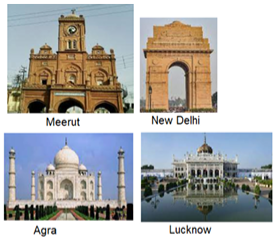
On her vacation, Priyanka visits four cities. Delhi, Lucknow, Agra, Meerut in a random order.
Image

$i$. What is the probability that she visits Delhi before Lucknow? $(1)$
$ii$. What is the probability she visit Delhi before Lucknow and Lucknow before Agra? $(1)$
$iii.$ What is the probability she visits Delhi first and Lucknow last? $(2)$
OR
What is the probability she visits Delhi either first or second? $(2)$
Read the following text carefully and answer the questions that follow:
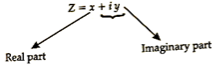
A number of the form $Z=x+i y$, where $x$ and $y$ are real and $i=\sqrt{-1}$ is called a complex number. Consider the complex number $Z_1=2+3 i$ and $Z_2=4-3 i$.
Image
$i$. Find the imaginary part of $Z_1 \overline{Z_1}... (1)$
$ii$. Find the real part of $\frac{z_1}{z_2}. (1)$
$iii$. Find the imaginary part of $Z_1-Z_2. (2)$
OR
Find the real part of $Z _1. (2)$