MCQ
In a closed organ pipe, the frequency of fundamental note is $30 \mathrm{~Hz}$. A certain amount of water is now poured in the organ pipe so that the fundamental frequency is increased to $110 \mathrm{~Hz}$. If the organ pipe has a cross-sectional area of $2 \mathrm{~cm}^2$, the amount of water poured in the organ tube is _____________$g.$ (Take speed of sound in air is $330 \mathrm{~m} / \mathrm{s}$ )
  • $400$
  • B
    $200$
  • C
    $600$
  • D
    $800$

Answer

Correct option: A.
$400$
a
$ \frac{V}{4 \ell_1}=30 \Rightarrow \ell_1=\frac{11}{4} \mathrm{~m} $

$ \frac{V}{4 \ell_2}=110 \Rightarrow \ell_2=\frac{3}{4} \mathrm{~m} $

$ \Delta \ell=2 \mathrm{~m},$

Change in volume $=A \Delta \ell=400 \mathrm{~cm}^3$

$M=\mathbf{4 0 0} \mathrm{g} ;\left(\because \rho=1 \mathrm{~g} / \mathrm{cm}^3\right)$

Need a full question paper?

Generate a complete, print-ready paper with questions like this in minutes — across 16+ boards, with answer keys.

Start Generating Free

Similar questions

A particle starts from rest and performing circular motion of constant radius with speed given by $v = \alpha \sqrt x$ where $\alpha$ is a constant and $x$ is the distance covered. The correct graph of magnitude of its tangential acceleration $(a_t)$ and centripetal acceleration $(a_c)$ versus $t$ will be:
A particle of mass $m$ is moving in a circular path of constant radius $r$ such that its tangential acceleration varies with time as $a_t = K^2rt^2$ ($K$ is a constant) Select the correct statement
“Stationary waves” are so called because in them
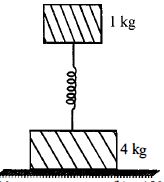
Two bodies of masses $1\, kg$ and $4\, kg$ are connected to a vertical spring, as shown in the figure. The smaller mass executes simple harmonic motion of angular frequency $25\, rad/s$, and amplitude $1.6\, cm$ while the bigger mass remains stationary on the ground. The maximum force exerted by the system on the floor is ..... $N$ ( take $g = 10\, ms^{-2}$)
$(a)$ Centre of gravity $(C.G.)$ of a body is the point at which the weight of the body acts.

$(b)$ Centre of mass coincides with the centre of gravity if the earth is assumed to have infinitely large radius

$(c)$ To evaluate the gravitational field intensity due to any body at an external point, the entire mass of the body can be considered to be concentrated at its $C.G.$

$(d)$ The radius of gyration of any body rotating about an axis is the length of the perpendicular dropped from the $C.G.$ of the body to the axis of rotation.

Which one of the following pairs of statements is correct ?

If the earth were to cease rotating about its own axis. The increase in the value of $g$ in $C.G.S.$ system at a place of latitude of $45^o$ will be ........  $cm/sec^{2}$.
A solid hemisphere of weight $P$ rests with its curved surface in contact with a rough inclined plane. A weight $Q$ is placed at some point on the rim of the hemisphere to keep its plane surface horizontal then its minimum coefficient of friction is
A cylindrical block of wood (density $= 650\, kg\, m^{-3}$), of base area $30\,cm^2$ and height $54\, cm$, floats in a liquid of density $900\, kg\, m^{-3}$ . The block is depressed slightly and then released. The time period of the resulting oscillations of the block would be equal to that of a simple pendulum of length ..... $cm$ (nearly)
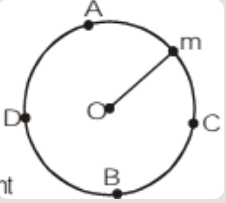
A mass is performing vertical circular motion $($see figure$)$. If the average velocity of the particle is increased, then at which point is the maximum breaking possibility of the string:
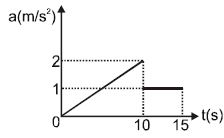
A particle starts from rest and undergoes an acceleration as shown in figure. The  velocity-time graph from figure will have shape.