In a co-axial straight cable, the central conductor and the outer conductor carry equal currents in opposite directions. The magnetic field is zero.
JEE MAIN 2024, Diffcult
Download our app for free and get started
$\oint \overrightarrow{\mathrm{B}} \cdot \overrightarrow{\mathrm{d} \ell}=\mu_0 \mathrm{i}_{\mathrm{enc}}=0$
$\dot{\triangle} \mathrm{B}=0$ outside the cable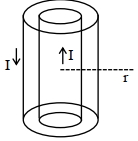

Download our appand get started for free
Experience the future of education. Simply download our apps or reach out to us for more information. Let's shape the future of learning together!No signup needed.*
Similar Questions
- 1The radius of a circular loop is $r$ and a current $i$ is flowing in it. The equivalent magnetic moment will beView Solution
- 2View SolutionA current carrying loop is placed in a uniform magnetic field. The torque acting on it does not depend upon
- 3An electron having mass $m$ and kinetic energy $K$ enter in uniform magnetic field $B$ perpendicularly, then its frequency will beView Solution
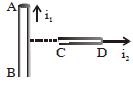
- 4An infinitely long straight conductor $AB$ is fixed and a current is passed through it. Another movable straight wire $CD$ of finite length and carrying current is held perpendicular to it and released. Neglect weight of the wireView Solution
- 5View SolutionA magnetic field can be produced by
- 6A beam of neutrons performs circular motion of radius, $r=1 \,m$. Under the influence of an inhomogeneous magnetic field with inhomogeneity extending over $\Delta r=0.01 \,m$. The speed of the neutrons is $54 \,m / s$. The mass and magnetic moment of the neutrons respectively are $1.67 \times 10^{-27} \,kg$ and $9.67 \times 10^{-27} \,J / T$. The average variation of the magnetic field over $\Delta r$ is approximately ....... $T$View Solution
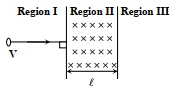
- 7A particle of mass $m$ and charge $\mathrm{q}$, moving with velocity $\mathrm{V}$ enters Region $II$ normal to the boundary as shown in the figure. Region $II$ has a uniform magnetic field B perpendicular to the plane of the paper. The length of the Region $II$ is $\ell$. Choose the correct choice$(s)$.View Solution
Figure: $Image$
$(A)$ The particle enters Region $III$ only if its velocity $V>\frac{q / B}{m}$
$(B)$ The particle enters Region $III$ only if its velocity $\mathrm{V}<\frac{\mathrm{q} / \mathrm{B}}{\mathrm{m}}$
$(C)$ Path length of the particle in Region $II$ is maximum when velocity $V=\frac{q / B}{m}$
$(D)$ Time spent in Region $II$ is same for any velocity $V$ as long as the particle returns to Region $I$
- 8$3\, A$ of current is flowing in a linear conductor having a length of $40\, cm$. The conductor is placed in a magnetic field of strength $500$ $gauss$ and makes an angle of $30^\circ $ with the direction of the field. It experiences a force of magnitudeView Solution
- 9Assertion : A proton and an alpha particle having the same kinetic energy are moving in circular paths in a uniform magnetic field. The radii of their circular paths will be equal.View Solution
Reason : Any two charged particles having equal kinetic energies and entering a region of uniform magnetic field $\overrightarrow B $ in a direction perpendicular to $\overrightarrow B $, will describe circular trajectories of equal radii.
- 10A cell of emf $90\,V$ is connected across series combination of two resistors each of $100\,\Omega$ resistance. A voltmeter of resistance $400\,\Omega$ is used to measure the potential difference across each resistor. The reading of the voltmeter will be $.........\,V$View Solution