Question
In a common base amplifier the phase difference between the input signal voltage and the output voltage is
Answer

(a)In $CB$  amplifier Input and output voltage signal are in same phase.

Need a full question paper?

Generate a complete, print-ready paper with questions like this in minutes — across 16+ boards, with answer keys.

Start Generating Free

Similar questions

Two point charges $A$ and $B$ of magnitude $+8 \times 10^{-6}\,C$ and $-8 \times 10^{-6}\,C$ respectively are placed at a distance $d$ apart. The electric field at the middle point $O$ between the charges is $6.4 \times 10^{4}\,NC ^{-1}$. The distance ' $d$ ' between the point charges $A$ and $B$ is..............$m$
A carbon resistor of $(47 \pm 4.7) \;k\Omega$ is to be marked with rings of different colours for its identification. The colour code sequence will b
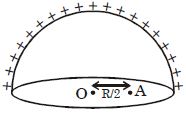
A hemispherical bowl of mass $m$ is uniformly charged with charge density $'\sigma '$ . Electric potential due to charge distribution at a point $'A'$ is (which lies at centre of radius as shown).
The time period of oscillation of a magnet in a vibration magnetometer is $1.5$ seconds. The time period of oscillation of another magnet similar in size, shape and mass but having one-fourth magnetic moment than that of first magnet, oscillating at same place will be.....$sec$
Monochromatic light of frequency $6.0 \times 10^{14}\,\, Hz$ is produced by a laser. The power emitted is $2 \times 10^{-3}\,\, W.$ The number of photons emitted, on the average, by the source per second is
If $L$ and $R$ are respectively the inductance and resistance, then the dimensions of $\frac{R}{L}$ will be
A particle of mass $200 \,gm$ executes $S.H.M.$ The restoring force is provided by a spring of force constant $80 \,N / m$. The time period of oscillations is .... $\sec$
If the total energy transferred to a surface in time $t$ is $6.48 \times 10^5 \mathrm{~J}$, then the magnitude of the total momentum delivered to this surface for complete absorption will be :
$A$ ball is thrown vertically downwards with velocity $\sqrt {2gh} $ from $a$ height $h$. After colliding with the ground it just reaches the starting point. Coefficient of restitution is
A rectangular loop of sides $12 \mathrm{~cm}$ and $5 \mathrm{~cm}$, with its sides parallel to the $x$-axis and $y$-axis respectively moves with a velocity of $5 \mathrm{~cm} / \mathrm{s}$ in the positive $\mathrm{x}$ axis direction, in a space containing a variable magnetic field in the positive $z$ direction. The field has a gradient of $10^{-3} \mathrm{~T} / \mathrm{cm}$ along the negative $\mathrm{x}$ direction and it is decreasing with time at the rate of $10^{-5} \mathrm{~T} / \mathrm{s}$. If the resistance of the loop is $6 \mathrm{~m} \Omega$, the power dissipated by the loop as heat is______ $\times 10^{-9} \mathrm{~W}$.