MCQ
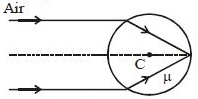
Parallel rays are incident on a transparent sphere along its one diameter. After refrection these rays converge at the other end of this diameter the refractive index of the sphere is
  • A
    $1$
  • B
    $1.5$
  • C
    $1.6$
  • $2 $

Answer

Correct option: D.
$2 $
d
$\frac{\mu_{2}}{v}-\frac{\mu_{1}}{u}=\frac{\mu_{2}-\mu_{1}}{R}$

$\mathrm{v}=2 \mathrm{R}, \mathrm{u}=\infty, \mathrm{R}=+\mathrm{R}, \mu_{1}=1, \mu_{2}=\mu$

$\frac{\mu}{2 R}-\frac{1}{\infty}=\frac{\mu-1}{R} \Rightarrow \mu=2$
Need a full question paper?

Generate a complete, print-ready paper with questions like this in minutes — across 16+ boards, with answer keys.
Start Generating Free

Similar questions

Let $\overrightarrow{\text{C}}=\overrightarrow{\text{A}}+\overrightarrow{\text{B}}.$
The photoelectric effect can be understood on the basis of
A potentiometer wire of length $1\,m$ and resistance $10\,\Omega$ is connected in series with a cell of $emf$ $2\,V$ with internal resistance $1 \,\Omega$ and a resistance box including a resistance $R$. If potential difference between the ends of the wire is $1\, mV$, the value of $R$ is ............. $\Omega $
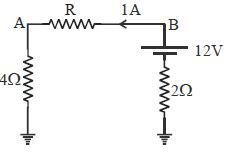
In the given circuit
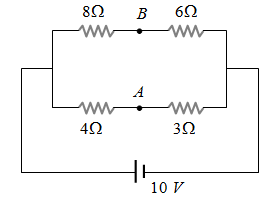
The potential difference between point A & B is

The black shapes in the figure are closed surfaces. The electric field lines are in red. For which case the net flux through the surfaces is non$-$zero?
The minimum intensity of light to be detected by human eye is $10^{-10} \mathrm{~W} / \mathrm{m}^2$ . The number of photons of wavelength $5.6 \times 10^{-7} \mathrm{~m}$ entering the eye, with pupil area $10^{-6} \mathrm{~m}^2$ , per second for vision will be nearly
Flux $\phi $ (in weber) in a closed circuit of resistance $10\, ohm$ varies with time $t$ (in $sec$) according to the equation $\phi  = 6t^2 - 5t +1$ . What is the magnitude of the induced current at $t = 0.25\, s$ ?.....$A$
An electric line of force in the $x y^{-}$plane is given by equation $x^2+y^2=1$. A particle with unit positive charge, initially at rest at the point $x=1, y=0$ in the $x y^{-}$plane.
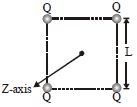
Four point $+ve$ charges of same magnitude $(Q)$ are placed at four corners of a rigid square frame as shown in figure. The plane of the frame is perpendicular to $Z-$ axis. If a $ -ve$ point charge is placed at a distance $z$ away from centre along axis $(z << L )$ then