MCQ
In a cyclic process :
  • A
    Work done is zero.
  • The work done by the system is equal to the heat given to the system.
  • C
    Work done does not depend on heat.
  • D
    The internal energy of the system increases

Answer

Correct option: B.
The work done by the system is equal to the heat given to the system.
B

Need a full question paper?

Generate a complete, print-ready paper with questions like this in minutes — across 16+ boards, with answer keys.
Start Generating Free

Similar questions

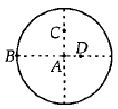
The moment of inertia of a uniform circular disc is maximum about an axis perpendicular to the disc and passing through
A car when passes through a convex bridge exerts a force on it which is equal to
A tube closed at one end and containing air is excited. It produces the fundamental note of frequency $512 Hz$. If the same tube is open at both the ends the fundamental frequency that can be produced is .... $Hz$
A cricket player catches a ball of mass $120 \mathrm{~g}$ moving with $25 \mathrm{~m} / \mathrm{s}$ speed. If the catching process is completed in $0.1 \mathrm{~s}$ then the magnitude of force exerted by the ball on the hand of player will be (in SI unit):
The maximum load a wire can withstand without breaking, when its length is reduced to half of its original length, will
Two forces, ${F_1}$ and ${F_2}$ are acting on a body. One force is double that of the other force and the resultant is equal to the greater force. Then the angle between the two forces is
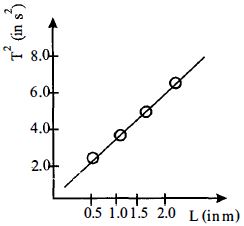
In an experiment for determining the gravitational acceleration $g$ of a place with the help of a simple pendulum, the measured time period square is plotted against the string length of the pendulum in the figure. What is the value of $g$ at the place? ...... $m/s^2$
A liquid with coefficient of volume expansion $\gamma$ is filled in a container of a material having the coefficient of linear expansion $\alpha$. If the liquid overflows on heating, then
According to Kepler's law of planetary motion, if $T$ represents time period and $r$ is orbital radius, then for two planets these are related as:
An object is moving on a circular track of radius $450\, m$. At some instant, the object is moving at $30\, m/s$ and gaining speed at a uniform rate of $2 m/s^2$. Its acceleration at this instant is nearly  .......... $m/s^2$