Question
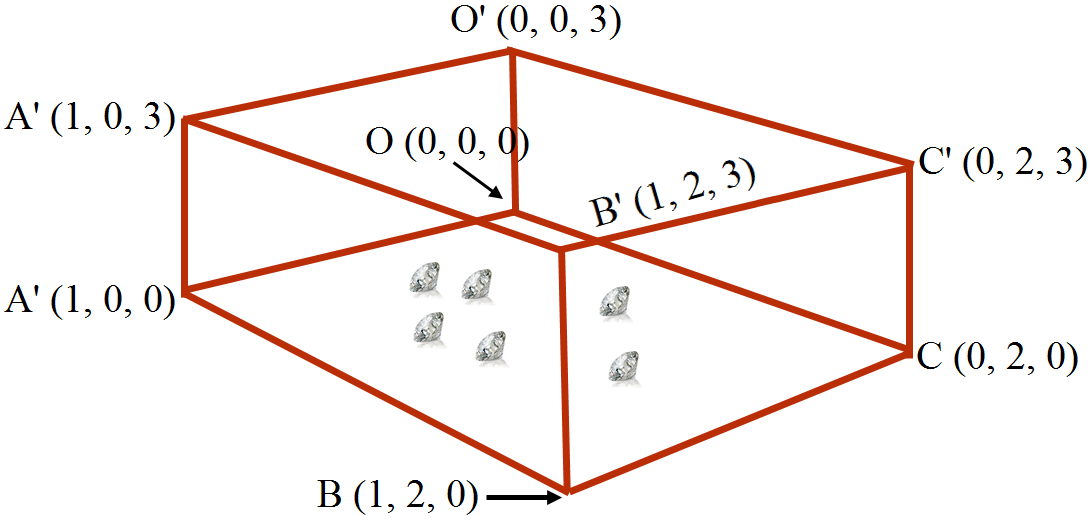
In a diamond exhibition, a diamond is covered in cubical glass box having coordinates O(0, 0, 0), A(1, 0, 0), B(1, 2, 0), C(0, 2, 0), O'(0, 0, 3), A'(1, 0, 3), B'(1, 2, 3) and C'(0, 2, 3). Based on the above information, answer the following questions.
  1. Direction ratios of OA are:
  1. < 0, 1, 0 >
  2. < 1, 0, 0 >
  3. < 0, 0, 1 >
  4. None of these
  1. Equation of diagonal OB' is:
  1. $\frac{\text{x}}{1}=\frac{\text{y}}{2}=\frac{\text{z}}{3}$
  2. $\frac{\text{x}}{0}=\frac{\text{y}}{1}=\frac{\text{z}}{2}$
  3. $\frac{\text{x}}{1}=\frac{\text{y}}{0}=\frac{\text{z}}{2}$
  4. None of these
  1. Equation of plane OABC is:
  1. x = 0
  2. y = 0
  3. z = 0
  4. None of these
  1. Equation of plane O' A' B' C' is:
  1. x = 3
  2. y = 3
  3. z = 3
  4. z = 2
  1. Equation of plane ABB' A' is:
  1. x = 1
  2. y = 1
  3. z = 2
  4. x = 3

Answer

  1. (b) < 1, 0, 0 >
​​​​​​​Solution:

D.R'. s of OA are < 1 - 0, 0 - 0, 0 - 0 >,

i.e., < 1, 0, 0 >
  1. (a) $\frac{\text{x}}{1}=\frac{\text{y}}{2}=\frac{\text{z}}{3}$
​​​​​​​​​​​​​​​​​​​​​Solution:

Equation of diagonal OB' is

$\frac{\text{x}-0}{1}=\frac{\text{y}-0}{2}=\frac{\text{z}-0}{3}$

i.e., $\frac{\text{x}}{1}=\frac{\text{y}}{2}=\frac{\text{z}}{3}$
  1. (c) z = 0
​​​​​​​​​​​​​​​​​​​​​​​​​​​​Solution:

OABC is xy-plane, therefore its equation is z = 0.
  1. (c) z = 3
​​​​​​​​​​​​​​​​​​​​​​​​​​​​Solution:

Plane O' A' B' C' is parallel to xy-plane passing through (0, 0, 3), therefore its equation is z = 3.
  1. (a) x = 1
​​​​​​​​​​​​​​​​​​​​​​​​​​​​​​​​​​​Solution:

Plane ABB' A' is parallel to yz-plane passing through ( 1, 0, 0), therefore its equation is x = 1.

Need a full question paper?

Generate a complete, print-ready paper with questions like this in minutes — across 16+ boards, with answer keys.

Start Generating Free

Similar questions

Read the following text carefully and answer the questions that follow:
Two motorcycles $A$ and $B$ are running at the speed more than allowed speed on the road along the lines
$\vec{r}=\lambda(\hat{i}+2 \hat{j}-\hat{k})$ and $\vec{r}=3 \hat{i}+3 \hat{j}+\mu(2 \hat{i}+\hat{j}+\hat{k})$, respectively.
Image
$i$. Find the cartesian equation of the line along which motorcycle $A$ is running. $(1)$
$ii$. Find the direction cosines of line along which motorcycle $A$ is running. $(1)$
$iii$. Find the direction ratios of line along which motorcycle $B$ is running. $(2)$
OR
Find the shortest distance between the given lines. $(2)$
In pre-board examination of class XII, commerce stream with Economics and Mathematics of a particular school, 50% of the students failed in Economics, 35% failed in Mathematics and 25% failed in both Economics and Mathematics. A student is selected at random from the class. Based on the above information, answer the following questions.
  1. The probability that the selected student has failed in Economics, if it is known that he has failed in Mathematics, is:
  1. $\frac{3}{10}$
  2. $\frac{12}{25}$
  3. $\frac{1}{4}$
  4. $\frac{5}{7}$
  1. The probability that the selected student has failed in Mathematics, if it is known that he has failed in Economics, is:
  1. $\frac{22}{25}$
  2. $\frac{12}{25}$
  3. $\frac{1}{2}$
  4. $\frac{3}{25}$
  1. The probability that the selected student has passed in at least one of the two subjects, is:
  1. $\frac{1}{4}$
  2. $\frac{1}{2}$
  3. $\frac{3}{4}$
  4. None of these.
  1. The probability that the selected student has failed in at least one of the two subjects, is:
  1. $\frac{3}{5}$
  2. $\frac{22}{25}$
  3. $\frac{2}{5}$
  4. $\frac{43}{100}$
  1. The probability that the selected student has passed in Mathematics, if it is known that he has failed in Economics, is:
  1. $\frac{2}{5}$
  2. $\frac{3}{4}$
  3. $\frac{1}{3}$
  4. $\frac{1}{2}$
Shreya got a rectangular parallelepiped shaped box and spherical ball inside it as return gift. Sides of the box are x, 2x, and $\frac{\text{x}}{3},$ while radius of the ball is r.

Based on the above information, answer the following questions.
  1. If S represents the sum of volume of parallelepiped and sphere, then Scan be written as.
  1. $\frac{4\text{x}^3}{3}+\frac{2}{2}\pi\text{r}^2$
  2. $\frac{2\text{x}^2}{3}+\frac{4}{3}\pi\text{r}^2$
  3. $\frac{2\text{x}^3}{3}+\frac{4}{3}\pi\text{r}^3$
  4. $\frac{2}{3}\text{x}+\frac{4}{3}\pi\text{r}$
  1. If sum of the surface areas of box and ball are given to be constant $k^2$ then x is equal to.
  1. $\sqrt{\frac{\text{k}^2-4\pi\text{r}^2}{6}}$
  2. $\sqrt{\frac{\text{k}^2-4\pi\text{r}}{6}}$
  3. $\sqrt{\frac{\text{k}^2-4\pi}{6}}$
  4. $\text{None of these}$
  1. The radius of the ball, when Sis minimum, is.
  1. $\sqrt{\frac{\text{k}^2}{54+\pi}}$
  2. $\sqrt{\frac{\text{k}^2}{54+4}}$
  3. $\sqrt{\frac{\text{k}^2}{64+3\pi}}$
  4. $\sqrt{\frac{\text{k}^2}{4\pi+3}}$
  1. Relation between length of the box and radius of the ball can be represented as.
  1. $\text{x} = \frac{2}{\text{r}}$
  2. $\text{x}=\frac{\text{r}}{2}$
  3. $\text{x}=\frac{2}{\text{r}}$
  4. $\text{x}=3\text{r}$
  1. Minimum value of S is.
  1. $\frac{\text{k}^2}{2(3\pi+54)^\frac{2}{3}}$
  2. $\frac{\text{k}}{2(3\pi+54)^\frac{3}{2}}$
  3. $\frac{\text{k}^3}{2(4\pi+54)^\frac{1}{2}}$
  4. $\text{None of these}$
Consider the following equation of curve $y^2 = 4x$ and straight line $x + y = 3.$
Based on the above information, answer the following questions.
  1. The line $x + y = 3$ cuts the x-axis and y-axis respectively at.
  1. $(0, 2), (2, 0)$
  2. $(3, 3), (0, 0)$
  3. $(0, 3), (3, 0)$
  4. $(3, 0), (0, 3)$
  1. Point(s) of intersection of two given curves is (are).
  1. $(1, -2), (-9, 6)$
  2. $(2, 1), (-6, 9)$
  3. $(1, 2), (9, -6)$
  4. None of these.
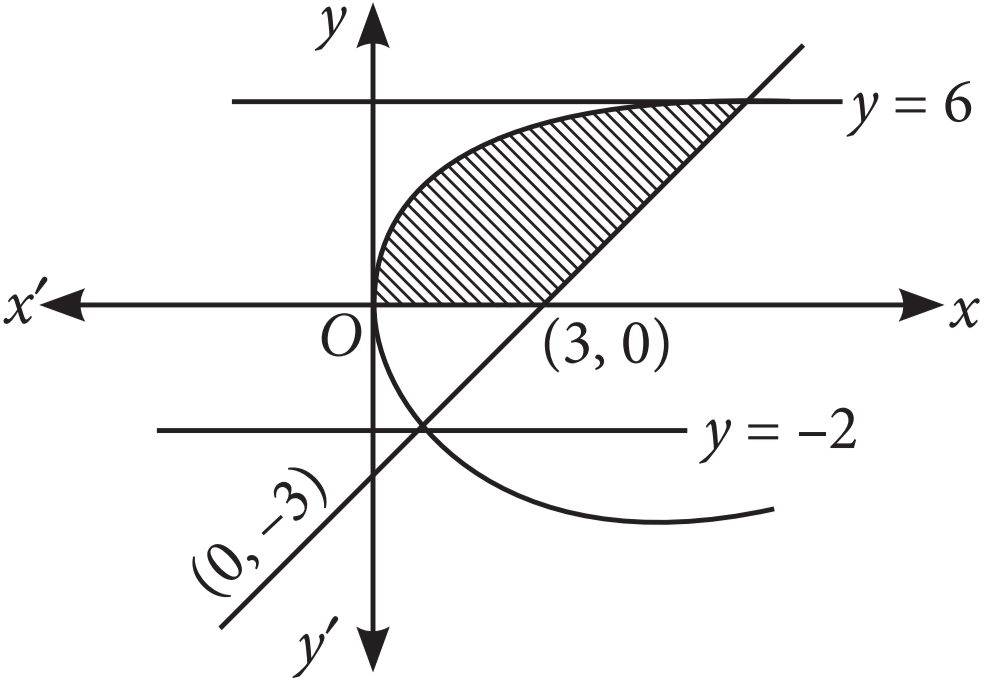
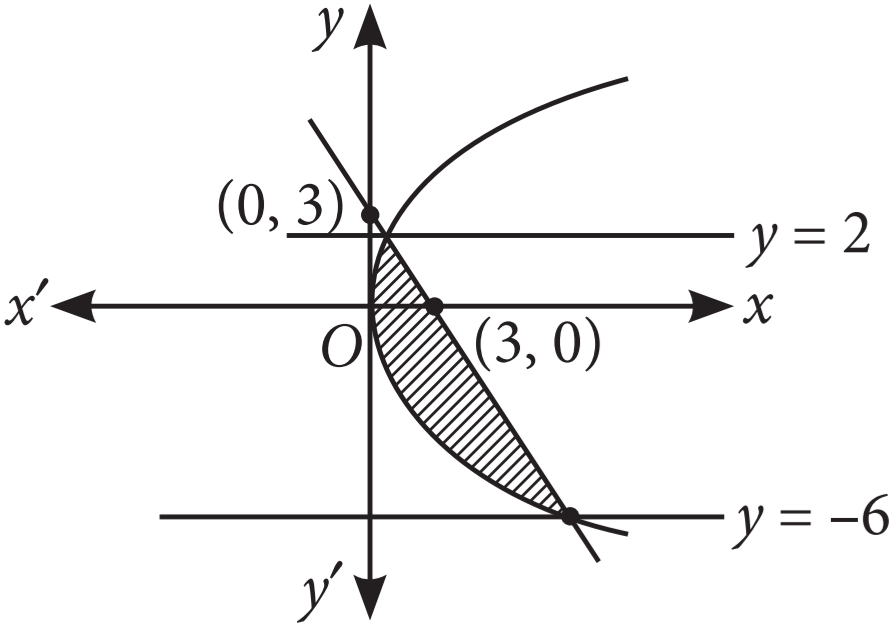
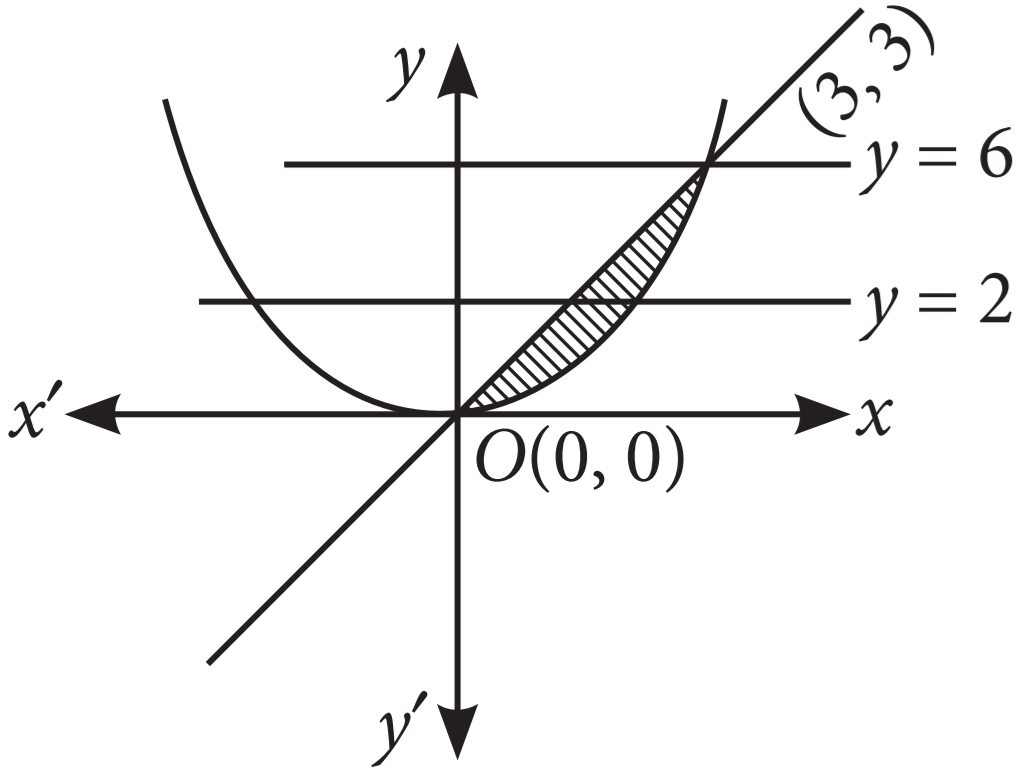
  1. Which of the following shaded portion re present the area bounded by given curves?
    1. None of these
  1. Value of the integral $\int\limits_{-6}^{2}(3-\text{y})\text{ dy}$ is
  1. $10$
  2. $20$
  3. $30$
  4. $40$
  1. Value of area bounded by given curves is.
  1. $56\text{ sq.units}$
  2. $\frac{63}{5}\text{ sq. units}$
  3. $\frac{64}{3}\text{ sq. units}$
  4. $31\text{ sq.units}$

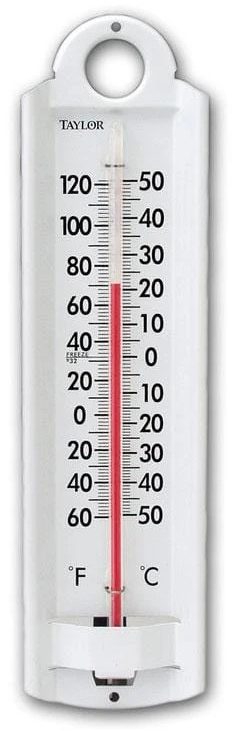
A thermometer reading 80°F is taken outside. Five minutes later the thermometer reads 60°F. After another 5 minutes the thermometer reads 50°F. At any time t the thermometer reading be T°F and the outside temperature be S°F.

Based on the above information, answer the following questions.
  1. If $\lambda$ is posinve constant of propornonality, then $\frac{\text{dn}}{\text{dt}}$ is:
  1. $\lambda(\text{T - S})$
  2. $\lambda(\text{T + S})$
  3. $\lambda\text{T S}$
  4. $-\lambda(\text{T - S})$
  1. The value of T(S) is:
  1. 30°F
  2. 40°F
  3. 5D°F
  4. 60°F
  1. The value of T(10) is:
  1. 50°F
  2. 60°F
  3. 80°F
  4. 90°F
  1. Find the general solution of differential equation fanned in given situation.
  1. $\log\text{T}=\text{St + c}$
  2. $\log(\text{T}-\text{S})=\lambda{\text{t + c}}$
  3. $\log\text{T}=\text{tT + c}$
  4. $\log(\text{T + S})=\lambda{\text{t + c}}$
  1. Find the value of constant of integration c in the solution of differential equation formed in given situation.
  1. $\log(60\ -\ \text{S})$
  2. $\log(80\ +\ \text{S})$
  3. $\log(80\ -\ \text{S})$
  4. $\log(60\ +\ \text{S})$
Read the following text carefully and answer the questions that follow:
Dinesh is having a jewelry shop at Green Park, normally he does not sit on the shop as he remains busy in political meetings. The manager Lisa takes care of jewelry shop where she sells earrings and necklaces. She gains profit of $₹30$ on pair of earrings & $₹40$ on neckless. It takes $30$ minutes to make a pair of earrings and $1$ hour to make a necklace, and there are $10$ hours a week to make jewelry. In addition, there are only enough materials to make $15$ total of jewelry items per week..
Image
$i$. Formulate the above information mathematically. $(1)$
$ii$. Graphically represent the given data. $(1)$
$iii$. To obtain maximum profit how many pair of earing and neckleses should be sold? $(2)$
OR
What would be the profit if $5$ pairs of earrings and $5$ necklaces are made? $(2)$
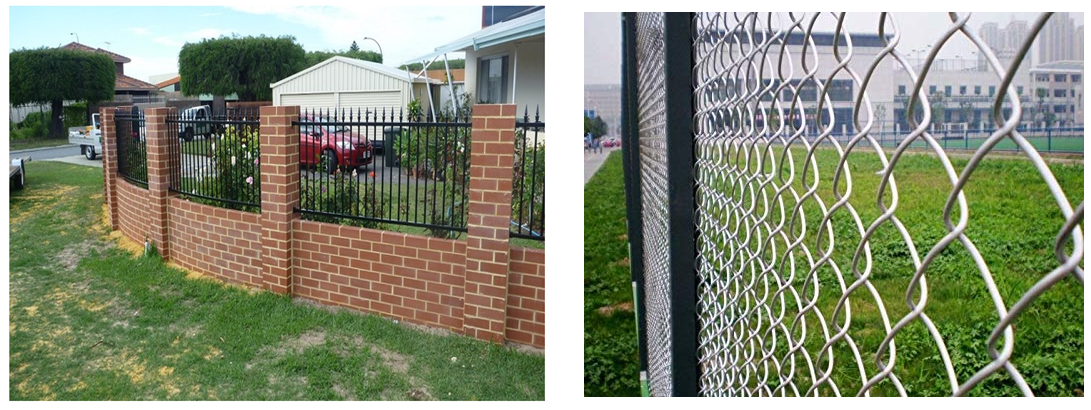
Shobhit's father wants to construct a rectangular garden using a brick wall on one side of the garden and wire fencing for the other three sides as shown in figure. He has $200$ ft of wire fencing.

Based on the above information, answer the following questions.
  1. To construct a garden using $200$ ft of fencing, we need to maximise its.
  1. Volume
  2. Area
  3. Perimeter
  4. Length of the side
  1. If x denote the length of side of garden perpendicular to brick wall and y denote the length of side parallel to brick wall, then find the relation representing total amount of fencing wire.
  1. $x + 2y = 150$
  2. $x + 2y = 50$
  3. $y + 2x = 200$
  4. $y + 2x = 100$
  1. Area of the garden as a function of $x$, say $A(x),$ can be represented as.
  1. $200 + 2x^2$
  2. $x - 2x^2$
  3. $200x - 2x^2$
  4. $200 - x^2$
  1. Maximum value of $A(x)$ occurs at $x$ equals.
  1. $50$ ft
  2. $30$ ft
  3. $26$ ft
  4. $31$ ft
  1. Maxi mum area of garden will be.
  1. $2500$ sq. ft
  2. $4000$ sq. ft
  3. $5000$ sq. ft
  4. $6000$ sq. ft
A poster is to be formed for a company advertisement. The top and bottom margins of poster should be 9cm and the side margins should be 6cm. Also, the area for printing the advertisement should be $864cm^2$.

Based on the above information, answer the following questions.
  1. If a cm be the width and b cm be the height of Poster, then the area of poster, expressed in terms of a and b, is given by.
  1. $648 + 18a + 12b$
  2. $18a + 12b$
  3. $584 + 18a + 12b$
  4. None of these
  1. The relation between a and b is given by.
  1. $\text{a}=\frac{648+12\text{b}}{\text{b}-18}$
  2. $\text{a}=\frac{12\text{b}}{\text{b}-18}$
  3. $\text{a}=\frac{12\text{b}}{\text{b}+18}$
  4. $\text{None of these}$
  1. Area of poster in terms of bis given by.
  1. $\text{a}=\frac{12\text{b}^2}{\text{b}-18}$
  2. $\text{a}=\frac{648\text{b}+12\text{b}^2}{\text{b}-18}$
  3. $\text{a}=\frac{648\text{b}+12\text{b}^2}{\text{b}+18}$
  4. $\text{a}=\frac{12\text{b}^2}{\text{b}+18}$
  1. The value of b, so that area of the poster is minimized, is.
  1. 54
  2. 36
  3. 27
  4. 22
  1. The value of a, so that area of the poster is minimized, is.
  1. 24
  2. 36
  3. 40
  4. 22
$x$ and $y$ are the sides of two squares such that $y = x - x^2.$ Find the rate of change of the area of second square with respect to the area of first square.
Nitin wants to construct a rectangular plastic tank for his house that can hold $80\ ft^3$ of water. The top of the tank is open. The width of tank will be $5$ ft but the length and heights are variables. Building the tank cost? $₹\ 20$ per sq. foot for the base and $₹\ 10$ per sq. foot for the side.

Based on the above information, answer the following questions.

  1. In order to make a least expensive water tank, Nitin need to minimize its.
  1. Volume
  2. Base
  3. Curved surface area
  4. Cost
  1. Total cost of tank as a function of h can be represented as.
  1. $c(h) = 100h - 320 - 1600/ h$
  2. $c(h) = 100h - 320h - 720h^2$
  3. $c(h) = 100 + 320h + 1600h^2$
  4. $\text{c}\big(\text{h}\big)=100\text{h}+320+\frac{1600}{\text{h}}$
  1. Range of $h$ is.
  1. $(3, 5)$
  2. $\big(0,\infty\big)$
  3. $(0, 8)$
  4. $(0, 3)$
  1. Value of hat which $c(h)$ is minimum, is.
  1. $4$
  2. $5$
  3. $6$
  4. $6, 7$
  1. The cost of least expensive tank is.
  1. $₹\ 1020$
  2. $₹\ 1100$
  3. $₹\ 1120$
  4. $₹\ 1220$