Question
In a diffraction pattern due to a single slit, how will the angular width of central maximum change, if
a. Orange light is used in place of green light,
b. the screen is moved closer to the slit,
c. the slit width is decreased?
Justify your answer in each case.
Answer

angular width of central maxima of a single slit diffraction is given as $2 \theta=\frac{2 \lambda}{a}$
a. As $\lambda$ increases (orange light has greater wave length) diffraction angle $2 \theta$ will also increase.
b. Increasing or decreasing closeness of screen and slit does not affect angular width.
c. If a (slit width) decreases, $2 \theta$ will increase as $2 \theta \propto \frac{1}{a}$

Need a full question paper?

Generate a complete, print-ready paper with questions like this in minutes — across 16+ boards, with answer keys.

Start Generating Free

Similar questions

Monochromatic light of wavelength 589 nm is incident from air on a water surface. What are the wavelength, frequency and speed of (a) reflected, and (b) refracted light? Refractive index of water is 1.33.
(I) Draw the energy band diagram for P-type semiconductor at (i) T=0K and (ii) room temperature.
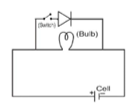
(II) In the given diagram considering an ideal diode, in which condition will the bulb glow
(a) when the switch is open
(b) when the switch is closed
Justify your answer.

Image
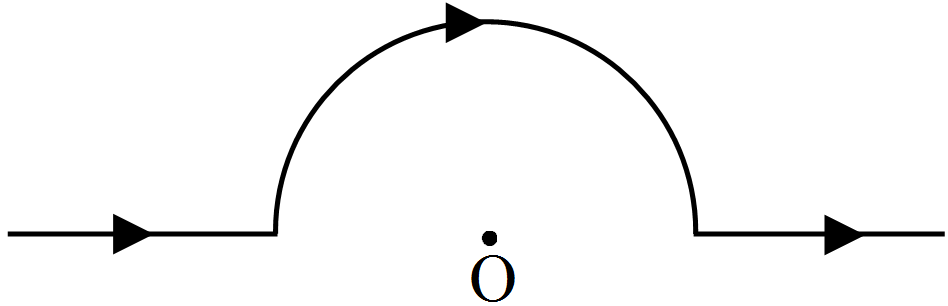
A straight wire carrying a current of 12A is bent into a semi-circular arc of radius 2.0cm as shown. What is the magnetic field at O due to:

  1. Straight segments.
  2. The semi-circular arc?

Explain the phenomenon of nuclear fission.
What is the energy of a hydrogen atom in the first excited state if the potential energy is taken to be zero in the ground state?
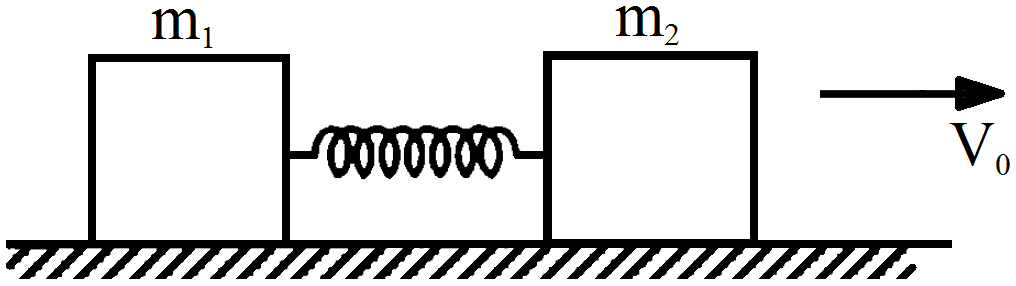
Two blocks of masses m1 and m2 are connected by a spring of spring constant k. The block of mass m2 is given a sharp impulse so that it acquires a velocity v0 towards right. Find
  1. The velocity of the centre of mass.
  2. The maximum elongation that the spring will suffer.
​​​​​​​
Using Gauss’s theorem, show mathematically that for any point outside the shell, the field due to a uniformly charged thin spherical shell is the same as if the entire charge of the shell is concentrated at the centre. Why do you expect the electric field inside the shell to be zero according to this theorem?
An AC source of voltage $\text{V = Vm}\sin\omega\text{t}$ is applied across a series LCR circuit. Draw the phasor diagrams for this circuit, when,
  1. Capacitive impedance exceeds the inductive impedance.
  2. Inductive impedance exceeds capacitive impedance.
In a hydrogen atom, the electron and proton are bound at a distance of about 0.53 $\mathring{\text{A}}$:
  1. Estimate the potential energy of the system in eV, taking the zero of the potential energy at infinite separation of the electron from proton.
  2. What is the minimum work required to free the electron, given that its kinetic energy in the orbit is half the magnitude of potential energy obtained in (a)?
  3. What are the answers to (a) and (b) above if the zero of potential energy is taken at 1.06 Å separation?
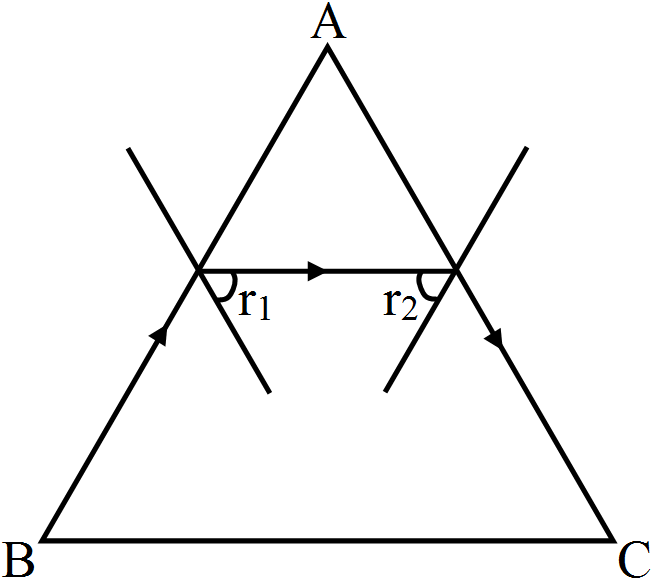
A light ray incident at grazing angle on the face AB of a prism ABC, follows the path shown in the figure. Obtain the relation between the angle of prism A and the refractive index $\mu$ of its material.