MCQ
In a ferromagnetic material, below the curie temperature, a domain is defined as:
  • A
    a macroscopic region with zero magnetization.
  • B
    a macroscopic region with consecutive magnetic dipoles oriented in opposite direction.
  • C
    a macroscopic region with randomly oriented magnetic dipoles.
  • a macroscopic region with saturation magnetization.
Answer

Correct option: D.
a macroscopic region with saturation magnetization.
d
conceptual

Need a full question paper?

Generate a complete, print-ready paper with questions like this in minutes — across 16+ boards, with answer keys.

Start Generating Free

Similar questions

Assertion : The resistivity of a semi-conductor increases with temperature.
Reason : The atoms of semi-conductor vibrate with larger amplitude at higher temperatures thereby increasing its resistivity
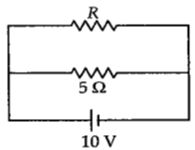
he power dissipated in the circuit shown in the figure is $30\,W$. The value of $R$  is ............. $\Omega$
To establish an instantaneous displacement current of $I$ ampere in the space between the plates of a parallel plate capacitor of $\frac{1}{2}$ farad, the value of $\frac{d V}{d t}$ is .......
The energy required to charge a capacitor of $5\,\mu \,F$ by connecting a $d.c$. source of $20\, kV$ is......$kJ$
Two different loops are concentric and lie in the same plane. The current in the outer loop is clockwise and increasing with time. The induced current in the inner loop then, is
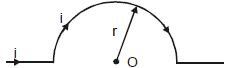
A portion of a conductive wire is bent in the form of a semicircle of radius $r$ as shown below in fig. At the centre of semicircle, the magnetic induction will be
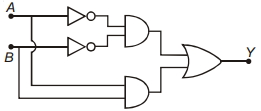
Write down the boolean expression for output $Y$ of a system shown in figure
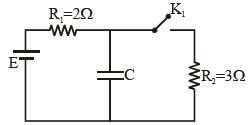
In the circuit shown in the figure $K_1$ is open. The charge on capacitor $C$ in steady state is $q_1$. Now key is closed and at steady state charge on $C$ is $q_2$. The ratio of charges $q_1/q_2$ is
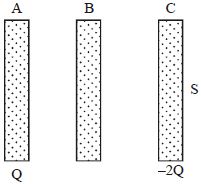
Three identical metal plates with large surface areas are kept parallel to each other as shown in figure. The left most plates is given a charge $Q$ and the right most plate $C$ is given a charge $-2Q.$ The middle plate $B$ is neutral. Then the charge appearing on the outer surface $S$ of the plate $C$ is :-
Lenz's law is a consequence of the law of conservation of: