Question
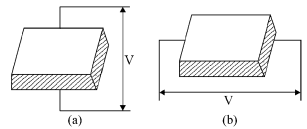
In a given figure, a rectangular object is shown. Its length is I, breadth is 0.5 I and thickness 0.25 I . To measure its resistance, potential difference $V$ is applied in two ways [figure (a) and (b)]. In which arrangement, the resistance of the substance will be more?
Image

Answer

If resistance in both states is $R_1$ and $R_2$
By definition of resistance,$R =\rho \frac{l}{A}$
$R _1=\frac{\rho(0.25 l)}{(l)(0.5 l)}=\frac{\rho}{2 l}$
and $R _2=\frac{(\rho)(l)}{(0.5 l)(0.25 l)}=\frac{8 \rho}{l}$
i.e. $\quad R _2> R _1$
Although the resistance of substance does not depend on potential difference and current but depends on the area of the cross section from which current enters.

Need a full question paper?

Generate a complete, print-ready paper with questions like this in minutes — across 16+ boards, with answer keys.

Start Generating Free