Questions

2 Marks Questions

Take a timed test

37 questions · self-marked practice — reveal the answer and mark yourself.

Question 12 Marks
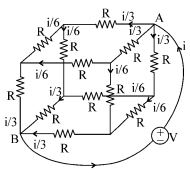
If 12 resistances each of $12 \Omega$ resistance are joined in a cubical network, then calculate the equivalent resistance at the corners opposite to diagonals of this network.
Image
Answer
Let potential difference between A and B is V .
By Kirchoff's second rule
$-V+R\left(\frac{I}{3}\right)+R\left(\frac{I}{6}\right)+R\left(\frac{I}{3}\right)=0$
$\Rightarrow \quad V=\frac{5}{6}$ R.I
$\therefore \quad R _{e q}=\frac{ V }{ I }=\frac{\frac{5}{6} RI }{ I }=\frac{5}{6} R$
$R _{e q}=\frac{5}{6} \times 12=10 \Omega$ Ans.
View full question & answer
Question 22 Marks
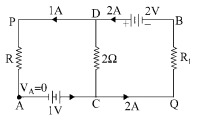
In the given figure, point A is at zero potential. Use Kirchhoff's rules to find out the potential at B.
Image
Answer
By Kirchhoff's first law, current flowing in arm DC of loop BDCQ at junction $D =(2-1) A =1 A$
In branch ACBD
$V_A-V_B=\left(V_A-V_C\right)+\left(V_C-V_D\right)+\left(V_D-V_B\right)$
$V_A-V_B=(-1)+(-2)+2$
$0-V_B=-1$
$V_B=1$ Volt Ans.

View full question & answer
Question 32 Marks
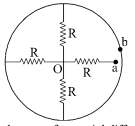
Calculate the magnitude of equivalent resistance across the points $a$ and $b$ in the network shown in the given figure.

Image
Answer
Let a battery of potential difference V is joined between terminals $a$ and $b$. From the battery, a current $i$ enters from terminal $a$ and an equal quantity of current moves out from terminal $b$. At point $O$, magnitude of current will get divided in three equal parts in three resistances, hence potential difference between $a$ and $b$
$ V=V_{a b}+V_{a b}=i R+\frac{i}{3} R $
Hence, equivalent resistance
$ \therefore \quad R_{eqq}=\frac{V}{i}=\frac{4}{3} R $
View full question & answer
Question 42 Marks
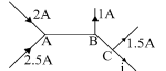
Calculate the value of $i$ as shown in the figure.
Image
Answer
If current flowing in the branches AB and BC are x and y respectively, then by Kirchhoff's junction rule,
$x+2.5+2.0=0$
$x=-4.5 A$
Hence, 4.5 A current will flow from A to B At junction B ,
$ 4.5-1.0+y=0 \text { or, } y=-3.5 A $
Current flowing from B to C will be 3.5 A.
In the same way, at junction C ,
$ 3.5-1.5-i=0 \text { or, } i=2.0 A $ Ans.
View full question & answer
Question 52 Marks
A cell whose electromotive force is 2 volt and internal resistance 0.1 is joined with an external resistance of 3,9 . Find the terminal voltage of the cell.
Answer
Given that : $ E=2 V $
Internal resistance of the cell,
$r=0.1 \Omega$ and $R =3.9 \Omega$
Current voltage of the cell,
$ I=\frac{E}{R+r} $
Putting the value
$I=\frac{2}{3.9+0.1}=\frac{2}{4}=\frac{1}{2}=0.5 A$
Terminal voltage of the cell,
$V = E - Ir =2-0.5 \times 0.1$
$=2-0.05=1.95 V$
or $V = IR =0.5 \times 3.9=1.95 V$
View full question & answer
Question 62 Marks
Two wires A and B are made up of same material. Their areas of cross-section is same and ratio of their lengths is $2: 1$. If same potential difference is applied across the ends of lengths of each wire, then what will be the ratio of current flowing in the two wires?
Answer
When the potential difference is same $ I_1=\frac{V}{R_1} $
From the formula,
$\rho=\frac{ RA }{l}$ or $R =\frac{\rho l}{A}$
$\therefore \quad I _1=\frac{ VA }{\rho l_1}$
$I_2=\frac{V A}{\rho l_2}$
$\begin{array}{ll}\therefore & \frac{ I _1}{ I _2}=\frac{l_2}{l_1}\end{array}$
$\because \quad \frac{l_1}{l_2}=\frac{2}{1}$ or $\frac{l_2}{l_1}=\frac{1}{2}$
$\therefore \quad \frac{ I _1}{ I _2}=\frac{1}{2} I _1$ Hence, $I _2=1: 2 \quad$ Ans.

View full question & answer
Question 72 Marks
Length of a metallic wire is 1 m and its area of cross-section is A square meters. If this wire is stretched to double its length, then by how much percent will its resistance increase?
Answer
We know that the resistance of the wire, $ R=\rho \frac{l}{A} $
On increasing the length of the wire, its area of crosssection will decrease but the volume will remain the same.
$A l d= A { }^{\prime}(2 l) d$, where $d$ is density of the substance.
$A^{\prime}=\frac{A}{2}$
$R ^{\prime}=\frac{\rho(2 l)}{ A / 2}=\frac{4(\rho l)}{ A }=4 R$
Percentage increase in the resistance of the wire
$ =\frac{R^{\prime}-R}{R} \times 100 \%=\frac{4 R-R}{R} \times 100 \%=300 \% $
View full question & answer
Question 82 Marks
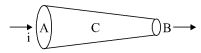
In the given figure, a current carrying conductor of non-uniform cross-section is shown. At what points, the magnitude will be maximum of (i) current (ii) current density and (iii) drift velocity?
Image
Answer
(i) Magnitude of current will be same at all points.
(ii) Current density is inversely proportional to the area of cross-section. Hence, magnitude of current density is maximum at point $B$.
(iii) Magnitude of current flowing is same at every point of the conductor. It is possible only when intensity of electric field is more in the part of less cross-section. Hence, drift velocity will be maximum at point $B$.
View full question & answer
Question 92 Marks
A rod of aluminum whose area of crosssection is $4.00 \times 10^{-6} m^2$. A current of 5.00 A is flowing through it. Find the drift velocity of electrons in the rod. Density of aluminium is and atomic mass is 27 . It is to be assumed that one electron is obtained from one atom.
Answer
Area of cross-section $=4.00 \times 10^{-6} m^2$, Current, $I =5.00 A$,
Density $d=2.7 \times 10^3 kg / m ^3, M =27 \times 10^{-3} kg$
Electron density in the rod, $n=\frac{ N }{ V }$
$n=\frac{ N }{ V }=\frac{1}{ M }\left(\frac{m}{V}\right) N _{ A }=\frac{d N_{ A }}{ M }$
$n=\frac{\left(2.70 \times 10^3\right)\left(6.023 \times 10^{23}\right)}{27.00 \times 10^{-3}}$
$=5.8 \times 10^{28}$ electron $/ m ^3$
Drift velocity, $v_d=\frac{ I }{n e A}$
$=\frac{5.00}{5.8 \times 10^{28} \times 1.6 \times 10^{-19} \times 4.00 \times 10^{-6}}$
$=8.6 \times 10^{-4} m / s$
View full question & answer
Question 102 Marks
Free electron density of copper is $8.5 \times 10^{28}$ per $m ^3$. Find out the current in copper wire of length 0.1 m and area of cross-section $1 mm^2$ when a battery of 3 V is joined across its ends. (Given mobility of electrons = $4.5 \times 10^{-6} m^2 V^{-1} s^{-1}$, charge on electron, $e=1.6 \times 10^{-19} C$ )
Answer
Given that : Free electron density,
$n=8.5 \times 10^{28}$ per $m ^3$
Length of wire, $L=0.1 m$
Area of cross-section,$A =1 mm^2$
$=\left(10^{-3}\right)^2 m^2$
$=10^{-6} m^2$
Voltage across the ends of the wire, $V =3 V$
Mobility of electrons, $\mu_e=4.5 \times 10^{-6} m^2 V^{-1} s^{-1}$
Charge on one electron $e=1.6 \times 10^{-19} C$
Intensity of electric field in the wire,
$ E=\frac{V}{L}=\frac{3 V}{0.1}
$ $ E=30 V / m $
$\because$ Electric current, $I =n e A \mu_e E$
On keeping the values,
$\therefore \quad I =\left(8.5 \times 10^{28}\right)\left(1.6 \times 10^{-19}\right)$
$\left(10^{-6}\right)\left(4.5 \times 10^{-6}\right) \times 30$
$=0.918 A=918 \times 10^{-3} A$
$=918 mA $ 
View full question & answer
Question 112 Marks
An electric current of 5 A is flowing through a wire of area of cross-section $4 \times 10^{-6} m^2$. If the number density of charge carriers (free electrons) is $5 \times 10^{26}$ $m ^{-3}$. Find the drift velocity of the electrons.
Answer
Area of cross-section, $A=4 \times 10^{-6} m^2$
Current I $=5 A$
Number density of free electron, $n=5 \times 10^{26} m^{-3}$
$v_d=\frac{ I }{n A e}=\frac{5}{5 \times 10^{26} \times 4 \times 10^{-6} \times 1.6 \times 10^{-19}}$
$=\frac{1}{64} m / s$ Ans.
View full question & answer
Question 122 Marks
A potential difference of 12 volt is applied across the ends of 0.24 m long conductor. Calculate the drift velocity of the electrons. Mobility of electron is $5.6 \times 10^{-6} m^2 V^{-1} s^{-1}$.
Answer
Length of the conductor, $L =0.24 m$
Potential difference across its ends $V =12 V$
Electric field E inside the conductor
$E =\frac{ V }{ L }$
$E =\frac{12 V}{0.24 m}$
$=50 V / m$
Mobility of electron, $\mu_{ e }=5.6 \times 10^{-6} m^2 V^{-1} s^{-1}$
$\mu_e=\frac{v_d}{ E } \Rightarrow v_d=\mu_e E$
$v_d=5.6 \times 10^{-6} \times 50$
$=2.80 \times 10^{-4} m / s$ Ans.
View full question & answer
Question 132 Marks
A potential difference $V$ is applied across the ends of a conductor of length $L$ and diameter $D$. What will be the effect on drift velocity of charge carriers in the conductor when (i) V is made half (ii) L is doubled and (iii) D is made half?
Answer
Drift velocity
$v_d=\frac{ I }{n l A}=\frac{ V / R }{n l A}$
$v_d=\frac{ V }{n l A\left(\frac{\rho l}{A}\right)}=\frac{ V }{n l \rho l}$
(i) On reducing V to half, the magnitude of drift velocity will also reduce to half.
(ii) On doubling the value of $l$, drift velocity will also get doubled.
(iii) If D is made half, there is no change on the value of the drift velocity because drift velocity does not depend on D.
View full question & answer
Question 142 Marks
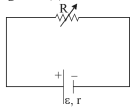
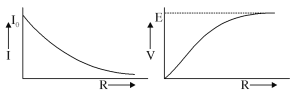
A variable resistor R, electromotive force and internal resistance $r$ are joined as shown in the given figure across the ends of the cell. Draw graph to show (i) terminal voltage and (ii) current $I$ as a function of $R$.
Image
Answer
Current in circuit
$ I=\frac{E}{R+r}=\frac{E}{R\left(1+\frac{r}{R}\right)} $
and terminal voltage
$V = IR$
$V =\frac{ E \times R }{ R \left(1+\frac{r}{ R }\right)}=\frac{ E }{\left(1+\frac{r}{ R }\right)}$
Image
View full question & answer
Question 152 Marks
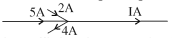
Write Kirchhoff's junction rule. Write the magnitude of current $I$ in the given figure.
Image
Answer
Kirchhoff's junction rule: The algebraic sum of all the currents meeting at a junction in a closed electric circuit is zero.
which means $\quad \Sigma I=0$
Applying Kirchhoff's junction to find the value of I in the given figure,
$ \begin{aligned} 5+2-I-4 & =0 \\
I & =3 A \end{aligned} $
View full question & answer
Question 162 Marks
Write Kirchhoff's rules for electric circuit.
Answer
First law (junction rule) : Algebraic sum of all the currents meeting at a junction in any closed circuit is zero. which means $\Sigma I =0$
Second law (loop rule): According to this law, the algebraic sum of the products of currents and resistances of any closed loop of any electric circuit is equal to the algebraic sum of electromotive forces working in that loop.
i.e.,$\Sigma E =\Sigma V =\Sigma IR$
View full question & answer
Question 172 Marks
Write an expression for resistance and resistivity of a conductor in terms of number of free electrons per unit volume and relaxation time.
Answer
$I =n A e v_d$
$v_d=\frac{e V \tau}{m L}$
Putting the value of equation (2) in equation (1)
$I =n A e\left[\frac{e V \tau}{m L}\right]$
$I =\left[\frac{n e^2 A \tau}{m L}\right] V$
Comparing equation (3) with $I =\frac{ V }{ R }$
$\therefore \quad R =\frac{m L}{n A e^2 \tau}$
On comparing equation (4) with $R=\frac{\rho L}{A}$
$\therefore \quad \rho=\frac{m}{n e^2 \tau}$
View full question & answer
Question 182 Marks
What will be the change in the resistance of wire of eureka if its radius is made half and length is made one-fourth?
Answer
$R =\rho\left(\frac{l}{A}\right)$ or $R =\rho\left(\frac{l}{\pi r^2}\right)$
$R _1=\rho\left(\frac{l_1}{\pi r_1^2}\right)$
$\frac{ R _1}{ R }=\left(\frac{l_1}{l}\right)\left(\frac{r}{r_1}\right)^2=\left(\frac{l / 4}{l}\right)\left(\frac{r}{r / 2}\right)^2$
$=\frac{1}{4} \times 4=1$
$R_1=R$
Hence these will be no change in resistance. Ans.
View full question & answer
Question 192 Marks
State factors on which the resistance of a conductor depends.
Answer
From $\quad R =\frac{m l}{n e^2 A \tau}$, it is clear that resistance R of any conductor depends on the following :
(i) length of the conductor ( $R \propto l$ )
(ii) area of cross-section A of the conductor $\left( R \propto \frac{1}{A}\right)$
(iii) free electron density $n$ in the conductor ( $R \propto n$ )
(iv) relaxation time (I) of free electrons $\left( R \propto \frac{1}{\tau}\right)$
Since relaxation time depends on temperature, hence electric resistance also depends on temperature. On increasing temperature, relaxation time decreases, hence resistance increases.
View full question & answer
Question 202 Marks
Two conductors $X$ and $Y$ of same diameters but different substances are joined in series with a battery. If electron density in X is double than that of Y , then find the ratio of drift velocities of electrons in these two wires.
Answer
$I =n_e A_{v d}$ or $\quad v_d=\frac{1}{n e A}$. Since the diameters of two wires is same, their areas are also same and since both the wires are joined in series with a battery so same current will flow through them. The drift velocity,
$v_{ d } \propto \frac{1}{n}$
$\frac{\left(v_d\right)_x}{\left(v_d\right)_y}=\frac{n_y}{n_x}=\frac{n_y}{2 n_y}=\frac{1}{2}$
$\because n_x=2 n_y$
Hence, $\left(v_d\right)_x:\left(v_d\right)_y=1: 2$
View full question & answer
Question 212 Marks
Any current flowing through a copper wire when passed through an iron wire of same thickness. What will be the effect on its drift velocity?
Answer
$I =n_e A_{v d}$ or $v_d=\frac{ I }{n e A}$, where $I , e$ and A are constant. Hence, $v_d \propto \frac{1}{n}$. The free electron density ( $n$ ) is less in iron than in copper, drift velocity will be more in iron than in copper.
View full question & answer
Question 222 Marks
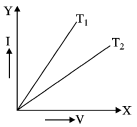
I-V graph at two different temperatures $T _1$ and $T _2$ for a metallic wire. Which temperature is greater and why? Image
Answer
Slope of graph at the temperature $T_2$ is less. Hence resistance will be more at this temperature. With increase in temperature, resistance also increases. Hence, $T_2$ is greater.
View full question & answer
Question 232 Marks
Write relation between conductivity and mobility of metal.
Answer
Ratio of drift velocity and electric field inside the conductor is constant at a given temperature. This constant quantity is known as mobility ( $\mu$ ) of charge carrier (electron)
Mobility $(\mu)=\frac{\text { Drift velocity }}{\text { Electric field }}$
$=\frac{v_d}{ E }=\frac{\left(\frac{e E }{m}\right) \tau}{ E }=\frac{e \tau}{m}$
$\mu=\frac{e \tau}{m}$
Conductivity of the substance
$\sigma=\frac{n e^2 \tau}{m}$
$\sigma=n e\left[\frac{e \tau}{m}\right]$
On putting the value from equation (1) in (2)
$\sigma=n e(\mu)$
Hence, conductivity of metal $\sigma=n e \mu $
View full question & answer
Question 242 Marks
In a cylindrical conductor, a direct current is flowing. Is there any electric field inside the conductor?
Answer
Current flows in the conductor only when electric field established inside the conductor applies force on every free electron. Hence there is electric field inside the conductor.
View full question & answer
Question 252 Marks
Why the magnitude of drift velocity of metal electrons is very less?
Answer
If we apply any electric potential across the ends of a metallic conductor, an electric field is established between its two ends and a force act on free electrons in the opposite direction of electric field due to which every free electron develops a velocity and this velocity keeps on increasing and electrons move till it does not collide with any metallic ion in its path. Its velocity decreases to zero after the collision and again the velocity increases till next collision and then it becomes zero.
If average distance covered between two collisions is $\lambda$ and time taken is $\tau$, then, drift velocity $\left(v_d\right)=\frac{\lambda}{\tau}$. Here the magnitude of $\lambda$ is very small in comparison to $\tau$, so magnitude of drift velocity is very small.
View full question & answer
Question 262 Marks
What will be the change in specific resistance of copper wire when (i) length is made three times (ii) area of cross-section is made three times (iii) radius is made three times and (iv) temperature is increased?
Answer
It is clear from $\rho=\frac{m}{n e^2 \tau}$ that resistivity is (i) unaffected by the increase in length (ii) unaffected by the increase in area of cross-section (iii) unaffected by the increase in radius (iv) will increase by increase in temperature because $\tau$ decrease on increasing the $\rho \propto \frac{1}{\tau}$ temperature.
View full question & answer
Question 272 Marks
Why potentiometer is more effective instrument in measuring electromotive force of cell than voltmeter?
Answer
When we use potentiometer then in the state of balance, no current flows from the source and potential of source does not change. Due to this reason, the potentiometer measures the correct potential. When we measure from a voltmeter, then for deflection, current from the source flows through it due to which its potential decreases and it measures the less potential.
View full question & answer
Question 282 Marks
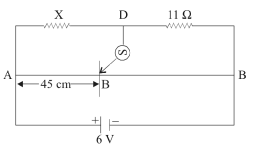
Find the value of X in the given figure.
Image
Answer
From the principle of meterbridge
$\frac{X}{45}=\frac{11}{10045}$
$\Rightarrow \quad \frac{X}{45}=\frac{11}{55}$
$\Rightarrow \quad X =\frac{45 \times 11}{55}=9 \Omega$ Ans.
View full question & answer
Question 292 Marks
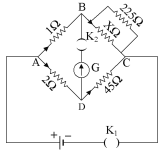
In the given figure, if the Wheatstone Bridge is balanced, then find the magnitude of unknown resistance $X$. Image
Answer
Resistance of arm BC of the Wheatstone Bridge
$R =\frac{225 X }{ X +225}$
Formula, $R =\frac{ R _1 R _2}{ R _1+ R _2}$
From the principle of Wheatstone Bridge,
$\frac{\text { Resistance of } AB }{\text { Resistance of } BC }=\frac{\text { Resistance of } \operatorname{arm} AD }{\text { Resistance of } \operatorname{arm} DC }$
$\Rightarrow \quad \frac{1}{\frac{225 X }{ X +225}}=\frac{2}{45}$
$\Rightarrow \quad \frac{X+225}{225 X}=\frac{2}{45}$
$\Rightarrow \quad 45 X +225 \times 45=450 X$
$\Rightarrow \quad 225 \times 45=450 X-45 X$
$\Rightarrow \quad 225 \times 45=405 X$
$\therefore \quad X=\frac{225 \times 45}{405}=\frac{225}{9}=25$
$\therefore \quad X=25 \Omega$ 
View full question & answer
Question 302 Marks
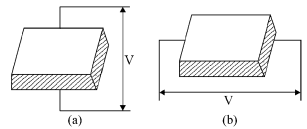
In a given figure, a rectangular object is shown. Its length is I, breadth is 0.5 I and thickness 0.25 I . To measure its resistance, potential difference $V$ is applied in two ways [figure (a) and (b)]. In which arrangement, the resistance of the substance will be more?
Image
Answer
If resistance in both states is $R_1$ and $R_2$
By definition of resistance,$R =\rho \frac{l}{A}$
$R _1=\frac{\rho(0.25 l)}{(l)(0.5 l)}=\frac{\rho}{2 l}$
and $R _2=\frac{(\rho)(l)}{(0.5 l)(0.25 l)}=\frac{8 \rho}{l}$
i.e. $\quad R _2> R _1$
Although the resistance of substance does not depend on potential difference and current but depends on the area of the cross section from which current enters.
View full question & answer
Question 312 Marks
A wire of copper whose radius is 0.1 mm and resistance are $2 k \Omega$. It is joined with a supply of 40 V . Find: (i) how many electrons are transferred per second between one end of the wire and the supply? (ii) what will be current density of the wire?
Answer
Radius of wire, $r=0.1 mm$
$=0.1 \times 10^{-3} m$
$r=10^{-4} m$
Resistance of the wire, $R =2 k \Omega=2 \times 10^3 \Omega$ Voltage applied across the ends of the wire, $V=40 V$
(i) From Ohm's law
Current in wire $I =\frac{ V }{ R }$
$I =\frac{40}{2 \times 10^3}=2 \times 10^{-2} A$
Also, $I =\frac{n e}{t} \Rightarrow n=\frac{1 \times t}{e}$
$n=\frac{\left(2 \times 10^{-2}\right) \times 1}{1.6 \times 10^{-19}}$
$=1.25 \times 10^{17}$
(ii) Area of cross-section of the wire
$A =\pi r ^2$
$=3.14 \times\left(10^{-4}\right)^2 m^2$
$=3.14 \times 10^{-8} m^2$
Current density in the wire,
$j=\frac{ I }{ A }=\frac{2 \times 10^{-2} A}{3.14 \times 10^{-8}}$
$j=6.37 \times 10^5 A / m ^2 \quad$ Ans.
View full question & answer
Question 322 Marks
Area of cross-section of a wire is $1.0 \times 10^{-7} m^2$ and the number of free electrons per cubic metre in the wire is $2 \times 10^{28}$ per $m ^3$. A current of 3.2 A is flowing in the wire. Find (i) current density in the wire (ii) drift velocity of free electrons.
Answer
$A =1.0 \times 10^{-7} m^2, n=2 \times 10^{28}, I =3.2 A$
(i) Current density in the wire,
$j=\frac{ I }{ A }=\frac{3.2 A}{1.0 \times 10^{-7} m^2}$
$=3.2 \times 10^7$ ampere $/$ meter $^2$
(ii)$\because j=n e v_d \Rightarrow v_d=\frac{j}{n e}$
$=\frac{3.2 \times 10^7 A}{2 \times 10^{28} m^{-3} \times\left(16 \times 10^{-19} C \right)}=10^{-2} m / s$ Ans.
View full question & answer
Question 332 Marks
An electron moves in a circular orbit $6^{15} \times 10^{15}$ times per second. Find the magnitude of current in the loop.
Answer
Sol. Charge flowing in revolving of electron once in circular orbit $=e$
Charge flowing in revolving times
$\therefore \quad N =6 \times 10^{15}$
$q= N e$
$q=\left(6 \times 10^{15}\right) \times 1.6 \times 10^{-19} C$
Time taken in revolving $t=1$ second
Current in the loop,
$I =\frac{q}{t}=\frac{\left(6 \times 10^{15}\right)\left(1.6 \times 10^{-19}\right)}{1} C$
$I =9.6 \times 10^{-4} A=0.96 \times 10^{-3} A$
$=0.96 mA$ Ans.
View full question & answer
Question 342 Marks
Resistivity of metals increases with temperature but of semiconductors decreases. Explain.
Answer
Some alloys such as manganin, Constantin are such that on which the effect of temperature is very less which means their resistance temperature coefficient is negligible. Due to high specific resistance and negligible resistance temperature coefficient, their wires are used in the making of resistance box etc.
Carbon, glass, semiconductors like silicon and germanium etc., their resistivity decrease with increase in temperature which means their resistance temperature coefficient is negative. On increasing temperature in semiconductors, the number of charge carriers increase due to which their resistivity decrease.
View full question & answer
Question 352 Marks
Two metallic wires A and B made from same substance have equal lengths and their cross-sections are in the ratio $1: 2$. They are joined in (i) series (ii) parallel. In both the above combinations, compare the drift velocities of electrons in the two wires.
Answer
$A _1: A _2=1: 2=l_2=1$
(i) On joining in series, the electric current is same.
$I _{ A }= I _{ B } \Rightarrow n e A_1\left(v_d\right)_1=n e A_2\left(v_d\right)_2$
or $\frac{\left(v_d\right)_1}{\left(v_d\right)_2}=\frac{ A _2}{A_1}=\frac{2}{1}=2: 1$
(ii) In parallel combination, potential difference remains the same
Hence, $V_A=V_B \Rightarrow I_A \times R_A=I_B \times R_B$
$\Rightarrow n e A_1\left(v_d\right)_1 \times \rho \frac{1}{A_1}=n e A_2\left(v_d\right)_2 \times \rho \frac{1}{A_2}$
$\Rightarrow \quad \frac{\left(v_d\right)_1}{\left(v_d\right)_2}=1 \Rightarrow\left(v_d\right)_1:\left(v_d\right)_2=1 ; 1$ Ans.
View full question & answer
Question 362 Marks
Electrons are continuously mobile in any conductor but then too, no electric current flows in the conductor till an electric source is joined across its ends. Explain.
Answer
Due to random motion of electrons, the net flow of electron in any definite direction is zero and because of this no current flows in the conductor. On applying potential difference across its ends, an electric field is developed in the conductor and because of this a force acts on the electrons in a direction opposite to the direction of electric field and electrons travel in a definite direction. The current starts flowing in the conductor.
View full question & answer
Question 372 Marks
A silver wire has a resistance of 2.1 Ω at 27.5${ }^{\circ} C$, and a resistance of 2.7 Ω at 100 ${ }^{\circ} C$. Determine the temperature coefficient of resistivity of silver.
Answer
Given:
$\begin{aligned} T _1 & =27.5^{\circ} C
\\ T _2 & =100^{\circ} C \end{aligned}$
$R _1=2.1 \Omega$ and $R _2=2.7 \Omega$
Let temperature coefficient of resistivity of silver $\alpha=$ ?
Formula $\quad R _2= R _1\left[1+\alpha\left( T _2- T _1\right)\right]$
$\Rightarrow \quad \alpha=\frac{\left( R _2- R _1\right)}{ R _1\left(T_2- T _1\right)}$
$\alpha=\frac{(2.7-2.1)}{2.1(100-27.5)}=\frac{0.6}{2.1 \times 72.5}$
$=\frac{60}{21 \times 725}=\frac{20}{7 \times 725}=\frac{20}{5075}$
$=3.94 \times 10^{-3}$
$\cong 4 \times 10^{-3}{ }^{\circ} C ^{-1}$
View full question & answer