Question

In a hydrogen atom, which of the following electronic transitions would  involve the maximum energy change

(a) From n = 2 to n = 1

(b) From n = 3 to n = 1

(c) From n = 4 to n = 2

(d) From n = 3 to n = 2

Answer

(b) From n = 3 to n = 1

Need a full question paper?

Generate a complete, print-ready paper with questions like this in minutes — across 16+ boards, with answer keys.

Start Generating Free

Similar questions

In PN-junction diode the reverse saturation current is  amp at 27  The forward current for a voltage of  0.2 volt  is [exp(7.62) = 2038.6, K = 1.4  

(a) 2037.6  

(b) 203.76 

(c) 20.376  

(d) 2.0376 

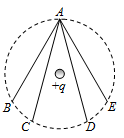
In the electric field of a point charge q, a certain charge is carried from point A to B, C, D  and E. Then the work done

(a) Is least along the path AB

(b) Is least along the path AD

(c) Is zero along all the paths AB, AC, AD  and AE

(d) Is least along AE

Air is pushed into a soap, bubble of radius r to double its radius. If the surface tension of the soap solution is S, the work done in the process is:

  1. $8\ \pi\text{r}^2\text{S}$

  2. $12\ \pi\text{r}^2\text{S}$

  3. $16\ \pi\text{r}^2\text{S}$

  4. $24\ \pi\text{r}^2\text{S}\cdot$

Amplification factor of a triode is 10. When the plate potential is 200 volt and grid potential is – 4 volt, then the plate current of 4mA is observed. If plate potential is changed to 160 volt and grid potential is kept at – 7 volt, then the plate current will be

(a) 1.69 mA

(b) 3.95 mA

(c) 2.87 mA

(d) 7.02 mA

The force that a unit positive charge would experiences if placed at that point is called as _____ due to charge at a point in space.
The purpose of cathode in cathode ray tube is ______:
An electric dipole is placed in an uniform electric field of a point charge, the __________ .

There are  n similar conductors each of resistance R. The resultant resistance comes out to be  x when connected in parallel. If they are connected in series, the resistance comes out to be

(a)   

(b)  

(c) x/n     

(d) nx

Unit of induced emf is:
A unitless quantity:
  1. Never has a non-zero dimension.
  2. Always has a non-zero dimension.
  3. May have a non-zero dimension.
  4. Does not exist.