Question

In a material medium, when a positron meets an electron both the particles annihilate leading to the emission of two gamma ray photons. This process forms the basis of an important diagnostic procedure called

(a) MRI

(b) PET

(c) CAT    

(d) SPECT

Answer

(b) PET

Need a full question paper?

Generate a complete, print-ready paper with questions like this in minutes — across 16+ boards, with answer keys.

Start Generating Free

Similar questions

Which of the following has the mass closest in value to that of the positron (1 a.m.u = 931 Mev)

(a) Proton

(b) Electron

(c) Photon

(d) Neutrino

The heavier nuclei tend to have larger $\frac{\text{N}}{\text{Z}}$ ratio because:
The length of a wire required to manufacture a solenoid of length l and self-induction L is (cross-sectional area is negligible)

A charge particle is free to move in an electric field. It will travel

(a) Always along a line of force

(b) Along a line of force, if its initial velocity is zero

(c) Along a line of force, if it has some initial velocity in the direction of an acute angle with the line of force

(d) None of the above

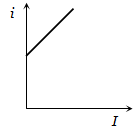
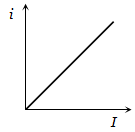
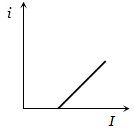
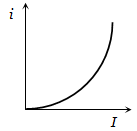
The graph between intensity of light falling on a metallic plate (I) with the current (i) generated is

(a)

(b)

(c)

(d)

Assertion : According to classical theory, the proposed path of an electron in Rutherford atom model will be parabolic.

Reason     : According to electromagnetic theory an accelerated particle continuously emits radiation.

(a) If both assertion and reason are true and the reason is the correct explanation of the assertion.

(b) If both assertion and reason are true but reason is not the correct explanation of the assertion.

(c) If assertion is true but reason is false.

(d) If assertion is false but reason is true.

Consider the situation of the previous problem. The directions of the magnetic field due to the dipole are opposite at:
  1. P1 and P2
  2. Q1 and Q2
  3. P1 and Q1
  4. P2 and Q2
In an AC circuit, the impedance is 3​ times the reactance, then the phase angle is.

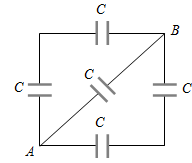
In the figure shown, the effective capacitance between the points A and B, if  each has capacitance C, is

(a) 2C

(b)    

(c) 5C       

(d)  

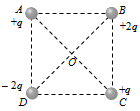
Four charges are arranged at the corners of a square ABCD, as shown in the adjoining figure. The force on the charge kept at the centre O is

(a) Zero  

(b) Along the diagonal AC

(c) Along the diagonal BD

(d) Perpendicular to side AB