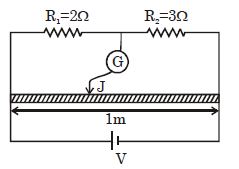
In a meter bridge experiment, initially the jockey is at null point. Now resistance $R_1$ $\&$ $R_2$ is interchanged. Shift in the position of jockey is ................ $cm$
Medium
Download our app for free and get started
Initially $\frac{\mathrm{R}_{1}}{\mathrm{R}_{2}}=\frac{2}{3}=\frac{\ell}{100-\ell} \Rightarrow \ell=40 \mathrm{\,cm}$
Now $\frac{\mathrm{R}_{2}}{\mathrm{R}_{1}}=\frac{3}{2}=\frac{\ell}{100-\ell} \Rightarrow \ell=60 \mathrm{\,cm}$
shift $=20 \mathrm{\,cm}$

Download our appand get started for free
Experience the future of education. Simply download our apps or reach out to us for more information. Let's shape the future of learning together!No signup needed.*
Similar Questions
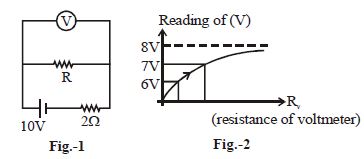
- 1In the given figure $-1$, resistance of shown voltmeter is variable. Variation of whose reading with respect to its resistance is shown in figure $-2$. The value of $R$ is ............... $\Omega$View Solution
- 2An electric iron draws $5\, amp$, a $TV$ set draws $3\, amp$ and refrigerator draws $2\, amp$ from a $220\, volt$ main line. The three appliances are connected in parallel. If all the three are operating at the same time, the fuse used may be of ............. $amp$View Solution
- 3When an ammeter of negligible internal resistance is inserted in series with circuit it reads $1A$. When the voltmeter of very large resistance is connected across $X$ it reads $1V$. When the point $A$ and $B$ are shorted by a conducting wire, the voltmeter measures $10\, V$ across the battery. The internal resistance of the battery is equal to .............. $\Omega$View Solution
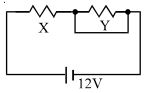
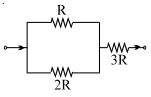
- 4The ratio of powers dissipatted respectively in $R$ and $3R$, as shown is:View Solution
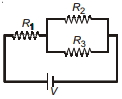
- 5Three identical resistors $R_1=R_2=R_3$ are connected as shown to a battery of constant e.m.f. The power dissipated is ...........View Solution
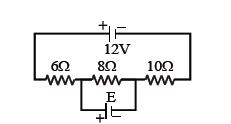
- 6In the circuit shown, the current through $8\,ohm$ issame before and after connecting $E$. The value of $E$ is .................... $\mathrm{V}$View Solution
- 7Two resistances are connected in two gaps of a meter bridge. The balance point is $20\, cm$ from the zero end. A resistance of $15\, ohms$ is connected in series with the smaller of the two. The null point shifts to $40\, cm$. The value of the smaller resistance in $ohms$ isView Solution
- 8A potentiometer consists of a wire of length $4\, m$ and resistance $10 \,\Omega$. It is connected to cell of $emf$ $2\, V$. The potential difference per unit length of the wire will be ............ $V/m$View Solution
- 9View SolutionIn given circuit
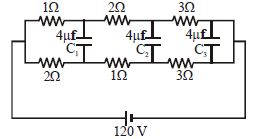
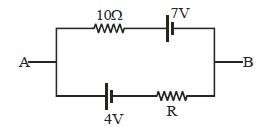
- 10In the following circuit if $V_A -V_B = 6\,V$ then the value of resistance $R$ (in $ohm$) is ............... $\Omega$View Solution