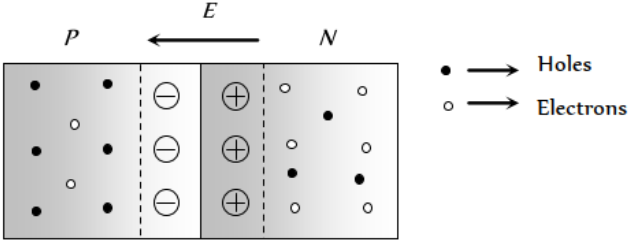
In a $P N$-junction diode not connected to any circuit
[IIT-JEE 1998]


Download our appand get started for free
Experience the future of education. Simply download our apps or reach out to us for more information. Let's shape the future of learning together!No signup needed.*
Similar Questions
- 1For a transistor, the current amplification factor is $0.8.$ The transistor is connected in common emitter configuration. The change in the collector current when the base current changes by 6 $m A$ isView Solution
- 2For a triode $r_p=10 \ kilo \ ohm$ and $g_m=3 \ milli \ mho$. If the load resistance is double of plate resistance, then the value of voltage gain will beView Solution
- 3The slope of plate characteristic of a vacuum tube diode for certain operating point on the curve is $10^{-3} \frac{ mA }{ V }.$ The plate resistance of the diode and its nature respectivelyView Solution
- 4$P$-type semiconductor is formed whenA. As impurity is mixed in $S i$B. $A$ Impurity is mixed in $S i$C. $B$ impurity is mixed in $G e$D. $P$ impurity is mixed in $G e$View Solution
- 5In a transistor in $CE$ configuration, the ratio of power gain to voltage gain isView Solution
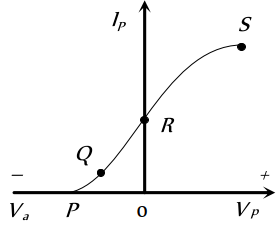
- 6View SolutionThe point representing the cut off grid voltage on the mutual characteristic of triode is
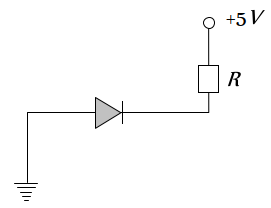
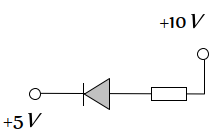
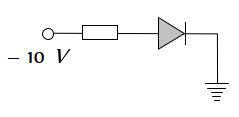
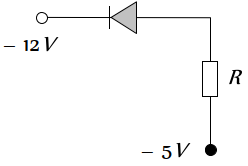
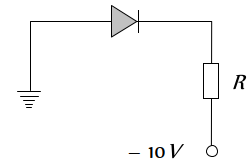
- 7View SolutionIn the given figure, which of the diodes are forward biased ?
- 8Which of the following statements concerning the depletion zone of an unbiased $P N$ junction is (are) trueView Solution
- 9View SolutionZener breakdown takes place if
- 10In an experiment, the saturation in the plate current in a diode is observed at $240 V$. But a student still wants to increase the plate current. It can be done, ifView Solution