Question
In a p-n junction with open ends:

Answer

  1. Holes and conduction electrons systematically go from the p-side to the n-side and from the n side to the p-side respectively.
  2. There is no net charge transfer between the two sides.
  3. There is a constant electric field near the junction.
Explanation:
Because of the difference in the concentration of charge carriers in the p−n junction, holes from the p side move to the n side and electrons from the n side move to the p side. This motion of charge carriers gives rise to diffusion current.
Because of this, a negative space charge region is formed in the p region and a positive space region is formed in the n region. This sets up an electric field across the junction. Thus, there is a constant electric field near the junction.
This electric field further opposes the diffusion of majority charge carriers across the junction. As a result, an electron from the p region starts moving to the n region and a hole from the n region starts moving to the p region. This sets up drift current. Thus, there is a systematic flow of charge carriers across the junction. Also, there is no net charge transfer between the two sides.
Need a full question paper?

Generate a complete, print-ready paper with questions like this in minutes — across 16+ boards, with answer keys.

Start Generating Free

Similar questions

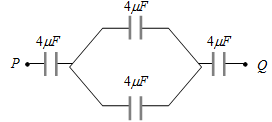
Four condensers each of capacity $4\ μF$  are connected as shown in figure $V_P - V_Q=15$ volts. The energy stored in the system is
A galvanometer of $10$ ohm resistance gives full scale deflection with $0.01$ ampere of current. It is to be converted into an ammeter for measuring $10$ ampere current. The value of shunt resistance required will be
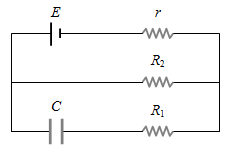
In the given figure each plate of capacitance $C$ has partial value of charge
The curve between charge density and distance near $P-N$ junction will be
When an impurity is doped into an intrinsic semiconductor, the conductivity of the semiconductor:
  1. Increases.
  2. Decreases.
  3. Remains the same.
  4. Becomes zero.
The wavelength of yellow line of sodium is $5896 \mathring A$ . Its wave number will be
A charge of magnitude $3e$ and mass $2m$ is moving in an electric field $\vec{E}$. The acceleration imparted to the charge is
Assertion :   At 0 K Germanium is a superconductor. 
Reason    :    At 0 K Germanium offers zero resistance.(a) If both assertion and reason are true and the reason is the correct explanation of the assertion.(b) If both assertion and reason are true but reason is not the correct explanation of the assertion.(c) If assertion is true but reason is false.(d) If the assertion and reason both are false.


Which of the following series in the spectrum of hydrogen atom lies in the visible region of the electromagnetic spectrum?
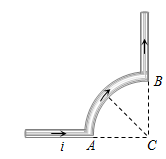
A wire carrying current $i$ is shaped as shown. Section $AB$ is a quarter circle of radius $r.$ The magnetic field is directed