Question
In a p-n junction:

Answer

  1. New holes and conduction electrons are produced continuously throughout the material.
  1. Holes and conduction electrons recombine continuously throughout the material except in the depletion region.
Explanation:
In a p‒n junction diode, diffusion current flows because of the diffusion of holes from the p side to the n side and of electrons from the n side to the p side. The current flowing in the diode due to the diffusion of charge carriers across the junction is called the diffusion current. The current flowing in the diode due to the movement of minority carriers across the junction due to their thermal energy is called the drift current. In an unbiased diode, the net current flowing across the junction is zero due to the cancellation of the drift current by the diffusion current. For the flow of diffusion and drift currents, holes and electrons are produced continuously throughout the material. When a hole crosses the junction, it combines with an electron on the n side. As the depletion region is devoid of free charge carriers, this recombination never takes place inside the depletion region.

Need a full question paper?

Generate a complete, print-ready paper with questions like this in minutes — across 16+ boards, with answer keys.
Start Generating Free

Similar questions

A Rowland ring of mean radius 15 cm has 3500 turns of wire wound on a ferromagnetic core of relative permeability 800. What is the magnetic field B in the core for a magnetising current of 1.2A?
Assertion  : If the temperature of a semiconductor is increased then it's resistance decreases.
Reason      : The energy gap between conduction band and valence band is very small(a) If both assertion and reason are true and the reason is the correct explanation of the assertion.(b) If both assertion and reason are true but reason is not the correct explanation of the assertion.(c) If assertion is true but reason is false.(d) If the assertion and reason both are false.


A photo cell is receiving light from a source placed at a distance of 1 m. If the same source is to be placed at a distance of 2 m, then the ejected electron(a) Moves with one-fourth energy as that of the initial energy(b) Moves with one-fourth of momentum as that of the initial momentum(c) Will be half in number(d) Will be one-fourth in number


A moving charge will gain energy due to the application of(a) Electric field (b) Magnetic field(c) Both of these(d) None of these
       
Fundamental gates are :
The current which is assumed to be flowing in a circuit from positive terminal to negative, is called:
A steady current is passing through a linear conductor of non uniform cross-section. The net quantity of charge crossing any cross section per second is:
The wavefront is a surface in which:
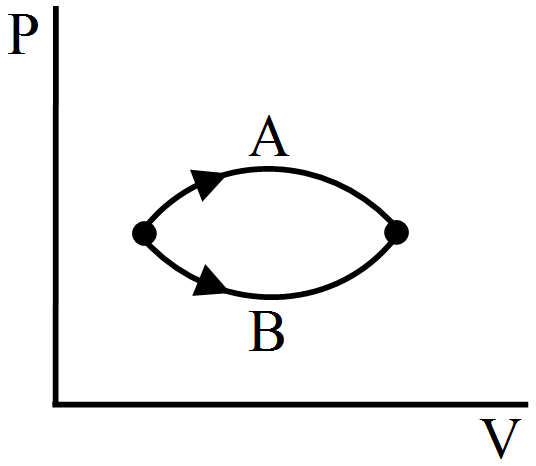
Figure. shows two processes A and B on a system. Let $\Delta\text{Q}_1$ and $\Delta\text{Q}_2$ be the heat given to the system in processes A and B respectively. Then,
  1. $\Delta\text{Q}_1>\Delta\text{Q}_2$
  2. $\Delta\text{Q}_1=\Delta\text{Q}_2$
  3. $\Delta\text{Q}_1<\Delta\text{Q}_2$
  4. $\Delta\text{Q}_1\le\Delta\text{Q}_2$
Positive rays consists of(a) Electrons (b) Neutrons (c) Positive ions (d) Electro magnetic waves