MCQ
In a photo-diode, 
  • A
    Photocurrent is proportional to incident light intensity.
  • B
    Photocurrent is inversely proportional to incident light intensity.
  • C
    Photocurrent is independent of the incident light intensity.
  • D
    Incident light intensity is proportional to the photocurrent.
Answer

  1. Photocurrent is proportional to incident light intensity.

Explanation:

In a photodiode, photocurrent is directly proportional to intensiy of incident light. More the incident light intensity, more will be the current produced.

Need a full question paper?

Generate a complete, print-ready paper with questions like this in minutes — across 16+ boards, with answer keys.

Start Generating Free

Similar questions

The specific resistance of a rod of copper as compared to that of thin wire of copper is:

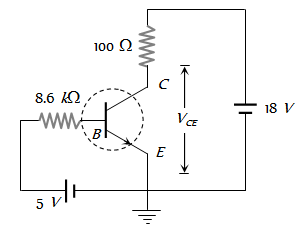
For the transistor circuit shown below, if b = 100, voltage drop between emitter and base is 0.7 V then value of VCE will be

(a) 10 V

(b) 5 V

(c) 13 V 

(d) 0 V

A very long bar magnet is placed with its north pole coinciding with the centre of a circular loop carrying as electric current i. The magnetic field due to the magnet at a point on the periphery of the wire is B. The radius of the loop is a. The force on the wire is:

A nucleus of mass 218 amu in free state decays to emit an a-particle. Kinetic energy of the a-particle emitted is 6.7 MeV. The recoil energy (in MeV) of the daughter nucleus is

(a) 1.0

(b) 0.5

(c) 0.25

(d) 0.125

 A bar magnet of the magnetic moment 5 Am2 has poles 20cm apart. Calculate the pole strength.
If ionisation energy of hydrogen atom in ground state is 13.6 eV , then ionisation energy of first excited state will be :
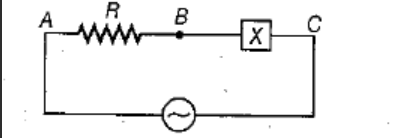
In the given circuit R in pure resistance and X is unknown circuit element. An AC voltage source is applied across A and C. If VAB​ = VAC​, then X is.
Image

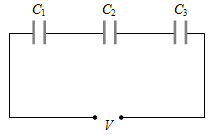
In the figure, three capacitors each of capacitance 6 pF are connected in series. The total capacitance of the combination will be

(a) 9  

(b) 6  

(c) 3 

(d) 2 

The energy of electron in first excited state of H-atom is  -3.4 eV  its kinetic energy is

(a) – 3.4 eV

(b) + 3.4 eV

(c) – 6.8 eV

(d) 6.8 eV

The angle of incidence at which reflected light is totally polarized for reflection from air to glass (refraction index n) is

(a)

(b)

(c)

(d)