Question
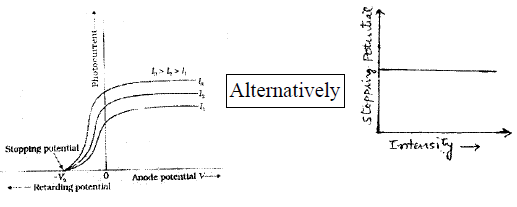
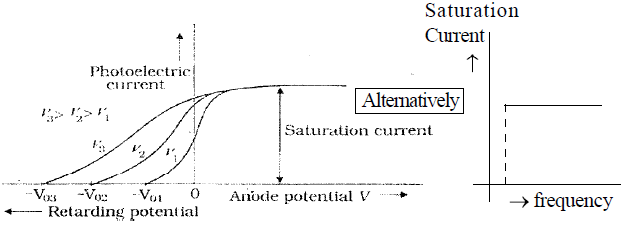
In a plot of photoelectric current versus anode potential, how does?
  1. The saturation current vary with anode potential for incident radiations of different frequencies but same intensity?
  2. The stopping potential vary for incident radiations of different intensities but same frequency?
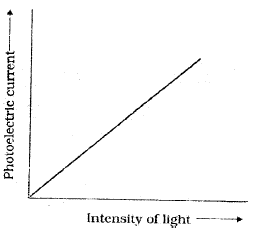
  3. Photoelectric current vary for different intensities but same frequency of incident radiations?
Justify your answer in each case.

Answer

  1. Saturation current does not change.
  1. stopping potential does not change.
  1. Photoelectric current increases with increase in intensity.

Need a full question paper?

Generate a complete, print-ready paper with questions like this in minutes — across 16+ boards, with answer keys.

Start Generating Free

Similar questions

Define the term self$-$inductance of a solenoid. Obtain the expression for the magnetic energy stored in an inductor of self$-$inductance $L$ to build up a current $I$ through it.
Does focal length of a lens depend on the colour of the light used? Does focal length of a mirror depend on the colour?
Suppose the resistance of the coil in the preivous problem is $25\Omega.$ Assume that the coil moves with uniform velocity during its removal and restoration. Find the thermal energy developed in the coil during:
  1. Its removal.
  2. Its restoration.
  3. Its motion.
A transverse wave described by$\text{y}=(0.02\text{m})\sin\Big[(1.0\text{m}^{-1})\text{x}+(30\text{s}^{-1})\text{t}\Big]$
propagates on a stretched string having a linear mass density of $1.2 \times 10^{-4}kg/m$. Find the tension in the string.
The equation for the vibration of a string, fixed at both ends vibrating in its third harmonic, is given by$\text{y}=(0.4\text{cm})\sin\big[(0.314\text{cm}^{-1})\text{x}\big]\cos\big[(600\pi\text{s}^{-1})\text{t}\big]$
  1. What is the frequency of vibration?
  2. What are the positions of the nodes?
  3. What is the length of the string?
  4. What is the wavelength and the speed of two travelling waves that can interfere to give this vibration ?
  1. In Young's double slit experiment, two slits are 1 mm apart, and the screen is placed 1 m away from the slits. Calculate the fringe width when light of wavelength 500 nm is used.
  2. What should be the width of each slit in order to obtain 10 maxima of the double slits pattern within the central maximum of the single slit pattern?
How many time constants will elapse before the current in a charging RC circuit drops to half of its initial value? Answer the same question for a discharging RC circuit.
Draw a labelled diagram of an a.c. generator. Explain briefly its principle and working.
A plane electromagnetic wave travels in vacuum, along the Y-direction. Write down the:
  1. Ratio of the magnitudes,
  2. The direction, of its electric and magnetic field vectors.
The variation of intensity of magnetisation I and the applied magnetic field intensity H for three magnetic materials X, Y and Z are as shown in the given graphs.

  1. Identify the materials X, Y and Z.
  2. Show graphically the variation of susceptibility with temperature for X.
  3. Put of Y and Z, which of the material will you prefer for making transformer cores and why?