MCQ
In a $PNP$ transistor working as a common-base amplifier, current gain is $0.96$ and emitter current is $7.2\, mA$. The base current is.....$mA$
  • A
    $0.4 $
  • B
    $0.2$
  • $0.29$
  • D
    $0.35$

Answer

Correct option: C.
$0.29$
c
(c)$\alpha = \frac{{{i_c}}}{{{i_e}}}$$=0.96$ and $ie = 7.2\, mA$
$ \Rightarrow {i_c} = 0.96 \times {i_e}$

$= 0.96 × 7.2 = 6.91 \,mA$
$\therefore {i_e} = {i_c} + {i_b}$

$==> 7.2 = 6.91 + ib $

$==> ib = 0.29 \,mA.$

Need a full question paper?

Generate a complete, print-ready paper with questions like this in minutes — across 16+ boards, with answer keys.

Start Generating Free

Similar questions

Column $I$ describe some situations in which a small object moves. Column $II$ describes some characteristics of these motions. Match the situation in Column $I$ with the characteristics in Column $II$ and indicate your answer by darkening appropriate bubbles in the $4 \times 4$ matrix given in the $ORS$.
Column $I$ Column $II$
$(A)$ The object moves on the $\mathrm{x}$-axis under a conservative force in such a way that its "speed" and "position" satisfy $v=c_1 \sqrt{c_2-x^2}$, where $\mathrm{c}_1$ and $\mathrm{c}_2$ are positive constants. $(p)$ The object executes a simple harmonic motion.
$(B)$ The object moves on the $\mathrm{x}$-axis in such a way that its velocity and its displacement from the origin satisfy $\mathrm{v}=-\mathrm{kx}$, where $\mathrm{k}$ is a positive constant. $(q)$ The object does not change its direction.
$(C)$ The object is attached to one end of a massless spring of a given spring constant. The other end of the spring is attached to the ceiling of an elevator. Initially everything is at rest. The elevator starts going upwards with a constant acceleration a. The motion of the object is observed from the elevator during the period it maintains this acceleration. $(r)$ The kinetic energy of the object keeps on decreasing.
$(D)$ The object is projected from the earth's surface vertically upwards with a speed $2 \sqrt{\mathrm{GM}_e / R_e}$, where, $M_e$ is the mass of the earth and $R_e$ is the radius of the earth. Neglect forces from objects other than the earth. $(s)$ The object can change its direction only once.
For a plane electromagnetic wave propagating in $x$-direction, which one of the following combination gives the correct possible directions for electric field $(E)$ and magnetic field $(B)$ respectively?
A ball is rolled off the edge of a horizontal table at a speed of $4\, m/second$. It hits the ground after $0.4\, second$. Which statement given below is true
A plane progressive wave is given by $y=2 \cos 2 \pi(330 t-x) m$. The frequency of the wave is :
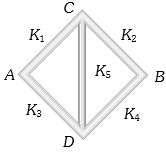
Five rods of same dimensions are arranged as shown in the figure. They have thermal conductivities $K1, K2, K3, K4$ and $K5$ . When points $A$ and $B$ are maintained at different temperatures, no heat flows through the central rod if
A string of $7 \;m$ length has a mass of $0.035\,kg$. If tension in the string is $60.5\; N,$ then speed of a wave on the string is .... $m/s$
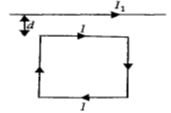
A square loop, carrying a steady current $I,$ is placed in a horizontal plane near a long straight conductor carrying a steady current $I_1$ at a distance $d$ from the conductor as shown in figure. The loop will experience
Dry ice is
Which of the following support the quantum nature of the $EM$ radiations

$(A)$  Photoelectric effect     $(B)$  Compton effect
$(C)$ Doppler's effect            $(D)$  Field effect

${F_g}$ and ${F_e}$ represents gravitational and electrostatic force respectively between electrons situated at a distance $10\, cm$. The ratio of ${F_g}/{F_e}$ is of the order of