MCQ
In a semiconductor diode, the barrier potential offers opposition to:
- AHoles in P-region only.
- BFree electrons in N-region only.
- CMajority carriers in both regions.
- DMajority as well as minority carriers in both regions.
Generate a complete, print-ready paper with questions like this in minutes — across 16+ boards, with answer keys.
In transformer, core is made of soft iron to reduce
|
(a) Hysteresis losses |
(b) Eddy current losses |
|
(c) Force opposing electric current |
(d) None of the above |
In an electrolysis experiment, a current i passes through two different cells in series, one containing a solution of  and the other a solution of
  . The rate of increase of the weight of the cathodes in the two cells will be
|
(a) In the ratio of the densities of Cu and Ag |
|
(b) In the ratio of the at. weights of Cu and Ag |
|
(c) In the ratio of half the atomic weight of Cu to the atomic weight of Ag |
|
(d) In the ratio of half the atomic weight of Cu to half the atomic weight of Ag |
When a thin transparent plate of thickness t and refractive index m is placed in the path of one of the two interfering waves of light, then the path difference changes by
|
(a) (m + 1)t |
(b) (m – 1)t |
(c) |
(d) |
A slit of size 0.15 cm is placed at 2.1 m from a screen. On illuminated it by a light of wavelength 5 × 10⁻⁵ cm. The width of central maxima will be
|
(a) 70 mm |
(b) 0.14 mm |
(c) 1.4 mm |
(d) 0.14 cm |
If a coil made of conducting wires is rotated between poles pieces of the permanent magnet. The motion will generate a current and this device is called
|
(a) An electric motor |
(b) An electric generator |
|
(c) An electromagnet |
(d) All of above |
For the diode, the characteristic curves are given at different temperature. The relation between the temperatures is
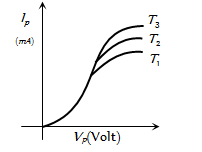
(a) 
|
(b) 
|
(c) 
|
(d) None of the above |
An object placed 10 cm in front of a lens has an image 20 cm behind the lens. What is the power of the lens (in dioptres)
|
(a) 1.5 |
(b) 3.0 |
(c) – 15.0 |
(d) + 15.0 |
$\text{B}_\text{y},=\text{B}_\text{y}+\frac{\text{vE}_\text{z}}{\text{c}^2}$
$\text{E}_\text{y},=\text{E}_\text{y}+\frac{\text{vB}_\text{z}}{\text{c}^2}$
$\text{B}'_\text{y}=\text{B}_\text{y}+\text{v}\text{E}_\text{z}$
$\text{E}'_\text{y}=\text{E}_\text{y}+\text{vB}_\text{z}$

