MCQ
In a simple harmonic oscillator, at the mean position
  • A
    Kinetic energy is minimum, potential energy is maximum
  • B
    Both kinetic and potential energies are maximum
  • Kinetic energy is maximum, potential energy is minimum
  • D
    Both kinetic and potential energies are minimum
Answer

Correct option: C.
Kinetic energy is maximum, potential energy is minimum
c
(c) $K . E=\frac{1}{2} k\left(A^{2}-x^{2}\right) ; U=\frac{1}{2} k x^{2}$

At the mean position $x=0$

$\therefore K . E .=\frac{1}{2} k A^{2}=$ Maximum and $U=0$

Need a full question paper?

Generate a complete, print-ready paper with questions like this in minutes — across 16+ boards, with answer keys.

Start Generating Free

Similar questions

The area of the parallelogram having diagonals ${3\hat i}\,\, + \,\,\hat j\,\, - \,\,2\hat k$ and $\hat i\,\, - \,\,3\hat j\,\, + \;\,4\hat k$ is
A child of mass $5\,kg$ is going round a merry-goround that makes $1$ rotation in $3.14\,s$. The radius of the merry-go-round is $2\,m$. The centrifugal force on the child will be $.......\,N$
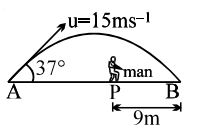
A ball is hit by a batsman at an angle of $37^o$ as shown in figure. The man standing at $P$ should run at what minimum velocity so that he catches the ball before it strikes the ground. Assume that height of man is negligible in comparison to maximum height of projectile.  ........ $ms^{-1}$
Considering the gases to be ideal, the value of $\gamma = \frac{{{C_P}}}{{{C_V}}}$ for a gaseous mixture consisting of $= 3$ moles of carbon dioxide and $2$ moles of oxygen will be $({\gamma _{{O_2}}} = 1.4,\,\,{\gamma _{C{O_2}}} = 1.3)$
A particle is projected from a horizontal plane ($x-z$ plane) such that its velocity vector at time t is given by $\vec V = a\hat i + (b - ct)\hat j$ Its range on the horizontal plane is given by
An ideal gas expands in such a way that $PV^2 =$ constant throughout the process.
A liquid does not wet the solid surface if angle of contact is
An automobile, travelling at $40\, km/h$, can be stopped at a distance of $40\, m$ by applying brakes. If the same automobile is travelling at $80\, km/h$, the minimum stopping distance, in metres, is (assume no skidding)..........$m$
he ratio of the coefficient of thermal conductivity of two different materials is $5 : 3$ . If the thermal resistance of the rod of same thickness resistance of the rods of same thickness of these materials is same, then the ratio of the length of these rods will be
A car is moving along a straight line, say $OP$ in given figure. It moves from $O$ to $P$ in $18\; s$ and returns from $P$ to $\mathrm{Q}$ in $6.0\; s$. What are the average velocity and average speed of the car in going from $O$ to $P$ and back to $Q?$
