In a sonometer wire, the tension is maintained by suspending a $50.7 kg$ mass from the free end of the wire. The suspended mass has a volume of $ 0.0075 \, m^3$. The fundamental frequency of the wire is $260 Hz$. If the suspended mass is completely submerged in water, the fundamental frequency will become .... $Hz$ (take $g = 10 ms^{-2}$)
Medium


Download our appand get started for free
Experience the future of education. Simply download our apps or reach out to us for more information. Let's shape the future of learning together!No signup needed.*
Similar Questions
- 1Two identical straight wires are stretched so as to produce $6$ beats per second when vibrating simultaneously. On changing the tension in one of them, the beat frequency remains unchanged. Denoting by ${T_1},\,{T_2}$, the higher and the lower initial tensions in the strings, then it could be said that while making the above change in tensionView Solution
- 2${v_1}$ and ${v_2}$ are the velocities of sound at the same temperature in two monoatomic gases of densities ${\rho _1}$ and ${\rho _2}$ respectively. If $\frac{\rho _1}{\rho _2} = \frac{1}{4}$ then the ratio of velocities ${v_1}$ and ${v_2}$ will beView Solution
- 3A person carrying a whistle emitting continuously a note of $272 Hz$ is running towards a reflecting surface with a speed of $18\, km/hour. $ The speed of sound in air is $345m{s^{ - 1}}$. The number of beats heard by him isView Solution
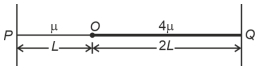
- 4Two uniform strings of mass per unit length $\mu$ and $4 \mu$, and length $L$ and $2 L$, respectively, are joined at point $O$, and tied at two fixed ends $P$ and $Q$, as shown in the figure. The strings are under a uniform tension $T$. If we define the frequency $v_0=\frac{1}{2 L} \sqrt{\frac{T}{\mu}}$, which of the following statement($s$) is(are) correct?View Solution
$(A)$ With a node at $O$, the minimum frequency of vibration of the composite string is $v_0$
$(B)$ With an antinode at $O$, the minimum frequency of vibration of the composite string is $2 v_0$
$(C)$ When the composite string vibrates at the minimum frequency with a node at $O$, it has $6$ nodes, including the end nodes
$(D)$ No vibrational mode with an antinode at $O$ is possible for the composite string
- 5An unknown frequency $x$ produces $8$ beats per seconds with a frequency of $250 Hz$ and $12$ beats with $270 Hz$ source, then $x$ is .... $Hz$View Solution
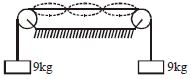
- 6The length of the wire shown in figure between the pulleys is $1.5\, m$ and its mass is $12.0\,g$. The frequency of vibration with which the wire vibrates in three loops forming antinode at the mid point of the wire is $(g = 9.8 \,m/s^2)$View Solution
- 7For a certain organ pipe, three successive resonance frequencies are observed at $425,595,$ and $765 \,Hz$ respectively, Taking the speed of sound in air to be $340 \,m / s$ the fundamental frequency of the pipe (in $Hz$ ) is .........View Solution
- 8A wave represented by the equation ${y_1} = a\,\cos \,\left( {kx - \omega t} \right)$ is superimposed with another wave to form a stationary wave such that the point $x = 0$ is node. The equation for the other wave isView Solution
- 9For a certain organ pipe, three successive resonance frequencies are observed at $425,595,$ and $765 \,Hz$ respectively, Taking the speed of sound in air to be $340 \,m / s$ the fundamental frequency of the pipe (in $Hz$ ) is .........View Solution
- 10A tuning fork of frequency $340\,\, Hz$ is vibrated just above a cylindrical tube of length $120 \,\,cm$. Water is slowly poured in the tube. If the speed of sound is $340\,\, ms^{-1}$ then the minimum height of water required for resonance is .... $cm$View Solution