${v_1}$ and ${v_2}$ are the velocities of sound at the same temperature in two monoatomic gases of densities ${\rho _1}$ and ${\rho _2}$ respectively. If $\frac{\rho _1}{\rho _2} = \frac{1}{4}$ then the ratio of velocities ${v_1}$ and ${v_2}$ will be
AIIMS 2002, Medium


Download our appand get started for free
Experience the future of education. Simply download our apps or reach out to us for more information. Let's shape the future of learning together!No signup needed.*
Similar Questions
- 1The rope shown at an instant is carrying a wave travelling towards right, created by a source vibrating at a frequency $n$. Consider the following statementsView Solution
$I.$ The speed of the wave is $4n \times ab$
$II.$ The medium at $a$ will be in the same phase as $d$ after $\frac{4}{{3n}}s$
$III.$ The phase difference between $b$ and $e$ is $\frac{{3\pi }}{2}$
Which of these statements are correct
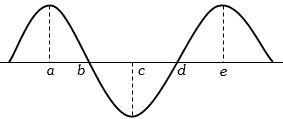
- 2If the velocity of sound in air is $350 m/s$. Then the fundamental frequency of an open organ pipe of length $50\,cm,$ will be ............... $\mathrm{Hz}$View Solution
- 3Two open organ pipes give $4$ beats/sec when sounded together in their fundamental nodes. If the length of the pipe are $100 cm$ and $102.5 cm$ respectively, then the velocity of sound is ..... $m/s$View Solution
- 4A wave travels on a light string.The equation of the wave is $Y = A \,\sin \,(kx - \omega t + 30^o)$.It is reflected from a heavy string tied to an end of the light string at $x = 0$. If $64\%$ of the incident energy is reflected the equation of the reflected wave isView Solution
- 5The equation $y = A{\cos ^2}\left( {2\pi \;nt - 2\pi \frac{x}{\lambda }} \right)$ represents a wave withView Solution
- 6The frequency of fundamental tone in an open organ pipe of length $0.48 m$ is $320 Hz.$ Speed of sound is $320 m/sec.$ Frequency of fundamental tone in closed organ pipe will be ... $Hz$View Solution
- 7A person in front of a mountain is beating a drum at the rate of $40$ per minute and hears no distinct echo. If the person moves $90 \,m$ closer to the mountain, he has to beat the drum at $60$ per minute to not hear any distinct echo. The speed of sound is .............. $ms^{-1}$View Solution
- 8A closed organ pipe has a fundamental frequency of $1.5\, kHz$. The number of overtones that can be distinctly heard by a person with this organ pipe will be : (Assume that the highest frequency a person can hear is $20,000\, Hz$)View Solution
- 9The end correction of a resonance column is $1\,cm.$ If the shortest length resonating with the tuning fork is $10\,cm,$ the next resonating length should be ..... $cm$View Solution
- 10$Assertion :$ The change in air pressure affects the speed of sound.View Solution
$Reason :$ The speed of sound in gases is proportional to the square of pressure.