In a spherical condenser radius of the outer sphere is $R$. The different in the radii of outer and inner sphere in $x$. Its capacity is proportional to
Diffcult


Download our appand get started for free
Experience the future of education. Simply download our apps or reach out to us for more information. Let's shape the future of learning together!No signup needed.*
Similar Questions
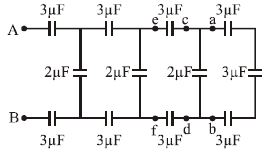
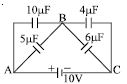
- 1The resultant capacitance between $A$ and $B$ in the fig. is......$\mu F$View Solution
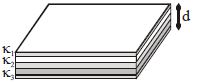
- 2A parallel plate capacitor is filled with $3$ dielectric materials of same thickness, as shown in the sketch. The dielectric constants are such that $k_3 > k_2 > k_1$. Let the magnitudes of the electric field in and potential drops across each dielectric be $E_3$, $E_2$,$ E_1$, $\Delta V_3$, $\Delta V_2$ and $\Delta V_1$, respectively. Which one of the following statement is true ?View Solution
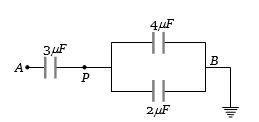
- 3In the figure a potential of $+$ $1200\, V$ is given to point $A$ and point $B$ is earthed, what is the potential at the point $P$....$V$View Solution
- 4A parallel plate capacitor has a capacity $C$. The separation between the plates is doubled and a dielectric medium is introduced between the plates. If the capacity now becomes $2C$, the dielectric constant of the medium isView Solution
- 5Seven capacitors, each of the capacitance $2\,\mu F$, are to be connected in a configuration to obtain an effective capacitance of $\left( {\frac{6}{{13}}} \right)\,\mu F$. Which of the combinations, shown in figures below, will achieve the desired value ?View Solution
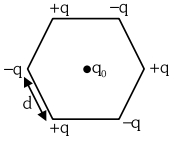
- 6Six charges $+ q ,- q ,+ q ,- q ,+ q$ and $- q$ are fixed at the corners of a hexagon of side $d$ as shown in the figure. The work done in bringing a charge $q _0$ to the centre of the hexagon from infinity is :$\left(\varepsilon_0-\right.$ permittivity of free space)View Solution
- 7In the circuit shown in figure, four capacitors are connected to a battery. A parallel plate capacitor has an electric field of $10^5\ V/m$ between the plates. If the charge on the capacitor plate is $1\ \mu C$, then the force on each capacitor plate is.....$Nt$View Solution
- 8Two identical capacitors, have the same capacitance $C$. One of them is charged to potential ${V_1}$ and the other to ${V_2}$. The negative ends of the capacitors are connected together. When the positive ends are also connected, the decrease in energy of the combined system isView Solution
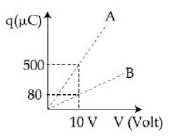
- 9Figure shows charge $(q)$ versus voltage $(V)$ graph for series and parallel combination of to given capacitors. The capacitances areView Solution
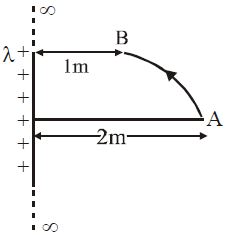
- 10Figure shows a positively charged infinite wire. $A$ particle of charge $2C$ moves from point $A$ to $B$ with constant speed. (Given linear charge density on wire is $\lambda = 4 \pi \varepsilon_0$)View Solution