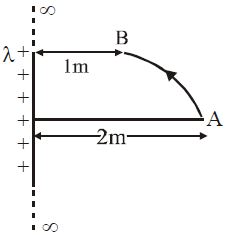
Figure shows a positively charged infinite wire. $A$ particle of charge $2C$ moves from point $A$ to $B$ with constant speed. (Given linear charge density on wire is $\lambda = 4 \pi \varepsilon_0$)
Medium
Download our app for free and get started
$\mathrm{E}=\frac{2 \mathrm{K} \lambda}{\mathrm{r}} \quad ; \mathrm{V}=-\int_{\infty}^{\mathrm{r}} \overrightarrow{\mathrm{E}} \cdot \mathrm{dr}$
${{\rm{V}}_{\rm{B}}} - {{\rm{V}}_{\rm{A}}} = - \int_2^1 {\overrightarrow {\rm{E}} } \cdot \overrightarrow {{\rm{dr}}} = - \left. {2{\rm{k}}\lambda \cdot \ell nr} \right|_2^1 = 2{\rm{k}}\lambda \cdot \ell n2$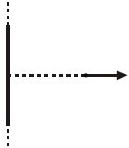

Download our appand get started for free
Experience the future of education. Simply download our apps or reach out to us for more information. Let's shape the future of learning together!No signup needed.*
Similar Questions
- 1View SolutionPolar molecules are the molecules:
- 2Combination of two identical capacitors, a resistor $R$ and a $DC$ voltage source of voltage $6\; V$ is used in an experiment on $C-R$ circuit. It is found that for a parallel combination of the capacitor the time in which the voltage of the fully charged combination reduces to half its original voltage is $10\; s$. For series combination the time needed for reducing the voltage of the fully charged series combination by half isView Solution
- 3Four identical thin, square metal sheets, $S_1, S_2, S_3$, and $S_4$, each of side $a$ are kept parallel to each other with equal distance $d( < < a)$ between them, as shown in the figure. Let $C_0=\varepsilon_0 a^2 / d$, where $\varepsilon_0$ is the permittivity of free space.View Solution
Match the quantities mentioned in $List-I$ with their values in $List-II$ and choose the correct option.
$List-I$ $List-II$ ($P$) The capacitance between $S_1$ and $S_4$, with $S_2$ and $S_3$ not connected, is ($1$) $3 C_0$ ($Q$) The capacitance between $S_1$ and $S_4$, with $S_2$ shorted to $S_3$, is ($2$) $C_0 / 2$ ($R$) The capacitance between $S_1$ and $S_3$, with $S_2$ shorted to $S_4$, is ($3$) $C_0 / 3$ ($S$) The capacitance between $S_1$ and $S_2$, with $S_3$ shorted to $S_1$, and $S_2$ shorted to $S_4$, is ($4$) $2 C_0 / 3$ ($5$) $2 C_0$ 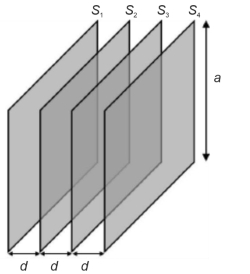
- 4A potential difference of $300\, volts$ is applied to a combination of $2.0\,\mu F$ and $8.0\,\mu F$ capacitors connected in series. The charge on the $2.0\,\mu F$ capacitor isView Solution
- 5A cube of side $b$ has a charge $q$ at each of its vertices. Determine the potential and electric field due to this charge array at the centre of the cube.View Solution
- 6Find the equivalent capacitance between $A$ and $B$View Solution
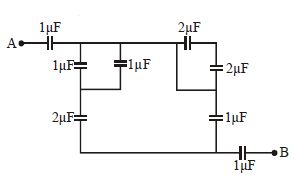
- 7The equivalent capacitance between the points $A$ and $B$ in the given diagram isView Solution
- 8View SolutionThe potential at a point due to an electric dipole will be maximum and minimum when the angles between the axis of the dipole and the line joining the point to the dipole are respectively
- 9Three capacitors of $2.0,\;3.0$ and $6.0\;\mu F$ are connected in series to a $10\,V$ source. The charge on the $3.0\,\mu F$ capacitor is........$\mu C$View Solution
- 10A parallel plate capacitor is made of two square parallel plates of area $A$ , and separated by a distance $d < < \sqrt A $ . The capacitor is connected to a battery with potential $V$ and allowed to fully charge. The battery is then disconnected. A square metal conducting slab also with area $A$ but thickness $\frac {d}{2}$ is then fully inserted between the plates, so that it is always parallel to the plates. How much work has been done on the metal slab by external agent while it is being inserted?View Solution