MCQ
In a standing wave, all particles of the medium cross the mean position with
  • A
    Different speeds at different instants
  • Different speeds at same instant
  • C
    Same speed at different instants
  • D
    Same speed at same instant

Answer

Correct option: B.
Different speeds at same instant
b
(b)

In a standing waves all particles of same wave have same $v$ and hence vibrate in phase passing the mean point at same time. The amplitude of the waves is different at different points hence the speed is different.

Need a full question paper?

Generate a complete, print-ready paper with questions like this in minutes — across 16+ boards, with answer keys.
Start Generating Free

Similar questions

At a common temperature, a block of wood and a block of metal feel equally cold or hot. The temperatures of block of wood and block of metal are
$A$ and $B$ start walking towards each other from the opposite ends of a $15\ km$ long straight road, at a speed of $5\ km/ hr$ and $7\ km/ hr$ respectively. How far apart will they be after one hour?
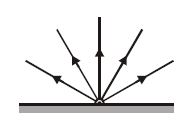
On a windless day, sound emanate isotropically from a point source. Rays of the sound waves emanated from a point source placed close to ground are shown in the figure. Consider horizontal wind towards the left blowing with constant velocity, which is uniform everywhere. In the following figures, rays of sound waves in presence of the wind are shown. Which one is the most correct representation?
A body of mass $2\, {kg}$ moving with a speed of $4\, {m} / {s}$. makes an elastic collision with another body at rest and continues to move in the original direction but with one fourth of its initial speed. The speed of the two body centre of mass is $\frac{x}{10} \,{m} / {s}$. Then the value of $x$ is ..... .
If the gravitational field in the space is given as $\left(-\frac{ K }{ r ^2}\right)$. Taking the reference point to be at $r =2\,cm$ with gravitational potential $V =10\,J / kg$. Find the gravitational potential at $r =3\,cm$ in $SI$ unit (Given, that $K =6\,J cm / kg$ )
If displacement $x$ and velocity $v$ are related as $4v^2 = 16\, -\, x^2$ in a $SHM$ . Then time period of given $SHM$ is (consider $SI\,units$ )
A car of mass $1000 kg$ accelerates uniformly from rest to a velocity of $54 km/hour $ in $ 5s$. The average power of the engine during this period in watts is .............. $W$ (neglect friction)
The distance of the eye-lens from the retina is x. For a normal eye, the maximum focal length of the eye-lens:
Velocity of transverse wave in stretched string doesn't depend on:
Two satellites $A$ and $B$ of masses $200\, kg$ and $400\, kg$ are revolving round the earth at height of $600\, km$ and $1600\, km$ respectively. If $T _{ A }$ and $T _{ B }$ are the time periods of $A$ and $B$ respectively then the value of $T _{ B }- T _{ A }$

[Given : radius of earth $=6400\, km$, mass of earth $=6 \times 10^{24}\, kg$ ]