MCQ
 In a standing wave on a string rigidly fixed at both ends
  • A
    all the particles must be at their positive extremes simultaneously once in half of the time period.
  • B
    all the particles must be at their positive extremes simultaneously once in a time period.
  • in one time period all the particles are simultaneously at rest twice.
  • D
    all the particle are never at rest simultaneously
Answer

Correct option: C.
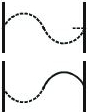
in one time period all the particles are simultaneously at rest twice.
c
In stationary wave pattern, the particles reaches their extreme position twice in one line period.

Need a full question paper?

Generate a complete, print-ready paper with questions like this in minutes — across 16+ boards, with answer keys.

Start Generating Free

Similar questions

The frequency order for $\gamma -$ rays $(a)$, $X-$ rays $(b)$ and $UV-$ rays $(c)$ is given as
Assertion : If a body is thrown upwards, the distance covered by it in the last second of upward motion is about $5 m$ irrespective of its initial speed
Reason : The distance covered in the last second of upward motion is equal to that covered in the first second of downward motion when the particle is dropped.
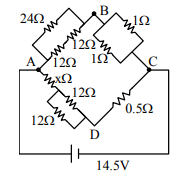
The value of unknown resistance $(x)$ for which the potential difference between $B$ and $D$ will be zero in the arrangement shown, is :
Image
A thin horizontal circular disc is rotating about a vertical axis passing through its centre. An insect is at rest at a point near the rim of the d isc. The insect now moves along a diameter of the disc to reach its other end . During the journey of the insect, the angular speed of the disc.
Two short bar magnets oflength $1\ cm$ each have magnetic moments $1.20\ Am^2$ and $1.00\ Am^2$ respectively. They are placed on a horizontal table parallel to each other with their $N$ poles pointing towards the South. They have a common magnetic equator and are separated by a distance of $20.0\ cm$. The value of the resultand horizontal magnetic induction at the mid-point $O$ of the line joining their centres is close to  (Horizontal component of earth.s magnetic induction is $3.6 \times  10^{-5}$ $Wbm^{-2}$  )
A cylindrical bar magnet is kept along the axis of a circular coil. If the magnet is rotated about its axis, then
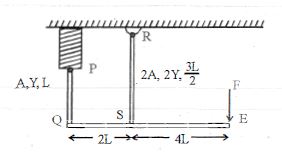
A rigid massless rod of length $6\ L$ is suspended horizontally by means of two elasticrods $PQ$ and $RS$ as given figure. Their area of cross section, young's modulus and lengths are mentioned in figure. Find deflection of end $S$ in equilibrium state. Free end of rigid rod is pushed down by a constant force . $A$ is area of cross section, $Y$ is young's modulus of elasticity
Kepler's second law regarding constancy of aerial velocity of a planet is a consequence of the law of conservation of
A small sphere of mass $m$ is dropped from a great height. After it has fallen $100\; m$ , it has attained its terminal velocity and continues to fall at that speed. The work done by air friction against the sphere during the first $ 100 \;m $ of fall is
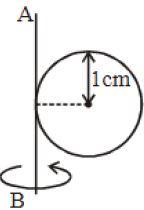
$5\,g$ and radius $1\,cm$ is fixed to a thin stick $AB$ of negligible mass as shown in the figure. The system is initially at rest. The constant torque, that will make the system rotate about $AB$ at $25$ rotations per second is $5\,s$ is close to