MCQ
The frequency order for $\gamma -$ rays $(a)$, $X-$ rays $(b)$ and $UV-$ rays $(c)$ is given as
  • A
    $b > a > c$
  • $a > b > c$
  • C
    $c > b > a$
  • D
    $a > c > b$

Answer

Correct option: B.
$a > b > c$
b

Need a full question paper?

Generate a complete, print-ready paper with questions like this in minutes — across 16+ boards, with answer keys.
Start Generating Free

Similar questions

The wavelength of the first spectral line in the Balmer series of hydrogen atom is $6561 \mathring A$. The wavelength of the second spectral line in the Balmer series of singly-ionized helium atom is
A ball is rolled off the edge of a horizontal table at a speed of $4\, m/second$. It hits the ground after $0.4\, second$. Which statement given below is true
The average kinetic energy of a helium atom at ${30^o}C$ is
Check up the only correct statement in the following :-
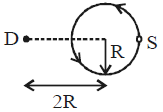
A whistle $S$ of frequency $f$ revolves in a circle of radius $R$ at a constant speed $v$. What is the ratio of largest and smallest frequency detected by a detector $D$ at rest at a distance $2R$ from the centre of circle as shown in figure ? (take $c$ as speed of sound)
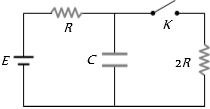
In the circuit, shown in fig. $‘K’$ is open. The charge on capacitor $C$ in steady state is $q_1$. Now key is closed and at steady state, the charge on $C$ is $q_2$. The ratio of charges $\left( {\frac{{{q_1}}}{{{q_2}}}} \right)$ is
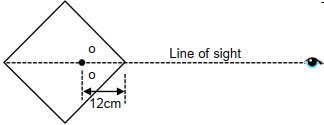
A large square container with thin transparent vertical walls and filled with water (refractive index $\frac{4}{3}$ ) is kept on a horizontal table. A student holds a thin straight wire vertically inside the water $12 cm$ from one of its corners, as shown schematically in the figure. Looking at the wire from this corner, another student sees two images of the wire, located symmetrically on each side of the line of sight as shown. The separation (in $cm$ ) between these images is . . . . . 
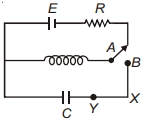
Switch is in position $A$ for long time. At time $t=0$ it is shifted to position $B$. Find the maximum charge that will accumulate on capacitor
A radioactive sample $\mathrm{S} 1$ having an activity $5 \mu \mathrm{Ci}$ has twice the number of nuclei as another sample $\mathrm{S} 2$ which has an activity of $10 \mu \mathrm{Ci}$. The half lives of $\mathrm{S} 1$ and $\mathrm{S} 2$ can be
Two waves of amplitudes $A_0$ and $x A_0$ pass through a region. If $x > j _0$ the difference in the maximum and minimum resultant amplitude possible is