MCQ
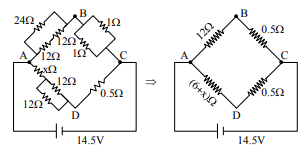
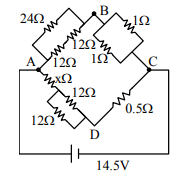
The value of unknown resistance $(x)$ for which the potential difference between $B$ and $D$ will be zero in the arrangement shown, is :
Image
  • A
    $3 \Omega$
  • B
    $9 \Omega$
  • C
    $6 \Omega$
  • D
    $42 \Omega$

Answer

Image
In case of balanced Wheatstone Bridge
$\frac{V_{A B}}{V_{A D}}=\frac{V_{B C}}{V_{C D}} $
$\Rightarrow \frac{12}{6+x}=\frac{0.5}{0.5}$
$x=6 \Omega$

Need a full question paper?

Generate a complete, print-ready paper with questions like this in minutes — across 16+ boards, with answer keys.
Start Generating Free

Similar questions

An electron has a mass of $9.1 \times {10^{ - 31}}kg$. It revolves round the nucleus in a circular orbit of radius $0.529 \times {10^{ - 10}}metre$ at a speed of $2.2 \times {10^6}m/s$. The magnitude of its linear momentum in this motion is
Inside a hollow charged spherical conductor, the potential
When radiation of wavelength $\lambda $ is incident on a metallic surface, the stopping potential is $4.8$ volts. If the same surface is illuminated with radiation of double the wavelength, then the stopping potential becomes $1.6$ volts. Then the threshold wavelength for the surface is
A metallic ball and highly stretched spring are made of the same material and have the same mass. They are heated so that they melt, the latent heat required
To an ideal triatomic gas $800 \,cal$ heat energy is given at constant pressure. If vibrational mode is neglected, then energy used by gas in work done against surroundings is ......... $cal$
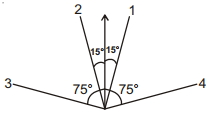
If declination at a place is known to be $15^{\circ} \,E$. And a compass needle points as shown, then geographic north is represented by the direction numbered.
A conductor in the form of a right angle $ABC$ with $AB = 3\, cm$ and $BC = 4\, cm$ carries a current of $10\, A$. There is a uniform magnetic field of $5\, T$ perpendicular to the plane of the conductor. The force on the conductor will be......$N$
A strong magnetic field is applied on a stationary electron, then
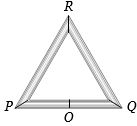
Three rods of equal length $l$ are joined to form an equilateral triangle $PQR.$ $O$ is the mid point of $PQ.$ Distance $OR$ remains same for small change in temperature. Coefficient of linear expansion for $PR$ and $RQ$ is same i.e. ${\alpha _2}$ but that for $PQ$ is ${\alpha _1}$. Then relation between ${\alpha _1}$ and ${\alpha _2}$ is
Given below are two statements:

Statement$- I$ : Susceptibilities of paramagnetic and ferromagnetic substances increase with decrease in temperature.

Statement$- II$: Diamagnetism is a result of orbital motions of electrons developing magnetic moments opposite to the applied magnetic field. Choose the $CORRECT$ answer from the options given below : -