MCQ
In a stationary wave, all particles are
  • At rest at the same time twice in every period of oscillation
  • B
    At rest at the same time only once in every period of oscillation
  • C
    Never at rest at the same time
  • D
    Never at rest at all

Answer

Correct option: A.
At rest at the same time twice in every period of oscillation
(a)

Need a full question paper?

Generate a complete, print-ready paper with questions like this in minutes — across 16+ boards, with answer keys.
Start Generating Free

Similar questions

The resistance of a wire of iron is 10 ohms and temp. coefficient of resistivity is $5 \times 10^{-3} /{ }^{\circ} \mathrm{C}$. At $21 \mathrm{x}$ it carries 30 milliamperes of current. Keeping constant potential difference between its ends, the temperature of the wire is raised to $120^{\circ} \mathrm{C}$. The current in milliamperes that flows in the wire is
de-Broglie wavelength of a body of mass $1 \mathrm{~kg}$ moving with velocity of $2000 \mathrm{~m} / \mathrm{s}$ is
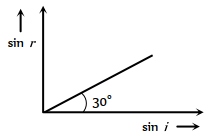
When light is incident on a medium at angle $i$ and refracted into a second medium at an angle $r$, the graph of $\sin i v s \sin r$ is as shown in the graph. From this, one can conclude that

Image

If $|\vec{A}-\vec{B}|=|\vec{A}|=|\vec{B}|$, the angle between $\vec{A}$ and $\vec{B}$ is
If the door of a refrigerator is kept open, then which of the following is true
In an electrolysis experiment, a current $i$ passes through two different cells in series, one containing a solution of $CuSO _4$ and the other a solution of $AgNO _3$. The rate of increase of the weight of the cathodes in the two cells will be
Consider an NPN transistor amplifier in common-emitter configuration. The current gain of the transistor is $100.$ If the collector current changes by $1\ mA$, what will be the change in emitter current
In which of the following systems of unit, Weber is the unit of magnetic flux
Polarising angle for water is $53^{\circ} 4^{\prime}$. If light is incident at this angle on the surface of water and reflected, the angle of refraction is
The de-Broglie wavelength $\lambda$