MCQ
In a transistor the collector current is always less than the emitter current because
  • A
    Collector side is reverse biased and the emitter side is forward biased
  • A few charge carriers are lost in the base and only remaining ones reach the collector
  • C
    Collector being reverse biased, attracts less electrons
  • D
    Collector side is forward biased and emitter side is reverse biased
Answer

Correct option: B.
A few charge carriers are lost in the base and only remaining ones reach the collector
b
$I_E = I_B + I_C$

Need a full question paper?

Generate a complete, print-ready paper with questions like this in minutes — across 16+ boards, with answer keys.

Start Generating Free

Similar questions

The coil of choke in a circuit
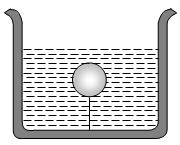
A solid sphere of density $\eta$ $( > 1)$  times lighter than water is suspended in a water tank by a string tied to its base as shown in fig. If the mass of the sphere is m then the tension in the string is given by
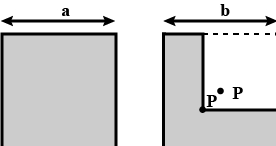
A uniform square wooden sheet of side $a$ has its centre of mass located at point $O$ as shown in the figure below on the left. A square portion of side $b$ of this sheet is cut out to produce an $L$-shaped sheet as shown in the figure on the right.The centre of mass of the L-shaped sheet lies at the point $P$ (in the above diagram), when
A stream-lined body falls through air from a height $h$ on the surface of liquid. Let $d$ and $D$ denote the densities of the materials of the body and the liquid respectively. If  $D > d$, then the time after which the body will be instantaneously at rest, is
An astronomical telescope has a large aperture to
If an interference pattern have maximum and minimum intensities in $36 : 1$ ratio then what will be the ratio of amplitudes
The unit of focal power of a lens is
A beam of electromagnetic radiation of intensity $6.4 \times 10^{-5}\; \mathrm{W} / \mathrm{cm}^{2}$ is comprised of wavelength, $\lambda=310 \;\mathrm{nm} .$ It falls normally on a metal (work function $\varphi=2 \;\mathrm{eV}$ ) of surface area of $1\; \mathrm{cm}^{2} .$ If one in $10^{3}$ photons ejects an electron, total number of electrons ejected in $1 \;s$ is $10^{\mathrm{x}}$.then $\mathrm{x}$ is

$\left(\mathrm{hc}=1240\; \mathrm{eV} \mathrm{nm}, 1\; \mathrm{eV}=1.6 \times 10^{-19} \;\mathrm{J}\right)$

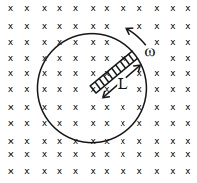
A metallic rod of length ' $L$ ' is rotated with an angular speed of ' $\omega$ ' normal to a uniform magnetic field ' $B$ ' about an axis passing through one end of rod as shown in figure. The induced emf will be :
In a plane $EM$ wave, the electric field oscillates sinusoidally at a frequency of $5 \times 10^{10} \mathrm{~Hz}$ and an amplitude of $50 \mathrm{Vm}^{-1}$. The total average energy density of the electromagnetic field of the wave is :

[Use $\varepsilon_0=8.85 \times 10^{-12} \mathrm{C}^2 / \mathrm{Nm}^2$ ]