MCQ
If an interference pattern have maximum and minimum intensities in $36 : 1$ ratio then what will be the ratio of amplitudes
  • A
    $5:7$
  • B
    $7:4$
  • C
    $4:7$
  • $7:5$

Answer

Correct option: D.
$7:5$
d
(d)$\frac{{{I_{\max }}}}{{{I_{\min }}}} = {\left( {\frac{{\frac{{{a_1}}}{{{a_2}}} + 1}}{{\frac{{{a_1}}}{{{a_2}}} - 1}}} \right)^2} \Rightarrow \frac{{{a_1} + {a_2}}}{{{a_1} - {a_2}}} = 6$
$\frac{{{a_2}}}{{{a_1}}} = 7:5$

Need a full question paper?

Generate a complete, print-ready paper with questions like this in minutes — across 16+ boards, with answer keys.
Start Generating Free

Similar questions

A radioactive material has a half life of $10$ days. What fraction of the material would remain after $30$ days
A $120\, m$ long train is moving in a direction with speed $20 \,m/s$. $A$ train $B$ moving with $30\, m/s$ in the opposite direction and $130\, m$ long crosses the first train in a time
A block of mass $m$ is lying on an inclined plane. The coefficient of friction between the  plane and the block is $\mu$. The force $(F_1)$ required to move the block up the  inclined plane will be
If $x \propto {t^{5/2}}$ , then
If the linear momentum is increased by $5\%$, the kinetic energy will increase by $.....\%$
A diver at a depth of $12m$ in water ($\mu = 4/3)$ sees the sky in a cone of semi-vertical angle
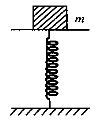
A mass of $2.0\, kg$ is put on a flat pan attached to a vertical spring fixed on the ground as shown in the figure. The mass of the spring and the pan is negligible.  When pressed slightly and released the mass executes a simple harmonic motion. The spring constant is $200\, N/m.$ What should be the minimum amplitude of the motion so that the mass gets detached from the pan (take $g = 10 m/s^2$). 
A light ray falls on a glass surface of refractive index $\sqrt{3}$, at an angle $60^{\circ}$. The angle between the refracted and reflected rays would be ....... $^o$
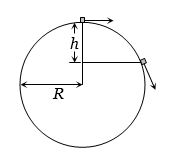
A particle originally at rest at the highest point of a smooth vertical circle is slightly displaced. It will leave the circle at a vertical distance $h$ below the highest point such that
An electron beam passes through a magnetic field of $2 \times 10^{-3}\,Wb/m^2$ and an electric field of $1.0 \times 10^4\,V/m$ both acting simultaneously. The path of electron remains undeviated. The speed of electron if the electric field is removed, and the radius of electron path will be respectively