Question
In a Young's double slit interference experiment the fringe pattern is observed on a screen placed at a distance D from the slits. The slits are separated by a distance d and are illuminated by monochromatic light of wavelength $\lambda$. Find the distance from the central point where the intensity falls to,
  1. Half the maximum.
  2. One fourth of the maximum.

Answer

  1. When intensity is half the maximum $\frac{\text{I}}{\text{I}_\text{max}}=\frac{1}{2}$
$\Rightarrow\frac{4\text{a}^2\cos^2\big(\frac{\phi}{2}\big)}{4\text{a}^2}=\frac{1}{2}$

$\Rightarrow\cos^2\Big(\frac{\phi}{2}\Big)=\frac{1}{2}\Rightarrow\cos\Big(\frac{\phi}{2}\Big)=\frac{1}{\sqrt{2}}$

$\Rightarrow\frac{\phi}{2}=\frac{\pi}{4}\Rightarrow\phi=\frac{\pi}{2}$

$\Rightarrow$ Path difference, $\text{x}=\frac{\lambda}{4}$

$\Rightarrow\text{y}=\frac{\text{xD}}{\text{d}}=\frac{\lambda\text{D}}{4\text{d}}$
  1. When intensity is $\frac{1}{4}\text{th}$ of the maximum $\frac{\text{I}}{\text{I}_\text{max}}=\frac{1}{4}$
$\Rightarrow\frac{4\text{a}^2\cos^2\Big(\frac{\phi}{2}\Big)}{4\text{a}^2}=\frac{1}{4}$

$\Rightarrow\cos^2\Big(\frac{\phi}{2}\Big)=\frac{1}{4}\Rightarrow\cos\Big(\frac{\phi}{2}\Big)=\frac{1}{2}$

$\Rightarrow\frac{\phi}{2}=\frac{\pi}{3}\Rightarrow\phi=\frac{2\pi}{3}$

$\Rightarrow$ Path difference, $\text{x}=\frac{\lambda}{3}$

$\Rightarrow\text{y}=\frac{\text{xD}}{\text{d}}=\frac{\lambda\text{D}}{3\text{d}}$

Need a full question paper?

Generate a complete, print-ready paper with questions like this in minutes — across 16+ boards, with answer keys.

Start Generating Free

Similar questions

  1. What is the largest average velocity of blood flow in an artery of radius $2×10 – 3m$ if the flow must remain lanimar?
  2. What is the corresponding flow rate ? (Take viscosity of blood to be $2.084 × 10⁻³ Pa/ s$).
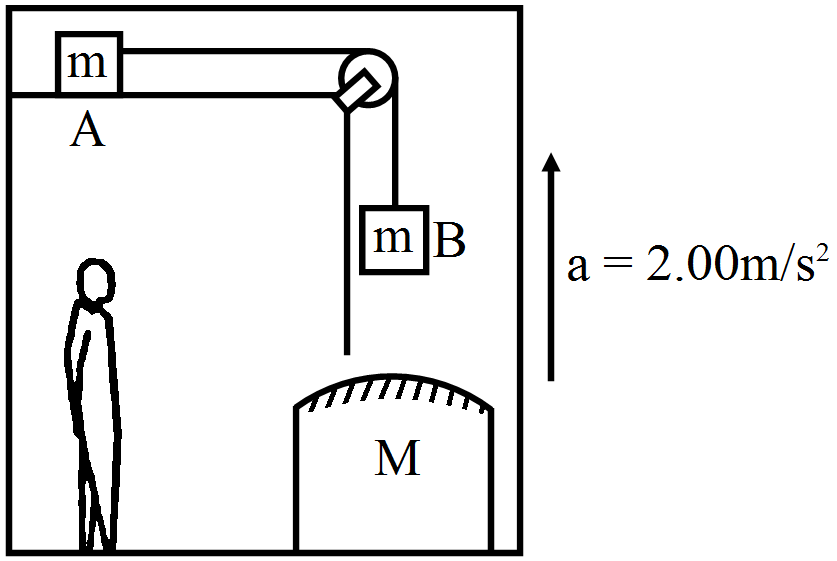
Consider the situation shown in figure. The elevator is going up with an acceleration of $2.00m/s^2$ and the focal length of the mirror is 12.0cm. All the surfaces are smooth and the pulley is light. The mass-pulley system is released from rest (with respect to the elevator) at t = 0 when the distance of B from the mirror is $42.0cm$. Find the distance between the image of the block B and the mirror at $t = 0.200s$. Take $g = 10m/s^2$.
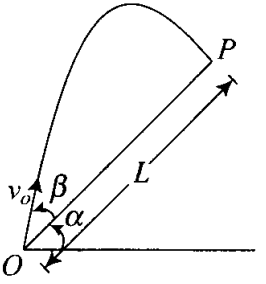
A particle is projected in air at an angle $\beta$ to a surface which itself is inclined at an angle $\alpha$ to the horizontal (Fig.).
  1. Time of flight.
(Hint: This problem can be solved in two different ways:
  1. Point P at which particle hits the plane can be seen as intersection of its trajectory (parobola) and straight line. Remember particle is projected at an angle $(\alpha+\beta)$ w.r.t. horizontal.
  2. We can take x-direction along the plane and y-direction perpendicular to the plane. In that case resolve g (acceleration due to gravity) in two differrent components, $g_x$ along the plane and $g_y$ perpendicular to the plane. Now the problem can be solved as two independent motions in x and y directions respectively with time as a common parameter.)
In a series RC circuit with an AC source, $\text{R}=300\Omega,\text{C}=25\mu\text{F},\in_0=50\text{V}$ and $\nu=\frac{50}{\pi}\text{Hz}.$ Find the peak current and the average power dissipated in the circuit.
For the wave on a string described in Exercise 15.11, do all the points on the string oscillate with the same,
  1. Frequency,
  2. Phase,
  3. Amplitude?
A projectile, launched with a speed v at an angle $\theta$ to the horizontal, hits a plane inclined at an angle a to the horizontal $(\alpha<\theta)$ and passing through the point of launching. Obtain an expression for the range r of the projectile on this inclined plane. When does the projectile hit this plane?
An incident wave and a reflected wave are represented by
$\xi_1=\text{a}\sin\frac{2\pi}{\lambda}(\nu\text{t}-\text{x})$
$\xi_2=\text{a}\sin\frac{2\pi}{\lambda}(\nu\text{t}+\text{x})$
Derive the equation of the stationary wave, and calculate the position of the nodes and antinodes.
Define the work done by a constant force on an object and describe their specific situations.
The cylindrical tube of a spray pump has a cross-section of $8.0cm^2$ one end of which has $40$ fine holes each of diameter $1.0mm$. If the liquid flow inside the tube is $1.5m\ min^{–1}$​​​​​​​, what is the speed of ejection of the liquid through the holes?
A steel wire of cross-sectional area $0.5 \mathrm{~mm}^2$ is held between two fixed supports. If the tension in the wire is negligible and it is just taut at a temperature of $20^{\circ} \mathrm{C}$, determine the tension when the temperature falls to $0^{\circ} \mathrm{C}$. Young's modulus of steel is $21 \times 10^{11}$ dyne $\mathrm{cm}^{-2}$ and the coefficient of linear expansion of steel is $12 \times 10^{-6}$ per ${ }^{\circ} \mathrm{C}$. Assume that the distance between the supports remains unchanged.