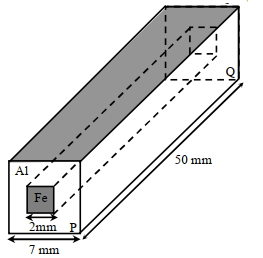
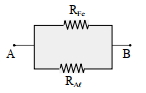
In an aluminium $(A1)$ bar of square cross section, a square hole is drilled and is filled with iron ( $Fe$ ) as shown in the figure. The electrical resistivities of $A 1$ and $Fe$ are $2.7 \times 10^{-8} \ \Omega m$ and $1.0 \times 10^{-7} \ \Omega m$, respectively. The electrical resistance between the two faces $P$ and $Q$ of the composite bar is
IIT 2015, Advanced


Download our appand get started for free
Experience the future of education. Simply download our apps or reach out to us for more information. Let's shape the future of learning together!No signup needed.*
Similar Questions
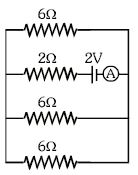
- 1The ammeter reading in the following circuit will be .............. $A$View Solution
- 2Every atom makes one free electron in copper. If $1.1$ $ampere$ current is flowing in the wire of copper having $1\, mm$ diameter, then the drift velocity (approx.) will be (Density of copper $ = 9 \times {10^3}\,kg\,{m^{ - 3}}$ and atomic weight = $63$)View Solution
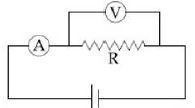
- 3The actual value of resistance $R$, shown in the figure is $30\,\Omega $. This is measured in an experiment as shown using the standard formula $R = \frac{V}{I}$ where $V$ and $I$ are the readings of the voltmeter and ammeter, respectively. If the measured value of $R$ is $5\%$ less, then the internal resistance of the voltmeter is ................. $\Omega$View Solution
- 4A $500\, W$ heating unit is designed to operate from a $115\, volt$ line. If the line voltage drops to $110\, volt$, the percentage drop in heat output will be ............... $\%$View Solution
- 5A metallic block has no potential difference applied across it, then the mean velocity of free electrons is $T$ = absolute temperature of the block)View Solution
- 6A cylindrical conductor has uniform cross-section. Resistivity of its material increase linearly from left end to right end. If a constant current is flowing through it and at a section distance $x$ from left end, magnitude of electric field intensity is $E$, which of the following graphs is correctView Solution
- 7In a meter bridge experiment null point is obtained at $40\, cm$ from one end of the wire when resistance $X$ is balanced against another resistance $Y$. If $X < Y$, then the new position of the null point from the same end, if one decides to balance a resistance of $3X$ against $Y$, will be close to .............. $cm$View Solution
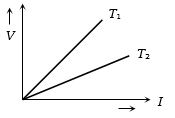
- 8The voltage $V$ and current $I$ graph for a conductor at two different temperatures ${T_1}$ and ${T_2}$ are shown in the figure. The relation between ${T_1}$ and ${T_2}$ isView Solution
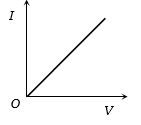
- 9$I-V$ characteristic of a copper wire of length $L$ and area of cross-section $A$ is shown in figure. The slope of the curve becomesView Solution
- 10If six identical cells each having an $e.m.f.$ of $6\,V$ are connected in parallel, the $e.m.f.$ of the combination is ................ $V$View Solution