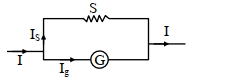
In an ammeter, $5 \%$ of the main current passes through the galvanometer. If resistance of the galvanometer is G, the resistance of ammeter will be :
JEE MAIN 2024, Diffcult


Download our appand get started for free
Experience the future of education. Simply download our apps or reach out to us for more information. Let's shape the future of learning together!No signup needed.*
Similar Questions
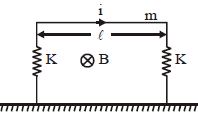
- 1A horizontal metallic rod of mass $'m'$ and length $'l'$ is supported by two vertical identical springs of spring of spring constant $'K'$ each and natural length $l_0.$ A current $'i'$ is flowing in the rod in the direction shown. If the rod is in equilibrium then the length of each spring in this state is :-View Solution
- 2A closely wound solenoid $80\; cm$ long has $5$ layers of windings of $400$ turns each. The diameter of the solenoid is $1.8\; cm$. If the current carried is $8.0\; A$, estimate the magnitude of $B$ inside the solenoid near its centre.View Solution
- 3A uniform magnetic field of $2 \times 10^{-3} \mathrm{~T}$ acts along positive $\mathrm{Y}$-direction. A rectangular loop of sides $20$ $\mathrm{cm}$ and $10 \mathrm{~cm}$ with current of $5 \mathrm{~A}$ is $\mathrm{Y}-\mathrm{Z}$ plane. The current is in anticlockwise sense with reference to negative $\mathrm{X}$ axis. Magnitude and direction of the torque is :View Solution
- 4A long straight wire of radius $a$ carries a steady current $I.$ The current is uniformly distributed over its cross-section. The ratio of the magnetic fields $B$ and $B',$ at radial distances $\frac{a}{2}$ and $2a$ respectively, from the axis of the wire isView Solution
- 5An electron, moving in a uniform magnetic field of induction of intensity $\vec B,$ has its radius directly proportional toView Solution
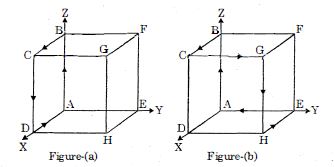
- 6Current $I$ is flowing along the path $ABCDA$ consisting of four edges of a cube (figure $-a$), produces a magnetic field $B_0$ at the centre of the cube. Find the magnetic field $B$ produced at the center of the cube by a current $I$ flowing along the path of the six edges $ABCGHEA$ (figure $b$)View Solution
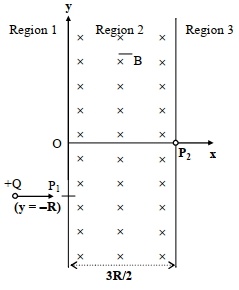
- 7A uniform magnetic field $B$ exists in the region between $x=0$ and $x=\frac{3 R}{2}$ (region $2$ in the figure) pointing normally into the plane of the paper. A particle with charge $+Q$ and momentum $p$ directed along $x$-axis enters region $2$ from region $1$ at point $P_1(y=-R)$. Which of the following option(s) is/are correct?View Solution
$[A$ For $B>\frac{2}{3} \frac{p}{QR}$, the particle will re-enter region $1$
$[B]$ For $B=\frac{8}{13} \frac{\mathrm{p}}{QR}$, the particle will enter region $3$ through the point $P_2$ on $\mathrm{x}$-axis
$[C]$ When the particle re-enters region 1 through the longest possible path in region $2$ , the magnitude of the change in its linear momentum between point $P_1$ and the farthest point from $y$-axis is $p / \sqrt{2}$
$[D]$ For a fixed $B$, particles of same charge $Q$ and same velocity $v$, the distance between the point $P_1$ and the point of re-entry into region $1$ is inversely proportional to the mass of the particle
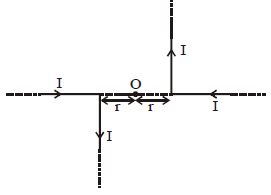
- 8Two infinite wires bent in the form of $L$ shape carries current $I$ as shown. What is magnetic field at $O$ ?View Solution
- 9Two thin, long, parallel wires, separated by a distance ‘$d$’ carry a current of ‘$i$’ in the same direction. They willView Solution
- 10View SolutionWhich particles will have minimum frequency of revolution when projected with the same velocity perpendicular to a magnetic field