For a wire $\frac{R}{l}=\frac{1}{2}$ and length of wire is $l=5\, cm .$ If potential difference $1\, V$ is applied across it, current through wire will be: $( R =$ Resistance $)$ (in $A$)
AIIMS 2019, Medium


Download our appand get started for free
Experience the future of education. Simply download our apps or reach out to us for more information. Let's shape the future of learning together!No signup needed.*
Similar Questions
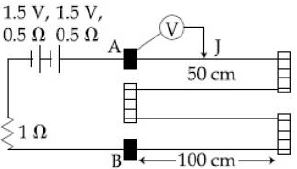
- 1In the circuit shown, a four wire potentiometer is made of a $400\, cm$ long wire, which extends between $A$ and $B$. The resistance per unit length of the potentiometer wire is $r = 0.01\, \Omega /cm$. If an ideal voltmeter is connected as shown with jockey $J$ at $50\, cm$ from end $A$, the expected reading of the voltmeter will be: ............... $V$View Solution
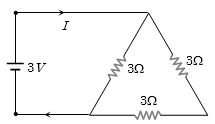
- 2A $3\, volt$ battery with negligible internal resistance is connected in a circuit as shown in the figure. The current $I$, in the circuit will be ............. $A$View Solution
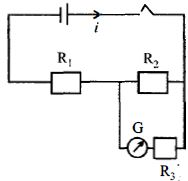
- 3To find the resistance of a galvanometer by the half deflection method the following circuit is used with resistances $R_1 = 9970\,\Omega,$ $R_2 = 30\,\Omega$ and $R_3 = 0\,\Omega.$ The deflection in the galvanometer is $d$. With $R_3 = 107\,\Omega$ the deflection changed to $\frac {d}{2}$The galvanometer resistance is approximately ............... $\Omega$View Solution
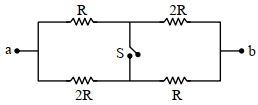
- 4The ratio of the equivalent resistance of the network (shown in figure) between the points $a$ and ${b}$ when switch is open and switch is closed is ${x}: 8 .$ The value of ${x}$ is ..... .View Solution
- 5$A$ current $I$ flows through a uniform wire of diameter $d$ when the mean electron drift velocity is $V$. The same current will flow through a wire of diameter $d/2$ made of the same material if the mean drift velocity of the electron is :View Solution
- 6At room temperature, copper has free electron density of $8.4 \times {10^{28}}$ per ${m^3}$. The copper conductor has a cross-section of $10^{-6} \,m^2$ and carries a current of $5.4\, A$. The electron drift velocity in copper isView Solution
- 7View SolutionTo draw maximum current from a combination of cells, how should the cells be grouped
- 8Three resistances of magnitude $2$, $3$ and $5$ $ohm$ are connected in parallel to a battery of $10\, volts$ and of negligible resistance. The potential difference across $3\,\Omega $ resistance will be ............... $volts$View Solution
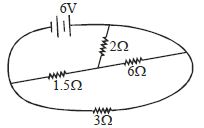
- 9Find the value of current from battery in the circuit ............... $A$View Solution
- 10View SolutionA heater coil is cut into two equal parts and only one part is now used in the heater. The heat generated will now be