Question
In an electromagnetic wave both the electric and magnetic fields are perpendicular to the direction of propagation, that is why electromagnetic waves are transverse in nature. Electromagnetic waves carry energy as they travel through space and this energy is shared equally by the electric and magnetic fields. Energy density of an electromagnetic waves is the energy in unit volume of the space through which the wave travels.
  1. The electromagnetic waves propagated perpendicular to both $\vec{\text{E}}$ and $\vec{\text{B}}.$ The electromagnetic waves travel in the direction of.
  1. $\vec{\text{E}}\times\vec{\text{B}}$
  2. $\vec{\text{E}}\times\vec{\text{B}}$
  3. $\vec{\text{B}}\times\vec{\text{E}}$
  4. $\vec{\text{B}}\times\vec{\text{E}}$
  1. Fundamental particle in an electromagnetic wave is:
  1. Photon
  2. Electron
  3. Phonon
  4. Proton
  1. Electromagnetic waves are transverse in nature is evident by:
  1. Polarisation
  2. Interference
  3. Reflection
  4. Diffraction
  1. For a wave propagating in a medium, identify the property that is independent of the others.
  1. Velocity
  2. Wavelength
  3. Frequency
  4. All these depend on each other.
  1. The electric and magnetic fields of an electromagnetic waves are:
  1. In opposite phase and perpendicular to each other.
  2. In opposite phase and parallel to each other.
  3. In phase and perpendicular to each other.
  4. In phase and parallel to each other.

Answer

  1. (b) $\vec{\text{E}}\times\vec{\text{B}}$

Explanation:

Electromagnetic waves propagate in the direction of $\vec{\text{E}}\times\vec{\text{B}}.$

  1. (a) Photon

Explanation:

Photon is the fundamental particle in an electromagnetic wave.

  1. (a) Polarisation

Explanation:

Polarisation establishes the wave nature of electromagnetic waves.

  1. (c) Frequency

Explanation:

Frequency u remains unchanged when a wave propagates from one medium to another. Both wavelength and velocity get changed.

  1. (c) In phase and perpendicular to each other.

Explanation:

The electric and magnetic fields of an electromagnetic wave are in phase and perpendicular to each other.

Need a full question paper?

Generate a complete, print-ready paper with questions like this in minutes — across 16+ boards, with answer keys.

Start Generating Free

Similar questions

  1. A mobile phone lies along the principal axis of a concave mirror. Show, with the help of a suitable diagram, the formation of its image. Explain why magnification is not uniform.
  2. Suppose the lower half of the concave mirror's reflecting surface is covered with an opaque material. What effect this will have on the image of the object? Explain.
A lady cannot see objects closer than 40cm from the left eye and closer than 100cm from the right eye. While on a mountaineering trip, she is lost from her team. She tries to make an astronomical telscope from her reading glasses to look for her teammates.
  1. Which glass should she use as the eyepiece?
  2. What magnification can she get with relaxed eye?
Derive the formula of electric potential at a point due to electric dipole.
In a microwave oven, the food is kept in a plastic container and the microwave is directed towards the food. The food is cooked without melting or igniting the plastic container. Explain.
A magnetic needle is free to rotate in a vertical plane which makes an angle of 60° with the magnetic meridian. If the needle stays in a direction making an angle of $\tan^{-1}\Big(\frac{2}{\sqrt{3}}\Big)$ with the horizontal, what would be the dip at that place?
Obtain the relation of phase between instantaneous current and voltage with the help of phase diagram for series LCR circuit.
A convex or converging lens is thicker at the centre than at the edges. It converges a parallel beam of light on refraction through it. It has a real focus. Convex lens is of three types: (i) Double convex lens (ii) Plano-convex lens (iii) Concavo-convex lens. Concave lens is thinner at the centre than at the edges. It diverges a parallel beam of light on refraction th rough it. It has a virtual focus.

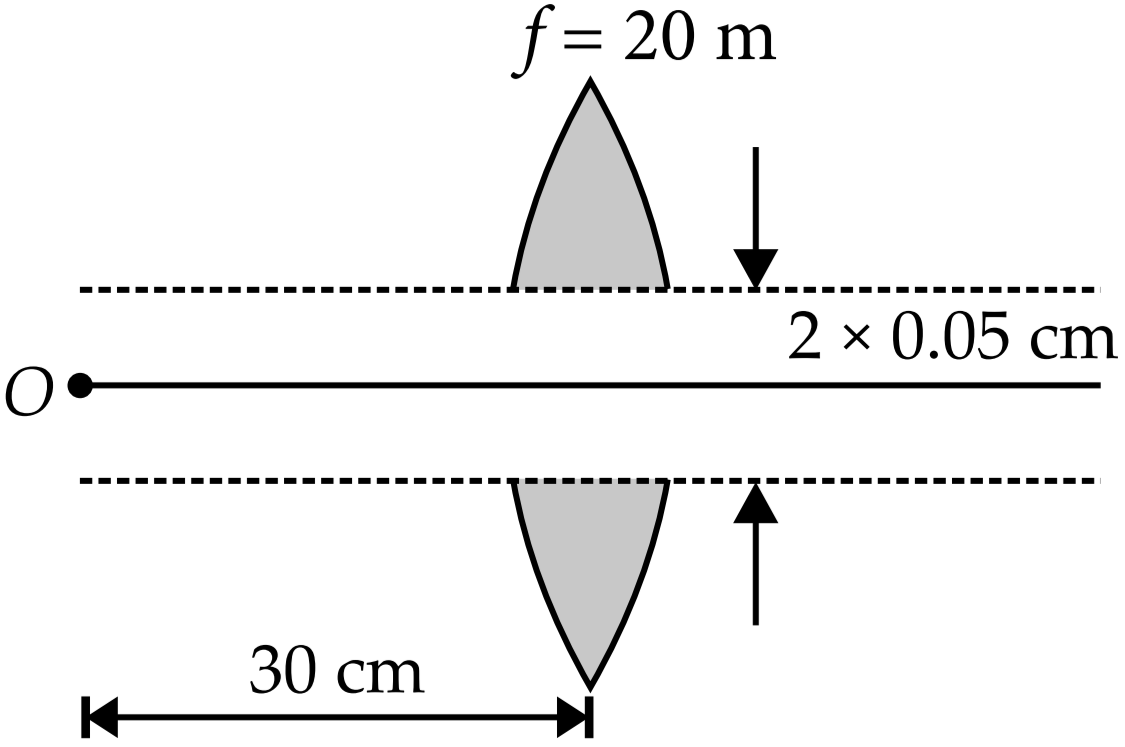
  1. A point object O is placed at a distance of 0.3m from a convex lens (focal length 0.2m) cut into two halves each of which is displaced by 0.0005 mas shown in figure.

What will be the location of the image?

  1. 30cm right of lens.
  2. 60cm right of lens.
  3. 70cm left of lens.
  4. 40cm left of lens.
  1. Two thin lenses are in contact and the focal length of the combination is 80cm. If the focal length of one lens is 20cm, the focal length of the other would be.
  1. 26.7cm
  2. 60cm
  3. 80cm
  4. 20cm
  1. A spherical air bubble is embedded in a piece of glass. For a ray of light passing through the bubble, it behaves tike a.
  1. Converging lens.
  2. Diverging lens.
  3. Piano-converging lens.
  4. Piano-diverging lens.
  1. Lens used in magnifying glass is:
  1. Concave lens.
  2. Convex lens.
  3. Both (a) and (b).
  4. None of the above.
  1. The magnification of an image by a convex lens is positive only when the object is placed.
  1. At its focus F.
  2. Between F and 2F.
  3. At 2F.
  4. Between F and optical centre.
Mention the changes occurring in the geomagnetic components.
A child has near point at 10cm. What is the maximum angular magnification the child can have with a convex lens of focal length 10cm?
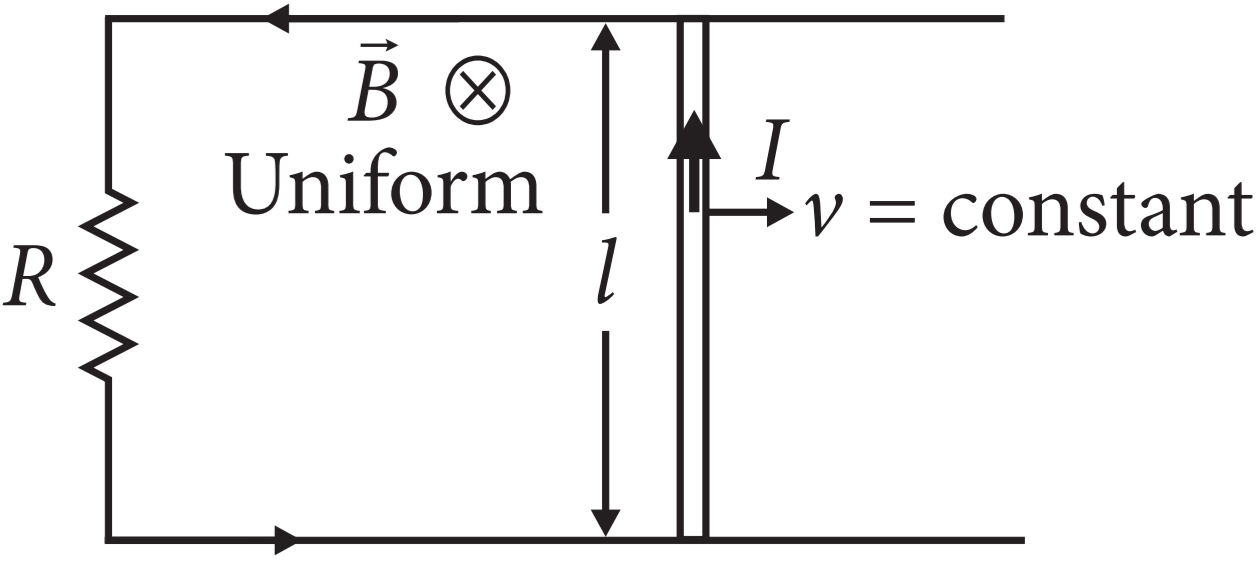
The emf induced across the ends of a conductor due to its motion in a magnetic field is called motional emf. It is produced due to the magnetic Lorentz force acting on the free electrons of the conductor. For a circuit shown in figure, if a conductor of length l moves with velocity v in a magnetic field B perpendicular to both its length and the direction of the magnetic field, then all the induced parametres are possible in the circuit.

  1. Direction of current induced in a wire moving in a magnetic field is found using
  1. Fleming's left hand rule.
  2. Fleming's right hand rule.
  3. Ampere's rule.
  4. Right hand clasp rule.
  1. A conducting rod of length l is moving in a transverse magnetic field of strength B with velocity v. The resistance of the rod is R. The current in the rod is:
  1. $\frac{\text{Blv}}{R}$

  2. $\frac{\text{B}^2\text{v}^2\text{l}^2}{\text{R}}$

  3. Blv
  4. Zero
  1. A 0.1m long conductor carrying a current of SO A is held perpendicular to a magnetic field of 1.25mT. The mechanical power required to move the conductor with a speed of I m s-1 is:
  1. 62.5 mW
  2. 625 mW
  3. 6.25 mW
  4. 12.5 mW
  1.  A bicycle generator creates 1.5 Vat 15km/ hr. The EMF generated at 10km/ hr is:
  1. 1.5 volts
  2. 2 volts
  3. 0.5 volts
  4. 1 volt
  1. The dimensional formula for emf E in MKS system will be:
  1. [ML2T-3A-1]
  2. [ML2T-1A]
  3. [ML2A]
  4. [MLT-3A-1]