Question
A lady cannot see objects closer than 40cm from the left eye and closer than 100cm from the right eye. While on a mountaineering trip, she is lost from her team. She tries to make an astronomical telscope from her reading glasses to look for her teammates.
  1. Which glass should she use as the eyepiece?
  2. What magnification can she get with relaxed eye?

Answer

The lady can not see objects closer than 40cm from the left eye and 100cm from the right eye.

For the left glass lens,

v = -40cm,

u = -25cm 

$\therefore \frac{1}{\text{f}}=\frac{1}{\text{v}}-\frac{1}{\text{u}}=\frac{1}{-40}-\frac{1}{-25}=\frac{1}{25}-\frac{1}{40}=\frac{3}{200}$

$\Rightarrow \text{f}=\frac{200}{3}\text{cm}$

For the right glass lens,

v = -100cm,

u = -25cm

$\frac{1}{\text{f}}=\frac{1}{\text{v}}-\frac{1}{\text{u}}=\frac{1}{-100}-\frac{1}{-25}=\frac{1}{100}=\frac{3}{100}$

$\Rightarrow\text{f}=\frac{100}{3}\text{cm}$

  1. For an astronomical telescope, the eye piece lens should have smaller focal length. So, she should

use the right lens $\big(\text{f}=\frac{100}{3}\text{cm}\big)$ as the eye piece lens.

  1. With relaxed eye, (normal adjustment)

$\text{f}_0=\frac{200}{3}\text{cm}$

$\text{f}_\text{e}=\frac{100}{3}\text{cm}$

magnification $=\text{m}=\frac{\text{f}_0}{\text{f}_\text{e}}=\frac{\big(\frac{200}{3}\big)}{\big( \frac{100}{3}\big)}=2$
Need a full question paper?

Generate a complete, print-ready paper with questions like this in minutes — across 16+ boards, with answer keys.

Start Generating Free

Similar questions

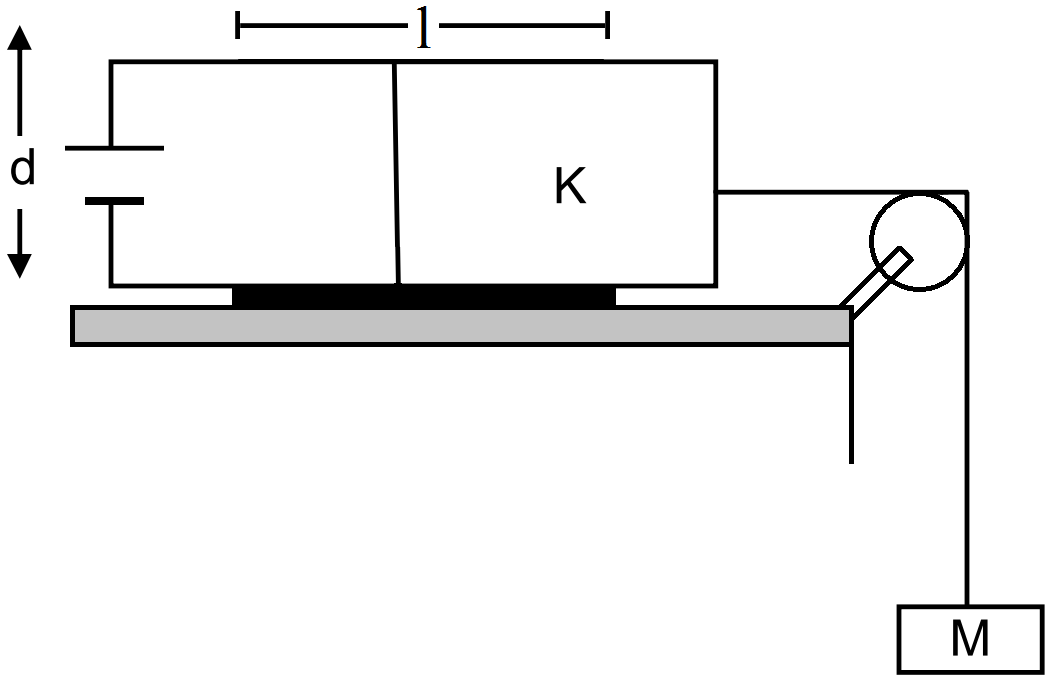
Consider the situation shown in figure. The width of each plate is b. The capacitor plates are rigidly clamped in the laboratory and connected to a battery of emf $\in.$ All surfaces are frictionless. Calculate the value of M for which the dielectric slab will stay in equilibrium.

A slide projector has to project a 35mm slide (35mm × 23mm) on a 2m × 2m screen at a distance of 10m from the lens. What should be the focal length of the lens in the projector?
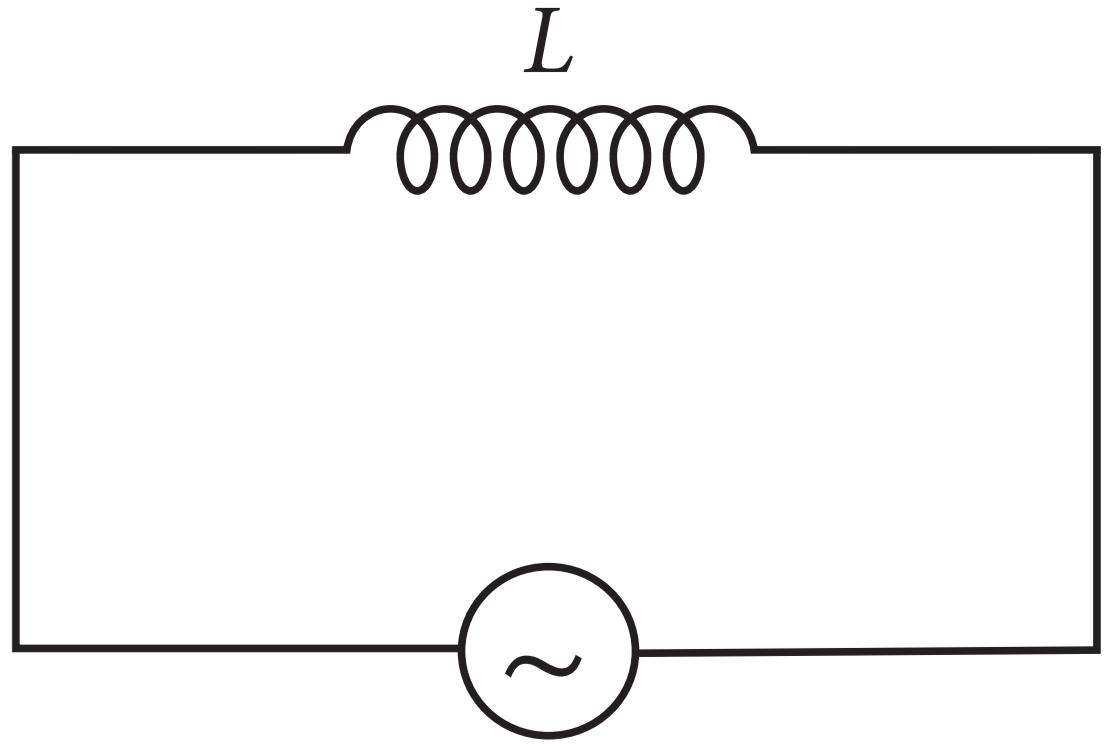
Let a source of alternating e.m.f. $\text{E} = \text{E}_\circ\sin\omega\text{t}$ be connected to a circuit containing a pure inductance L. If I is the value of instantaneous current in the circuit, then $\text{I}=\text{I}_\circ\sin\Big(\omega\text{t}-\frac{\pi}{2}\Big).$ The inductive reactance limits the current in a purely inductive circuit and is given by $\text{X}_\text{L}= \text{W}_\text{L}.$

  1. A 100 hertz a.c. is flowing in a 14mH coil. The reactance is:
  1. $15\Omega$
  2. $7.7\Omega$
  3. $8.8\Omega$
  4. $10\Omega$
  1. In a pure inductive circuit, resistance to the flow of current is offered by:
  1. Resistor
  2. Inductor
  3. Capacitor
  4. Resistor and inductor
  1. In a inductive circuit, by what value of phase angle does alternating current lags behind e.m.f.?
  1. 45º
  2. 90º
  3. 120º
  4. 75º
  1. How much inductance should be connected to 200V, 50Hz a.c. supply so that a maximum current of 0.9A flows through it?
  1. 5H
  2. 1H
  3. 10H
  4. 4.5H
  1. The maximum value of current when inductance of 2H is connected to 150V, 50Hz supply is:
  1. 0.337A
  2. 0.721A
  3. 1.521A
  4. 2.522A
A player hits a baseball at some angle. The ball goes high up in space. The player runs and catches the ball before it hits the ground. Which of the two (the player or the ball) has greater displacement?
Complete the following table:
Car Model
Driver X
Reaction time 0.20s
Driver Y
Reaction time 0.30s
A (deceleration on hard braking = 6.0m/s2)
Speed = 54km/h
Braking distance
a = ...
Total stopping distance
b = ...
Speed = 72km/h
Braking distance
c = ...
Total stopping distance
d = ...
B (deceleration on hard braking = 7.5m/s2)
Speed = 54km/h
Breaking distance
e = ...
Total stopping distance
f = ...
Speed 72km/h
Braking distance
g = ...
Total stopping distance
h = ...
At a prayer meeting, the disciples sing JAI-RAM JAI-RAM. The sound amplified by a loudspeaker comes back after reflection from a building at a distance of 80m from the meeting. What maximum time interval can be kept between one JAI-RAM and the next JAI-RAM so that the echo does not disturb a listener sitting in the meeting. Speed of sound in air is 320m/s.
The electric field intensity at a point at a distance of 20 cm from the centre of a sphere is 10 Volt/meter. Find the intensity of the electric field at a point located at a distance 8 cm from the centre of that circle. The radius of the sphere is 5 cm.
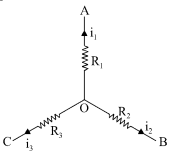
In the given figure, a part ABC of electric circuit is shown. The magnitudes of potentials at points $A, B$ and $C$ are and respectively, then find the value of potential at point $O$.
Image
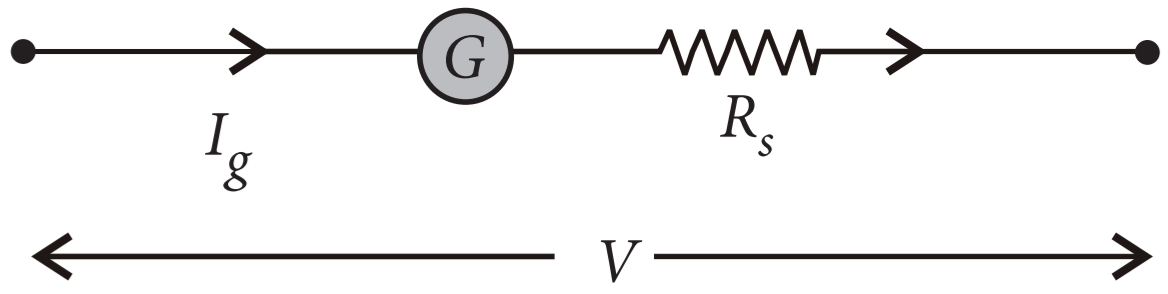
A galvanometer can be converted into voltmeter of given range by connecting a suitable resistance R, in series with the galvanometer, whose value is given by,
$\text{R}_\text{s}=\frac{\text{V}}{\text{I}_\text{g}}-\text{G}$
where Vis the voltage to be measured, lg is the current for full scale deflection of galvanometer and G is the resistance of galvanometer.

Series resistor(R,) increases range of voltmeter and the effective resistance of galvanometer. It also protects the galvanometer from damage due to large current. Voltmeter is a high resistance instrument and it is always connected in parallel with the circuit element across which potential difference is to be measured. An ideal voltmeter has infinite resistance. In order to increase the range of voltmeter n times the value of resistance to be connected in series with galvanometer is Rs = (n - 1)G.
  1. 10mA current can pass through a galvanometer of resistance $25\Omega$ What resistance in series should be connected through it, so that it is converted into a voltmeter of 100V?
  1. $0.975\Omega$
  2. $99.75\Omega$
  3. $975\Omega$
  4. $9975\Omega$
  1. There are 3 voltmeter A, B, C having the same range but their resistance are $15000\Omega,10000\Omega$, and $5000\Omega$ respectively. 'Tile best voltmeter amongst them is the one whose resistance is
  1. $5000\Omega$
  2. $10000\Omega$
  3. $15000\Omega$
  4. all are equally good.
  1. A milliammeter of range 0 to 25mA and resistance of $10\Omega$ is to be converted into a voltmeter with a range of 0 to 25V. 'Tile resistance that should be connected in series will be:
  1. $930\Omega$
  2. $960\Omega$
  3. $990\Omega$
  4. $1010\Omega$
  1. To convert a moving coil galvanometer (MCG) into a voltmeter:
  1. A high resistance R is connected in parallel with MCG.
  2. A low resistance R is connected in parallel with MCG.
  3. A low resistance R is connected in series with MCG.
  4. A high resistance R is connected in series with MCG.
  1. To increase the current sensitivity of a moving coil galvanometer, we should decrease:
  1. Zero.
  2. Low.
  3. High.
  4. Infinity.
On a winter day, the outside temperature is 0°C and relative humidity 40%. The air from outside comes into a room and is heated to 20°C. What is the relative humidity in the room? The saturation vapour pressure at 0°C is 4.6mm of mercury and at 20°C it is 18mm of mercury.