MCQ
In an elevator, a spring clock of time period $T_S$ (mass attached to a spring) and a pendulum clock of time period $T_P$ are kept. If the elevator accelerates upwards
  • A
    $T_S$ well as $T_P$ increases
  • B
    $T_S$ remain same, $T_P$ increases
  • $T_S$ remains same, $T_P$ decreases
  • D
    $T_S$ as well as $T_P$ decreases

Answer

Correct option: C.
$T_S$ remains same, $T_P$ decreases
c
$T_{s}=2 \pi \sqrt{\frac{m}{k}} T_{s}$ doesn't depend on $g .$

$T_{p}=2 \pi \sqrt{\frac{\ell}{g}} ; \quad T_{p} \propto g^{-1 / 2}$

$\therefore T_{p}$ decreases

Need a full question paper?

Generate a complete, print-ready paper with questions like this in minutes — across 16+ boards, with answer keys.

Start Generating Free

Similar questions

The resultant of $\vec{A} \times 0$ will be equal to
Moment of inertia of a dise of mass $M$ and radius ' $R$ ' about any of its diameter is $\frac{ MR ^2}{4}$. The moment of inertia of this disc about an axis normal to the disc and passing through a point on its edge will be, $\frac{ x }{2} MR ^2$. The value of $x$ is $..........$.
A soap film is formed on a circular frame. A loop of thread is lying on film. If the film inside the loop is broken, then tension in the thread will be : ($R =$ radius of loop, $T =$ surface tension of liquid)
In which of the following cases the centre of mass of a rod is certainly not at its centre?
A tuning fork of frequency 480Hz is used to vibrate a sonometer wire having natural frequency 410Hz. The wire will vibrate with a frequency.
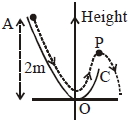
A particle $(\mathrm{m}=1\; \mathrm{kg})$ slides down a frictionless track $(AOC)$ starting from rest at a point $A$ (height $2\; \mathrm{m}$ ). After reaching $\mathrm{C}$, the particle continues to move freely in air as a projectile. When it reaching its highest point $P$ (height $1 \;\mathrm{m}$ ). the kinetic energy of the particle (in $\mathrm{J}$ ) is : (Figure drawn is schematic and not to scale; take $\left.g=10 \;\mathrm{ms}^{-2}\right)$
A balloon is rising with a constant acceleration of $2\ m/ s^2.$ At a certain instant when the balloon was moving with a velocity of $4\ m/ s,$ a stone was dropped from it in a region where $g = 10\ m/ s^2.$ The velocity and acceleration of stone as it comes out from the balloon are respectively $($in $m/ s$ and $m/ s^2)$
A car is moving on a circular level road of curvature $300\,metres.$ If the coefficient of friction is $0.3$ and acceleration due to gravity is $10\,m/s^2,$ the maximum speed the car can have is ........ $km/hr$ 
What is the ratio of densities of $2$ gases, $O_2\  \&\  N_2$, having partial pressures in the ratio $2:3\ ?$
The displacement of a particle in simple harmonic motion in one time period is: