MCQ
In an elevator moving vertically up with an acceleration 'g', the force exerted on the floor by a passenger of mass M is:
  • A
    Mg
  • B
    $\frac{1}{2}\text{Mg}$
  • C
    zero
  • D
    2Mg

Answer

  1. 2Mg

Explanation:

Force exerted by the passenger on floor

= R = M(g + a) = M(g + g) = 2Mg

Need a full question paper?

Generate a complete, print-ready paper with questions like this in minutes — across 16+ boards, with answer keys.

Start Generating Free

Similar questions

The displacement $(x)$ of a particle depends on time $t$ as $x=\alpha t^2-\beta t^3$. Choose the incorrect statements from the following.
Two pulses having equal and opposite displacements moving in opposite directions overlap at t =t1s. The resultant displacement of the wave at t = t1s is:
Water from a pipe is coming at a rate of $100\, litres$ per minute. If the radius of the pipe is $5\, cm$, the Reynolds number for the flow is of the order of : (density of water $= 1000\, kg/m^3$, coefficient of viscosity of water $= 1\, mPa\, s$)
A body is revolving with a uniform speed $v$ in a circle of radius $r$. The tangential acceleration is
Two satellites revolve around a planet in coplanar circular orbits in anticlockwise direction. Their period of revolutions are $1\, hour$ and $8\, hours$ respectively. The radius of the orbit of nearer satellite is $2 \times 10^{3}\, {km}$. The angular speed of the farther satellite as observed from the nearer satellite at the instant when both the satellites are closest is $\frac{\pi}{{x}}\, {rad} \,{h}^{-1}$ where ${x}$ is ..... .
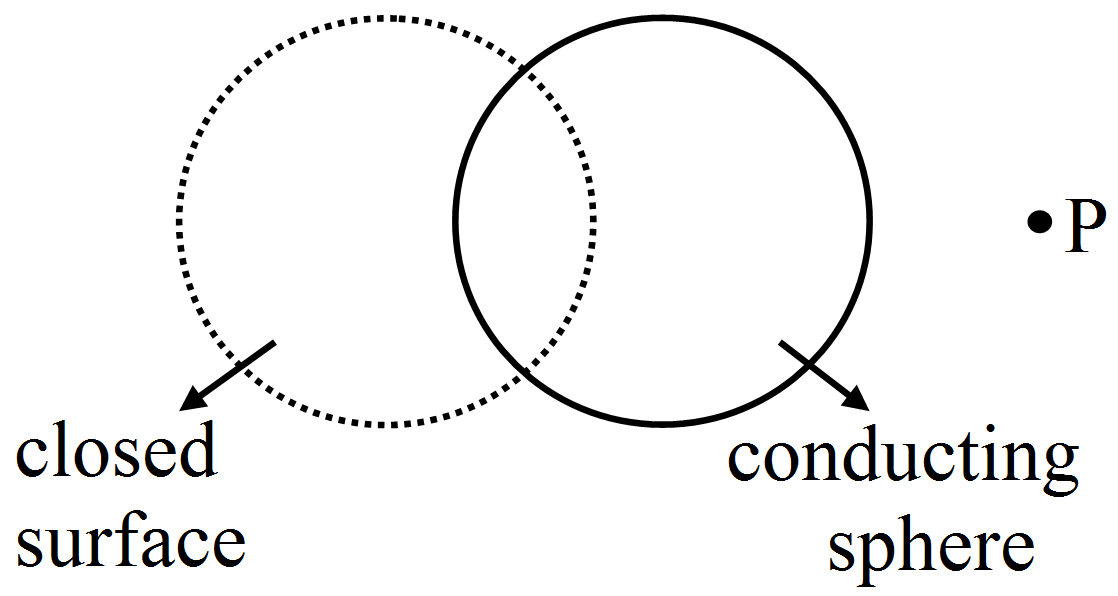
Figure shows a closed surface which intersects a conducting sphere. If a positive charged is placed at the point P, the flux of the electic field through the closed surface:

  1. Will remain zero.
  2. Will become positive.
  3. Will become neagative.
  4. Will become undefined.
A car is moving along a straight line, say $OP$ in given figure. It moves from $O$ to $P$ in $18\; s$ and returns from $P$ to $\mathrm{Q}$ in $6.0\; s$. What are the average velocity and average speed of the car in going from $O$ to $P$?
Assume that a tunnel is dug along a chord of the earth, at a perpendicular distance $( R / 2)$ from the earth's centre, where $'R'$ is the radius of the Earth. The wall of the tunnel is frictionless. If a particle is released in this tunnel, it will execute a simple harmonic motion with a time period
$Assertion :$ The Carnot cycle is useful in understanding the performance of heat engines.
$Reason :$ The Carnot cycle provides a way of determining the maximum possible efficiency achievable with reservoirs of given temperatures.
Consider the situation of the previous problem. Let the water push the left wall by a force F1 and the right wall by a force F2,
  1. F1 = F2
  2. F1 > F2
  3. F1 < F2
  4. The information is insufficient to know the relation between F1 and F2