MCQ
Two pulses having equal and opposite displacements moving in opposite directions overlap at t =t1s. The resultant displacement of the wave at t = t1s is:
  • A
    Twice the displacement of each pulse.
  • B
    Half the displacement of each pulse.
  • C
    Zero.
  • D
    Either (a) or (c).

Answer

  1. Zero.

Explanation:

The displacement due to two pulses will exactly cancel out each other. Thus, there will be no displacement throughout.

Need a full question paper?

Generate a complete, print-ready paper with questions like this in minutes — across 16+ boards, with answer keys.

Start Generating Free

Similar questions

A block of mass $1.9\, kg$ is at rest at the edge of a table, of height $1\, m$. A bullet of mass $0.1\, kg$ collides with the block and sticks to it. If the velocity of the bullet is $20\, m / s$ in the horizontal direction just before the collision then the kinetic energy just before the combined system strikes the floor, is $....J$

[Take $g =10\, m / s ^{2}$. Assume there is no rotational motion and loss of energy after the collision is negligable. $]$

The harmonics which are present in a pipe open at one end are
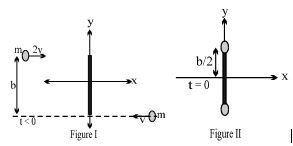
One ice skater of mass $m$ moves with speed $2v$ to the right, while another of the same mass $m$ moves with speed $v$ toward the left, as shown in figure $I$. Their paths are separated by $a$ distance $b$. At $t = 0$, when they are both at $x = 0$, they grasp a pole of length $b$ and negligible mass. For $t > 0$, consider the system as a rigid body of two masses $m$ separated by distance $b$, as shown in figure $II$. Which of the following is the correct formula for the motion after $t = 0$ of the skater initially at $y = b/2?$
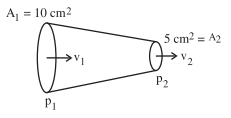
Glycerine of density $1.25 \times 10^3\,kg\,m ^{-3}$ is flowing through the conical section of pipe. The area of cross-section of the pipe at its ends is $10\,cm ^2$ and $5\,cm ^2$ and pressure drop across its length is $3\,Nm ^{-2}$. The rate of flow of glycerine through the pipe is $x \times 10^{-5} m ^3 s ^{-1}$. The value of $x$ is $..............$.
On the superposition of two harmonic oscillations represented by ${x_1} = a\,\sin \,\left( {\omega t + {\phi _1}} \right)$ and ${x_2} = a\,\sin \,\left( {\omega t + {\phi _2}} \right)$ a resulting oscillation with the same time period and amplitude is obtained. The value of ${\phi _1} - {\phi _2}$ is .... $^o$
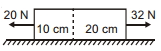
Figure shows a uniform rod of length $30 \,cm$ having a mass $3.0 \,kg$. The rod is pulled by constant forces of $20 \,N$ and $32 \,N$ as shown. Find the force exerted by $20 \,cm$ part of the rod on the $10 \,cm$ part (all surfaces are smooth) is ......... $N$
According to Kepler, planets move in
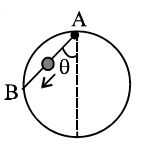
A bead is free to slide down a smooth wire tightly stretched between points $A$ and $B$ on a vertical circle. If the bead starts from rest at $A$, the highest point on the circle
The radius of gyration of body depends upon
A cube of mass $m$ slides down an inclined right-angle trough. If the coefficient of kinetic friction between the cube and the trough is $\mu _k$ , then the acceleration of the block is