In an engine the piston undergoes vertical simple harmonic motion with amplitude $7\, cm$ . A washer rests on top of the piston and moves with it. The motor speed is slowly increased. The frequency of the piston at which the washer no longer stays in contact with the piston, is close to ...... $Hz$
JEE MAIN 2016, Medium
Download our app for free and get started
Washer contact with piston $\Rightarrow \mathrm{N}=0$
Given Amplitude $\mathrm{A}=7 \mathrm{cm}=0.07 \mathrm{m}$
$a_{\max }=g=\omega^{2} A$
The frequency of piston
$\mathrm{f}=\frac{\omega}{2 \pi}=\sqrt{\frac{\mathrm{g}}{\mathrm{A}}} \frac{1}{2 \pi}=\sqrt{\frac{1000}{7}} \frac{1}{2 \pi}=1.9 \mathrm{Hz}$

Download our appand get started for free
Experience the future of education. Simply download our apps or reach out to us for more information. Let's shape the future of learning together!No signup needed.*
Similar Questions
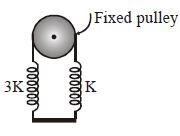
- 1A bar of mass $m$ is suspended horizontally on two vertical springs of spring constant $k$ and $3k$ . The bar bounces up and down while remaining horizontal. Find the time period of oscillation of the bar (Neglect mass of springs and friction everywhere).View Solution
- 2A pendulum has time period $T$ in air. When it is made to oscillate in water, it acquired a time period $T' = \sqrt 2 T$. The density of the pendulum bob is equal to (density of water $= 1$)View Solution
- 3View SolutionTwo mutually perpendicular simple harmonic vibrations have same amplitude, frequency and phase. When they superimpose, the resultant form of vibration will be
- 4A particle of mass $10\, gm$ is describing $S.H.M.$ along a straight line with period of $2\, sec$ and amplitude of $10, cm$. Its kinetic energy when it is at $5 \,cm$ from its equilibrium position isView Solution
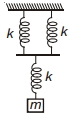
- 5A block of mass $m$ hangs from three springs having same spring constant $k$. If the mass is slightly displaced downwards, the time period of oscillation will beView Solution
- 6The time period of a second's pendulum is $2\, sec$. The spherical bob which is empty from inside has a mass of $50\, gm$. This is now replaced by another solid bob of same radius but having different mass of $ 100\, gm$. The new time period will be .... $\sec$View Solution
- 7A simple harmonic oscillator of angular frequency $2\,rad\,s^{-1}$ is acted upon by an external force $F = sin\,t\,N .$ If the oscillator is at rest in its equilibrium position at $t = 0,$ its position at later times is proportional toView Solution
- 8A simple pendulum with length $L$ and mass $m$ of the bob is vibrating with an amplitude $A$. The maximum tension in the string isView Solution
- 9A particle of unit mass is moving along the $x$-axis under the influence of a force and its total energy is conserved. Four possible forms of the potential energy of the particle are given in column $I$ (a and $U _0$ are constants). Match the potential energies in column $I$ to the corresponding statement$(s)$ in column $II.$View Solution
column $I$ column $II$ $(A)$ $U _1( x )=\frac{ U _0}{2}\left[1-\left(\frac{ x }{ a }\right)^2\right]^2$ $(P)$ The force acting on the particle is zero at $x = a$. $(B)$ $U _2( x )=\frac{ U _0}{2}\left(\frac{ x }{ a }\right)^2$ $(Q)$ The force acting on the particle is zero at $x=0$. $(C)$ $U _3( x )=\frac{ U _0}{2}\left(\frac{ x }{ a }\right)^2 \exp \left[-\left(\frac{ x }{ a }\right)^2\right]$ $(R)$ The force acting on the particle is zero at $x =- a$. $(D)$ $U _4( x )=\frac{ U _0}{2}\left[\frac{ x }{ a }-\frac{1}{3}\left(\frac{ x }{ a }\right)^3\right]$ $(S)$ The particle experiences an attractive force towards $x =0$ in the region $| x |< a$. $(T)$ The particle with total energy $\frac{ U _0}{4}$ can oscillate about the point $x=-a$. - 10The angular frequency of the damped oscillator is given by, $\omega = \sqrt {\left( {\frac{k}{m} - \frac{{{r^2}}}{{4{m^2}}}} \right)} $ where $k$ is the spring constant, $m$ is the mass of the oscillator and $r$ is the damping constant. If the ratio $\frac{{{r^2}}}{{mk}}$ is $8\%$, the change in time period compared to the undamped oscillator is approximately as followsView Solution