Question
In an inelastic collision,

Answer

In case of perfectly inelastic collision,

Final velocities of both the body is same

But, when the collision is not perfectly inelastic the velocities differ.

Thus, the final velocity of the bodies may or may not be same.

Also, there is a loss of kinetic energy during an inelastic collision.

thus, kinetic energy is not conserved and velocity of separation will be less than

velocity of approach.

A collision, let it be elastic or inelastic has always its momentum conserved and

is given by,

$m_1 u_1+m_2 u_2=m_1 v_1+m_2 v_2$

Thus, linear momentum of the system is conserved

Need a full question paper?

Generate a complete, print-ready paper with questions like this in minutes — across 16+ boards, with answer keys.
Start Generating Free

Similar questions

The half-life of a radioactive nucleus is $5$ years, The fraction of the original sample that would decay in $15$ years is
An observer starts moving with uniform acceleration $a$ toward a stationary sound source emitting a whistle of frequency $n.$ As the observer approaches source, the apparent frequency, heard by the observer varies with time as
A piece of fuse wire melts when a current of $15\, ampere$ flows through it. With this current, if it dissipates $22.5\, W$, the resistance of fuse wire will be .............. $\Omega$
A flat horizontal board moves up and down under $S.H.M.$ vertically with amplitude $A$. The shortest permissible time period of the vibration such that an object placed on the board may not lose contact with the board is ..........
The activity of a sample is $64 × 10^{-5}\, Ci.$ Its half-life is $3\, days$. The activity will become $5 × 10^{-6}\, Ci$ after .........$days$
Conside ranequi- convex lens of glass $\left( {\mu  = \frac{3}{2}} \right)$ If temperature of lens is increased by $40\, ^oC$ then its focal length remains same. The coefficient of linear expansion of glass is $2.5 \times 1 0^{-4} / \,^oC$ . Calculate change in refractive index of glass on increasing temperature by $40\,^o C$.
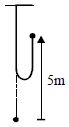
A block of mass $2\, kg$ is suspended $5\,m$ from a string, is released from a height of  $5\,m$ as shown in figure then what will be the impulse when string. Just becomes tight ............ $N-s$
The mass of a hydrogen molecule is $3.32 \times 10^{-27 } $ $kg$. If $10^{23}$ hydrogen molecules strike, per second, a fixed wall of area $2$ $cm^2$ at an angle of $45^o $ to the normal, and rebound elastically with a speed of $10^3\ m/s$, then the pressure on the wall is nearly:
A current $i$ $ampere$ flows along an infinitely long straight thin walled tube, then the magnetic induction at any point inside the tube is
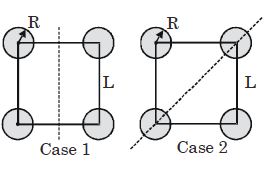
Four hollow spheres, each with a mass of $1\, kg$ and a radius $R = 10\,cm$, are connected with massless rods to form a square with side of length $L = 50\, cm$, In case $-1$, the masses rotate about an axis that bisects two sides of the square. In case $-2$, the masses rotate about an axis that passes through the diagonal of the square, as shown in the figure. Compute the ratio of the moments of inertia $I_1/I_2$, for the two cases