MCQ
In an interference experiment, the spacing between successive maxima or minima is

(Where the symbols have their usual meanings)

  • A
    $\frac{{\lambda d}}{D}$
  • $\frac{{\lambda D}}{d}$
  • C
    $\frac{{dD}}{\lambda }$
  • D
    $\frac{{\lambda d}}{{4D}}$


Answer

Correct option: B.
$\frac{{\lambda D}}{d}$
b
(b) In an interference experiment the spacing between successive maxima and minima is called the fringe width and is given by

$\beta=\frac{D \lambda}{d}$

Need a full question paper?

Generate a complete, print-ready paper with questions like this in minutes — across 16+ boards, with answer keys.
Start Generating Free

Similar questions

The maximum peak to peak voltage of an AM wire is 24 mV and the minimum peak to peak voltage is 8 mV. The modulation factor is
A galvanometer coil has a resistance $90\, \Omega$ and full scale deflection current $10\, mA$ . A $910\,\Omega$ resistance is connected in series with the galvanometer to make a voltmeter. If the least count of the voltmeter is $0.1\,V$, the number of divisions on its scale is
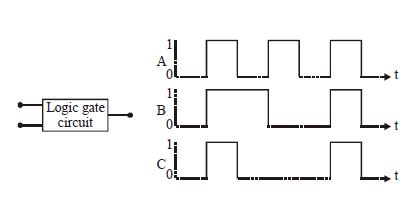
The following figure shows a logic gate circuit with two input $A$ and $B$ and output $C$.The voltage waveforms of $A, B$ and $C$ are asshown in second figure below. The logic gate is
 
When a distant object is viewed through an astronomical telescope, its image will be :
Find x in the following nuclear reaction. ${ }_{12} \mathrm{Mg}^{24}+{ }_2 \mathrm{He}^4 \rightarrow{ }_{14} \mathrm{Si}^x+{ }_0n^1$
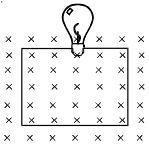
A square wire loop of $10.0\, cm$ side lies at right angles to a uniform magnetic field of $20\,T$. A $\,10\, V$ light bulb is in a series with the loop as shown in the fig. The magnetic field is decreasing steadily to zero over a time interval $\Delta t$. The bulb will shine with full brightness if $\Delta t$ is equal to.......$ms$
An electron has a mass of $9.1 \times {10^{ - 31}}kg$. It revolves round the nucleus in a circular orbit of radius $0.529 \times {10^{ - 10}}metre$ at a speed of $2.2 \times {10^6}m/s$. The magnitude of its linear momentum in this motion is
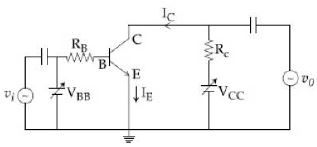
In the figure, given that $V_{BB}$ supply can vary from $0$ to $5.0 \,V,\,\,V_{CC} = 5\,V,$ $\beta _{dc} = 200,\,\,R_B = 100,\,k\Omega ,$ $R_C = 1\,k\Omega  $ an $V_{BE} = 1.0\,V,$ The minimum base current and the input voltage at which the transistor will go to saturation, will be respectively
$A$ bi-concave glass lens having refractive index $1.5$ has both surfaces of same radius of curvature $R$. On immersion in a medium of refractive index $1.75$, it will behave as a
Find the false statement.